Why Treating Spider Veins and Reticular Veins Matters in Chronic Venous Insufficiency | St. Louis Vein Specialist
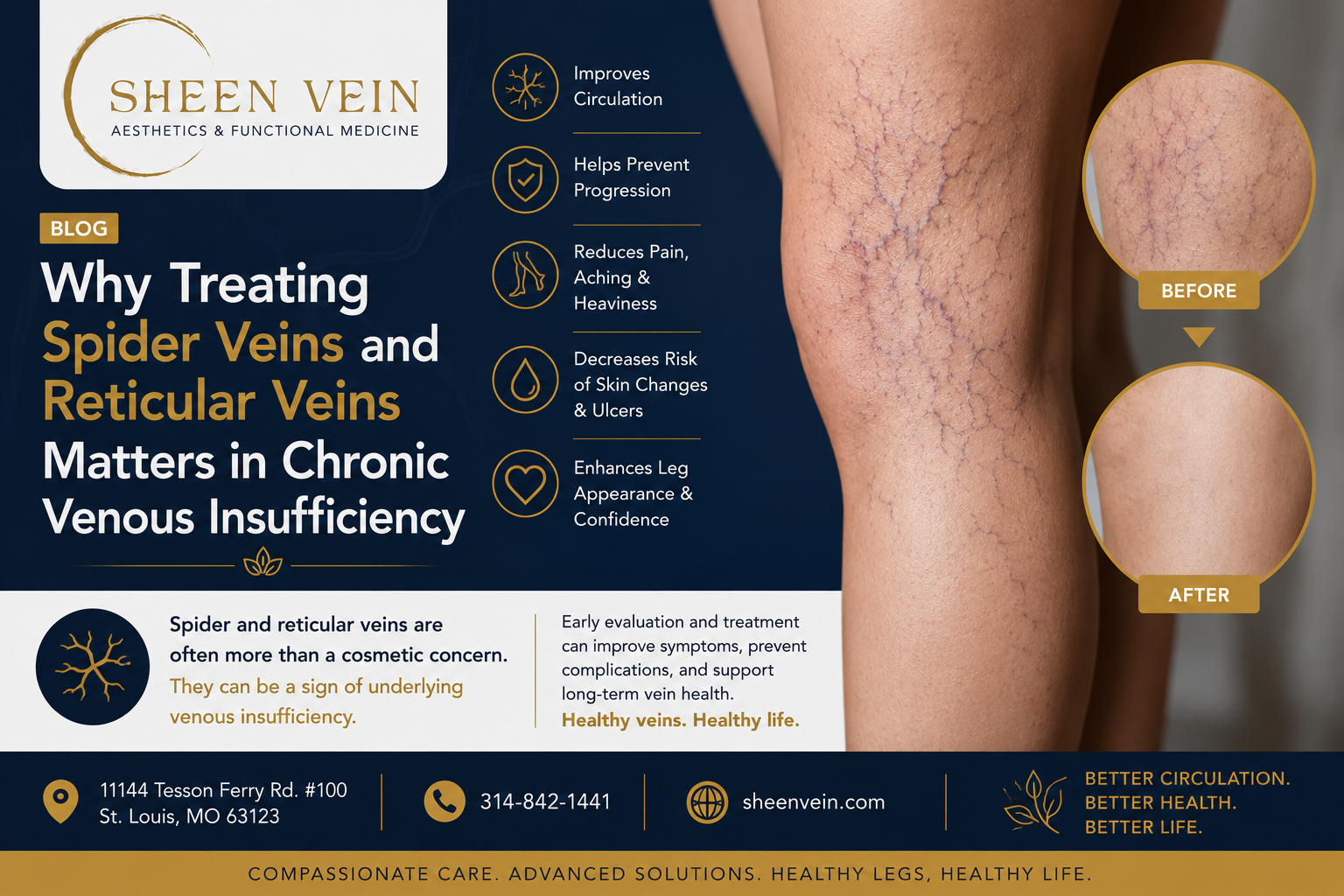
Spider Veins Are More Than a Cosmetic Concern
Many people assume spider veins and reticular veins are simply cosmetic issues. While these small visible veins can certainly affect appearance, they may also represent an important part of the overall venous circulation problem in patients with chronic venous insufficiency (CVI).
At Sheen Vein Aesthetics and Functional Medicine in St. Louis, Missouri, we frequently see patients who have undergone treatment for larger refluxing veins but continue to experience symptoms such as aching, heaviness, swelling, burning, itching, restless legs, and leg fatigue. In many cases, persistent spider veins and reticular veins continue to contribute to abnormal venous circulation and impaired microcirculation within the skin.
Understanding Spider Veins and Reticular Veins
Spider veins are small, visible red, blue, or purple blood vessels located within the skin. Reticular veins are slightly larger blue or green veins that often feed spider vein networks.
While they are smaller than varicose veins, these vessels are still part of the venous drainage system of the lower extremities.
Many patients are surprised to learn that these veins often remain connected to larger venous circulation pathways and may reflect underlying venous hypertension.
American Vein and Lymphatic Society:
https://www.myavls.org/patients/what-are-spider-veins.html
Chronic Venous Insufficiency and Venous Hypertension
Chronic venous insufficiency occurs when vein valves become damaged and allow blood to flow backward, a condition called venous reflux.
This creates elevated venous pressure throughout the leg.
As pressure increases, the effects are not limited to the larger veins. The abnormal pressure extends into smaller reticular veins, venules, and capillaries within the skin.
Society for Vascular Surgery:
https://vascular.org/patients-and-referring-physicians/conditions/chronic-venous-insufficiency
The Importance of Microcirculation
Microcirculation refers to the tiny blood vessels responsible for delivering oxygen and nutrients to tissues while removing waste products.
When venous hypertension develops, these small vessels become congested.
The result may include:
- Tissue inflammation
- Fluid leakage into surrounding tissues
- Swelling
- Skin irritation
- Itching
- Hyperpigmentation
- Venous eczema
- Delayed healing
Over time, microcirculatory dysfunction contributes to progressive skin damage and may eventually lead to venous stasis ulcers.
National Library of Medicine:
https://www.ncbi.nlm.nih.gov/books/NBK567802/
Why Leaving Spider Veins Untreated May Matter
Although treatment of large refluxing veins is often the first priority, addressing residual reticular and spider veins may also be important in certain patients.
From a circulation standpoint, these abnormal vessels can act as reservoirs where blood pools and venous pressure remains elevated.
By eliminating dysfunctional superficial veins, blood flow may be redirected into healthier venous pathways.
Potential benefits may include:
- Reduced venous congestion
- Improved microcirculation
- Less local inflammation
- Decreased leg heaviness
- Reduced aching and burning
- Improved skin appearance
- Enhanced overall treatment outcomes
Research has shown that abnormal superficial venous networks can contribute to chronic venous disease progression and symptoms.
European Society for Vascular Surgery Guidelines:
https://www.ejves.com/article/S1078-5884(22)00160-6/fulltext
A Comprehensive Vein Treatment Approach
Successful vein treatment is often about more than simply closing the largest refluxing vein.
A comprehensive treatment plan may include:
- Venous ultrasound evaluation
- Endovenous laser ablation (EVLT)
- Ultrasound-guided foam sclerotherapy
- Treatment of incompetent perforator veins
- Visual sclerotherapy for reticular veins
- Treatment of spider veins
- Compression therapy
Addressing both the major sources of reflux and the residual superficial venous networks may provide more complete symptom relief and improve long-term outcomes.
Spider Vein Treatment in St. Louis, Missouri
At Sheen Vein Aesthetics and Functional Medicine, we evaluate the entire venous circulation system rather than focusing solely on visible cosmetic concerns. Our goal is to identify sources of venous hypertension, improve circulation, and optimize the health of the skin and underlying tissues.
We proudly serve patients throughout St. Louis, Sunset Hills, Kirkwood, Fenton, Arnold, Chesterfield, Columbia, Illinois, and surrounding communities.
Learn more about our vein treatment services:
https://www.sheenveinandcosmetics.com/
Spider veins and reticular veins may be small, but their role in chronic venous insufficiency should not be underestimated. When viewed through the lens of venous circulation and microcirculation, treating these veins may be an important part of a comprehensive approach to improving leg health, reducing symptoms, and preserving skin integrity.