Venous Stasis Ulcers and Cutaneous Venous Circulation Defects: Understanding Chronic Leg Wounds in St. Louis
Why Some Leg Wounds Refuse to Heal
Venous stasis ulcers are among the most common chronic wounds affecting adults, particularly those with underlying vein disease. While many people view these wounds as a skin problem, the reality is that venous stasis ulcers are often the result of deeper circulation issues involving the veins responsible for draining blood from the legs.
At Sheen Vein Aesthetics and Functional Medicine in St. Louis, Missouri, we frequently evaluate patients with leg swelling, skin discoloration, varicose veins, and non-healing wounds. In many cases, these symptoms are linked to defects in the cutaneous venous circulation, the network of veins responsible for draining blood from the skin and superficial tissues of the lower extremities.
What Is a Venous Stasis Ulcer?
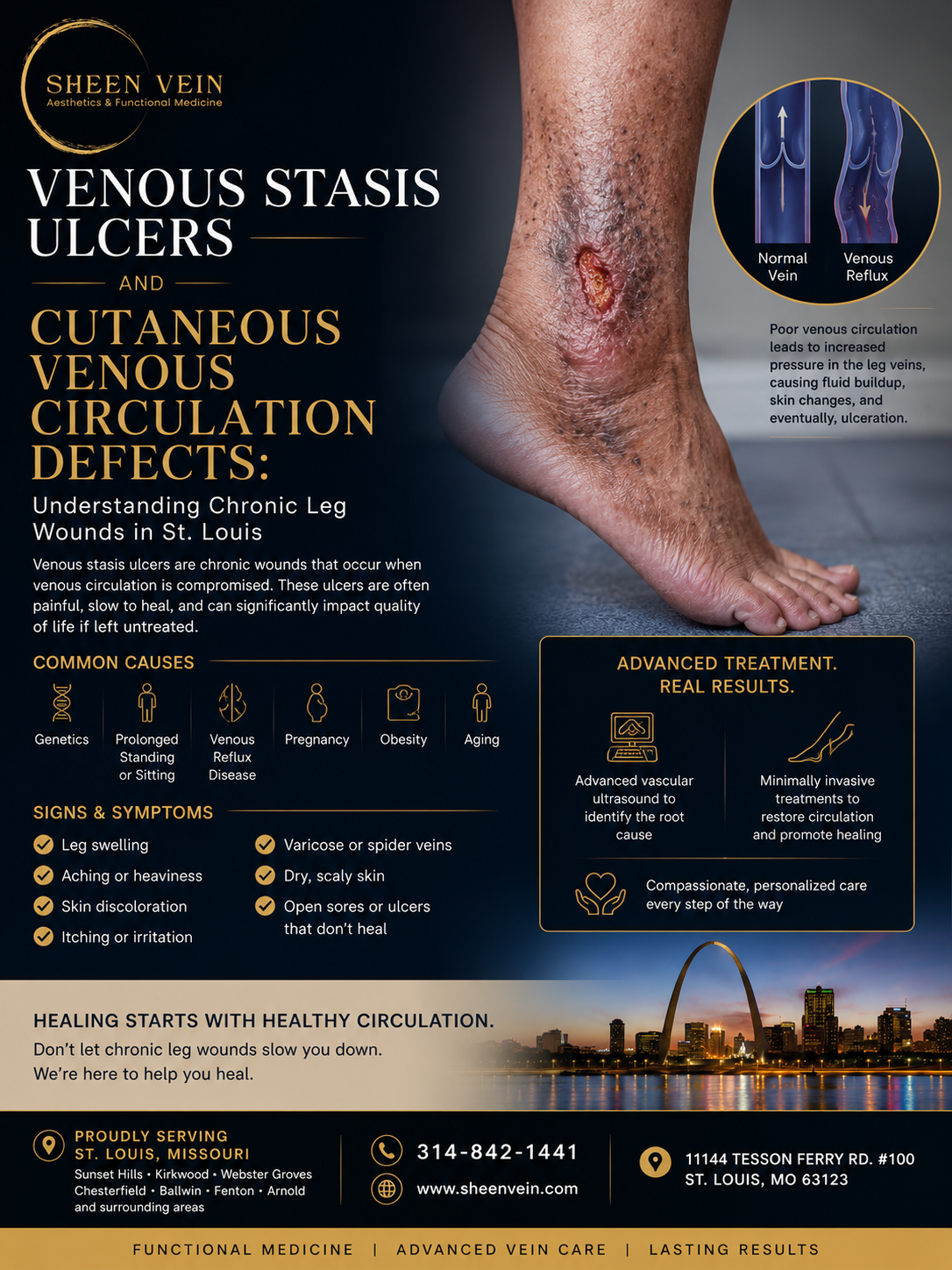
A venous stasis ulcer is an open wound that develops when chronic venous insufficiency (CVI) causes blood to pool in the legs. These ulcers most commonly occur near the inner ankle and lower leg and can persist for months or even years if the underlying venous disease is not addressed.
According to the Society for Vascular Surgery, venous ulcers account for the majority of lower extremity ulcers and are often associated with chronic venous hypertension.
Learn more:
https://vascular.org/patients-and-referring-physicians/conditions/venous-ulcers
Understanding Cutaneous Venous Circulation
The skin relies on a healthy network of superficial veins, perforator veins, and deep veins to maintain proper blood flow.
Normally, one-way valves inside the veins keep blood moving upward toward the heart. When these valves become damaged or incompetent, blood begins flowing backward, a condition known as venous reflux.
Over time, this creates increased pressure within the superficial veins and small vessels of the skin.
American Venous Forum:
https://www.veinforum.org/patients/vein-disease/
How Venous Reflux Damages the Skin
As venous pressure rises, the small blood vessels within the skin become overwhelmed.
This can lead to:
- Chronic leg swelling
- Skin inflammation
- Hyperpigmentation (brown discoloration)
- Venous eczema
- Lipodermatosclerosis
- Skin thickening
- Tissue damage
- Venous stasis ulcers
The skin essentially becomes trapped in an environment of chronic inflammation and impaired oxygen delivery.
Research published by the National Library of Medicine demonstrates that chronic venous hypertension contributes to microcirculatory dysfunction, inflammation, and tissue breakdown that ultimately lead to ulcer formation.
https://www.ncbi.nlm.nih.gov/books/NBK567802/
The Importance of Microcirculation
Many patients have visible varicose veins, but the damage extends beyond what can be seen on the surface.
Chronic venous insufficiency affects the microcirculation within the skin itself. Elevated venous pressure causes leakage of fluid, proteins, and inflammatory cells into surrounding tissues.
As a result:
- Oxygen delivery decreases
- Nutrient exchange becomes impaired
- Inflammation increases
- Healing capacity declines
This explains why even minor injuries may progress into chronic wounds when underlying venous disease is present.
Johns Hopkins Medicine:
https://www.hopkinsmedicine.org/health/conditions-and-diseases/chronic-venous-insufficiency
Signs You May Have Underlying Venous Disease
Many patients develop symptoms long before an ulcer forms.
Warning signs include:
- Leg heaviness
- Aching legs
- Swelling around the ankles
- Restless legs
- Night cramps
- Varicose veins
- Itching skin
- Brown discoloration near the ankles
- Hardened skin of the lower legs
Early treatment of venous insufficiency may help reduce the risk of progression to advanced skin damage and ulcer formation.
Modern Treatment Options
The good news is that today's vein treatments are significantly less invasive than traditional vein stripping procedures.
Treatment options may include:
- Endovenous laser ablation (EVLT)
- Ultrasound-guided foam sclerotherapy
- Varithena® treatment
- Compression therapy
- Wound care management
- Treatment of incompetent perforator veins
By correcting the underlying reflux, many patients experience improvement in swelling, skin health, and wound healing potential.
Venous Ulcer Treatment in St. Louis, Missouri
At Sheen Vein Aesthetics and Functional Medicine, we specialize in diagnosing and treating chronic venous insufficiency and venous ulcer disease throughout St. Louis, Sunset Hills, Fenton, Arnold, Kirkwood, Chesterfield, and surrounding Missouri and Illinois communities.
If you have a non-healing wound, chronic leg swelling, skin discoloration, or varicose veins, a comprehensive venous ultrasound evaluation may identify the underlying circulation problem.
Learn more about our vein treatment services:
https://www.sheenveinandcosmetics.com/
Venous stasis ulcers are not simply skin wounds. They are often the visible result of long-standing defects in cutaneous venous circulation. Identifying and treating the underlying venous disease is often the key to promoting healing and preventing recurrence.