Why Sheen Vein Aesthetics and Functional Medicine Is a Leading Clinic for Arthritic Knee Pain Treatment in St. Louis
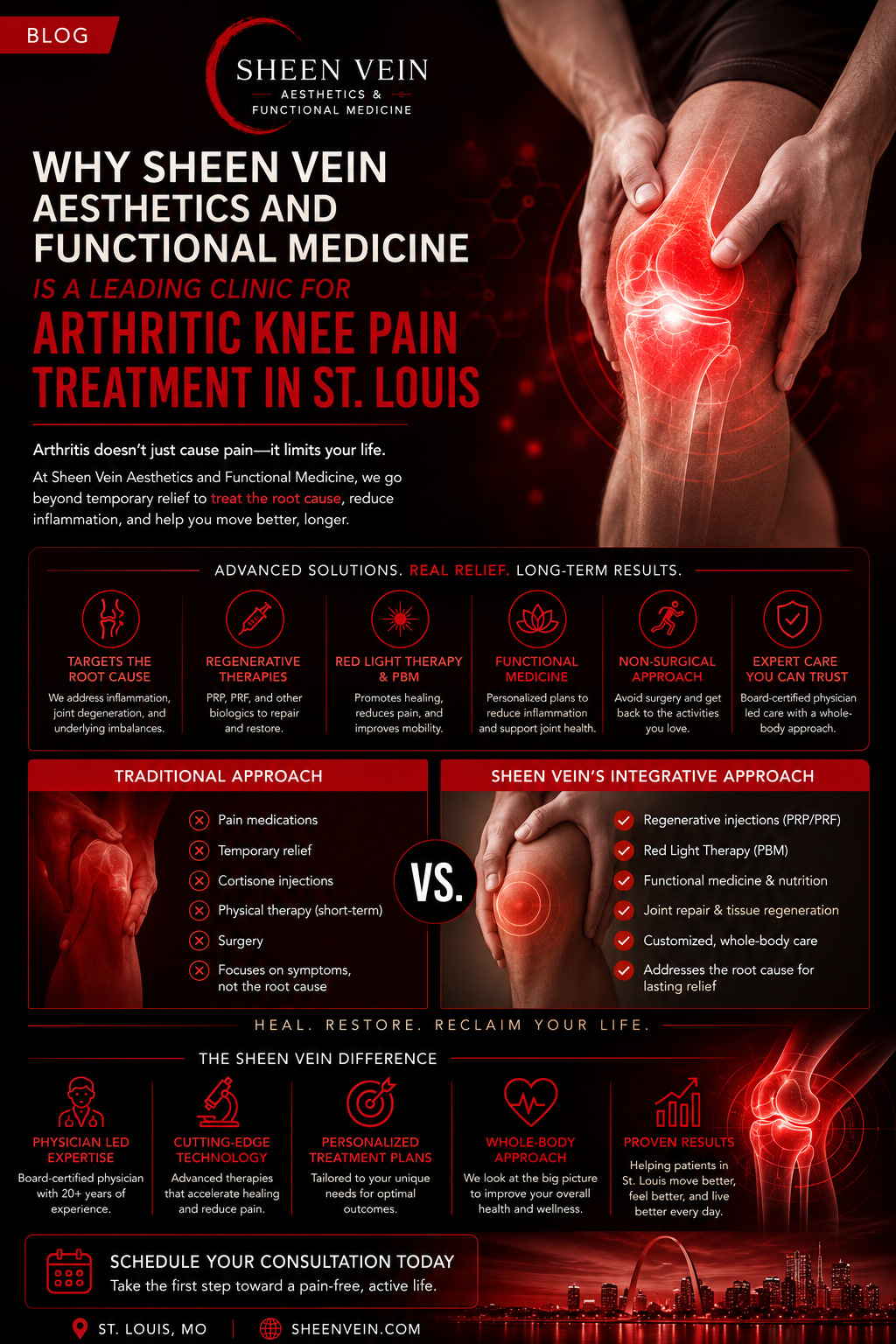
Knee Pain and Arthritis: Why Sheen Vein Aesthetics and Functional Medicine Offers a Different Approach in St. Louis
Knee pain can slowly change nearly every part of a person’s life. At first, it may be a mild ache after exercise or stiffness when getting out of a chair. Over time, climbing stairs, walking through a store, getting into a car, sleeping comfortably, or playing with grandchildren may become increasingly difficult.
Many patients are told that knee pain is simply part of getting older. Others are given anti-inflammatory medication, a steroid injection, or advice to wait until the arthritis becomes severe enough for knee replacement.
Although traditional treatments are appropriate and sometimes necessary, they are not the only options available.
At Sheen Vein Aesthetics and Functional Medicine, we approach arthritic knee pain as more than an isolated joint problem. We evaluate how inflammation, muscle strength, body composition, metabolism, circulation, sleep, nutrition, previous injury, and cellular recovery may be affecting the knee.
Depending on the diagnosis and the patient’s goals, our physician-led treatment plans may incorporate:
- Photobiomodulation
- Red and near-infrared light therapy
- Pulsed electromagnetic field therapy
- Platelet-rich plasma
- Platelet-rich fibrin
- Functional medicine
- Nutritional optimization
- Metabolic-health support
- Weight management
- Exercise and recovery guidance
We do not claim that every patient can avoid surgery or that regenerative treatments can rebuild an entirely destroyed joint. Instead, we focus on identifying appropriate candidates, setting realistic expectations, and using several complementary strategies to improve pain, mobility, and quality of life.
That comprehensive approach is why many patients consider Sheen Vein Aesthetics and Functional Medicine one of the leading choices for arthritic knee-pain treatment in St. Louis.
Understanding the Knee Joint
The knee is the largest joint in the human body and is essential for standing, walking, bending, climbing, balance, and many athletic movements. It connects the femur, or thigh bone, to the tibia, or shin bone, while the patella protects the front of the joint. Cartilage, menisci, ligaments, tendons, muscles, nerves, and joint fluid all work together to provide movement and stability.
Because the knee must support body weight while repeatedly bending and straightening, it is vulnerable to both injury and degeneration.
Pain may arise from:
- Articular cartilage
- Meniscus
- Ligaments
- Tendons
- Muscles
- Bursae
- Synovial lining
- Bone
- Nerves surrounding the joint
Not all knee pain is arthritis, which is why establishing the correct diagnosis is important before beginning treatment.
What Is Knee Osteoarthritis?
Knee osteoarthritis is a degenerative joint condition involving gradual changes in cartilage, bone, joint fluid, and the synovial lining.
It was once described simply as “wear and tear.” We now understand that osteoarthritis is more complex. Mechanical loading matters, but inflammation, metabolic dysfunction, previous injury, genetics, muscle weakness, aging, and body composition may all influence how quickly symptoms develop.
As cartilage becomes thinner and less effective at cushioning the joint, the knee may become painful, stiff, swollen, and less mobile.
Common symptoms include:
- Pain with walking
- Difficulty climbing stairs
- Morning stiffness
- Stiffness after sitting
- Swelling
- Grinding or crackling
- Reduced range of motion
- Pain when standing from a chair
- Pain after activity
- Weakness or instability
- Nighttime discomfort
Osteoarthritis cannot currently be completely cured, but its symptoms and functional impact can often be managed through a combination of lifestyle, rehabilitative, medical, regenerative, and surgical treatments.
Not Every Painful Knee Is “Bone-on-Bone”
Patients frequently use the phrase “bone-on-bone” after being told they have advanced arthritis.
However, pain severity does not always match the appearance of an X-ray.
Some people have substantial radiographic arthritis with relatively modest symptoms. Others experience significant pain despite less dramatic imaging changes.
Pain may also arise from:
- Meniscal damage
- Patellar tracking problems
- Tendinopathy
- Bursitis
- Ligament injury
- Referred pain from the hip or spine
- Inflammatory arthritis
- Gout
- Infection
- Nerve irritation
A treatment plan should be based on the entire clinical picture rather than one imaging phrase.
Why Knee Arthritis Hurts
Cartilage itself has limited pain sensation. Much of arthritis-related pain comes from surrounding structures.
These may include:
- Inflamed joint lining
- Bone beneath the cartilage
- Ligaments
- Tendons
- Muscles
- Joint capsule
- Fluid accumulation
- Irritated nerves
Pain may also become amplified when the nervous system remains exposed to chronic discomfort over time.
This is one reason that two patients with similar imaging findings may experience very different levels of pain.
Traditional Treatment Options for Knee Arthritis
Conventional medicine offers several useful treatment options.
The appropriate choice depends on the severity of the arthritis, the patient’s health, previous treatments, and functional goals.
Exercise and Physical Therapy
Exercise is one of the foundations of knee-arthritis treatment.
A physical-therapy program may focus on:
- Quadriceps strengthening
- Hamstring strength
- Hip stabilization
- Balance
- Flexibility
- Range of motion
- Gait retraining
- Activity modification
Stronger muscles help support the knee and reduce stress on painful joint structures.
Major osteoarthritis guidelines recommend exercise, self-management, and weight reduction when appropriate as foundational treatments for knee osteoarthritis.
However, some patients find exercise difficult because pain prevents them from participating consistently. In these situations, supportive therapies that reduce discomfort may help patients engage more effectively in strengthening and rehabilitation.
Anti-Inflammatory Medications
Common medications include:
- Ibuprofen
- Naproxen
- Prescription NSAIDs
- Topical diclofenac
- Acetaminophen
These medications may reduce pain and improve activity tolerance.
However, prolonged oral NSAID use may increase the risk of:
- Stomach irritation
- Ulcers
- Gastrointestinal bleeding
- Kidney problems
- Fluid retention
- Increased blood pressure
- Cardiovascular complications in susceptible patients
Medication may be appropriate, but it does not restore cartilage, improve muscle strength, or address the metabolic factors that may contribute to inflammation.
Corticosteroid Injections
Cortisone injections can provide temporary relief by reducing inflammation within the joint.
They may be helpful when:
- Pain is severe
- Swelling is present
- The patient needs short-term symptom control
- Pain is preventing rehabilitation
However, relief may be temporary, and repeated steroid exposure may affect blood sugar and tissue health.
Steroid injections can be valuable tools, but they are usually not a complete long-term strategy.
Hyaluronic Acid Injections
Hyaluronic acid injections are intended to improve lubrication within the joint.
Some patients report meaningful relief, while others notice little improvement.
Recommendations vary because clinical results are inconsistent. Whether hyaluronic acid is appropriate depends on the patient, arthritis severity, insurance coverage, and previous treatment response.
Braces, Canes, and Shoe Inserts
Mechanical support can sometimes reduce stress on painful portions of the knee.
Options may include:
- Unloading braces
- Patellar braces
- Canes
- Shoe inserts
- Supportive footwear
These devices do not reverse arthritis, but they may improve comfort, balance, and walking ability.
Nerve Ablation
Genicular nerve ablation uses controlled energy to interrupt selected pain signals from nerves around the knee.
It may help certain patients who are not ready for surgery or cannot undergo knee replacement.
However, nerve ablation reduces the transmission of pain rather than improving cartilage quality or addressing the biological environment of the joint.
Knee Replacement
Total or partial knee replacement may be appropriate for advanced arthritis that causes severe pain and disability despite appropriate conservative treatment.
Surgery can be life-changing for correctly selected patients.
It should be considered when:
- Pain is severe and persistent
- Walking is significantly limited
- Sleep is regularly disrupted
- Conservative treatments have failed
- Joint damage is advanced
- The patient is medically able to undergo surgery
Our approach is not intended to delay necessary surgery indefinitely. When the joint is severely damaged and function is significantly impaired, orthopedic evaluation may be the most appropriate next step.
How Our Approach Is Different
At Sheen Vein Aesthetics and Functional Medicine, we look beyond temporary pain suppression.
We consider the knee itself, but we also ask:
- Is chronic inflammation contributing?
- Is excess body fat increasing joint stress?
- Is insulin resistance affecting tissue recovery?
- Is muscle weakness reducing joint stability?
- Is poor sleep amplifying pain?
- Are nutritional deficiencies limiting healing?
- Is the patient receiving enough protein?
- Is the patient active enough to maintain strength?
- Would regenerative treatment be appropriate?
- Could PBM help the patient tolerate rehabilitation?
This whole-person approach does not replace conventional orthopedic care. It expands the treatment conversation.
Photobiomodulation for Arthritic Knee Pain
Photobiomodulation, commonly called PBM or red light therapy, uses selected wavelengths of red and near-infrared light to influence cellular activity.
PBM is different from a surgical laser. It does not cut, burn, or remove tissue.
Light energy interacts with cellular structures, including mitochondria, which help produce ATP—the energy cells use to function and repair themselves.
Depending on the treatment parameters, PBM may support:
- Cellular-energy production
- Local circulation
- Inflammatory regulation
- Muscle recovery
- Tissue repair
- Pain reduction
- Joint function
A 2024 systematic review and meta-analysis reported that photobiomodulation reduced pain and improved disability in patients with knee osteoarthritis, although researchers noted that additional work is needed to refine dosing and treatment parameters.
A broader 2025 umbrella review also found support for PBM in osteoarthritis-related disability while emphasizing that the overall evidence across conditions varies in certainty and that treatment protocols need greater standardization.
This is why PBM should be administered thoughtfully rather than treated as a generic wellness light.
How Red Light Therapy May Help the Arthritic Knee
Supporting Mitochondrial Function
The cells surrounding an arthritic joint require energy to maintain tissue and respond to stress.
PBM may support mitochondrial activity, potentially increasing the energy available for cellular processes.
Modulating Inflammation
Inflammation is part of arthritis pain.
PBM may help regulate inflammatory signaling without relying solely on medication.
Supporting Circulation
Healthy microcirculation helps deliver oxygen and nutrients to muscles and soft tissues surrounding the knee.
Improved circulation may support recovery and exercise tolerance.
Reducing Muscle Soreness
Weakness and compensation often cause the muscles around an arthritic knee to become sore and fatigued.
PBM may help support muscle recovery, allowing patients to participate more comfortably in strengthening.
Full-Body Red Light Therapy With PEMF
At Sheen Vein Aesthetics and Functional Medicine, patients may receive treatment in a full-body red light therapy bed that combines broad red and near-infrared light exposure with pulsed electromagnetic field support.
This may be beneficial when knee pain occurs alongside:
- Hip discomfort
- Low back pain
- Generalized arthritis
- Chronic inflammation
- Muscle soreness
- Reduced recovery
- Fatigue
Rather than treating the knee as though it exists in isolation, whole-body therapy may support multiple tissues and broader wellness goals.
Pulsed Electromagnetic Field Therapy
Pulsed electromagnetic field therapy, commonly called PEMF, uses low-frequency electromagnetic fields to influence cellular and tissue activity.
Depending on the patient and protocol, PEMF may be used to support:
- Circulation
- Muscle relaxation
- Recovery
- Bone and tissue health
- Pain management
At our practice, PEMF may be paired with photobiomodulation as part of a non-invasive knee-pain program.
Neither PBM nor PEMF can restore a severely destroyed joint to normal. Their role is to support pain management, recovery, activity, and quality of life in appropriately selected patients.
Platelet-Rich Plasma for Knee Osteoarthritis
Platelet-rich plasma, commonly called PRP, is prepared from the patient’s own blood.
A blood sample is collected and processed to concentrate platelets within a smaller volume of plasma. The resulting product is then injected into the knee.
Platelets contain signaling proteins involved in tissue repair and inflammatory regulation.
PRP is not a stem-cell treatment, and it should not be promoted as a guaranteed method of regrowing cartilage.
Its intended goals may include:
- Reducing pain
- Improving joint function
- Modulating inflammation
- Supporting the joint environment
- Delaying more invasive treatment in selected patients
The American Academy of Orthopaedic Surgeons states that PRP may reduce pain and improve function in patients with symptomatic knee osteoarthritis, although the recommendation is limited because preparation methods and study protocols vary.
More recent systematic reviews have reported meaningful improvements in pain and function for some patients, particularly those with mild to moderate knee osteoarthritis. However, results remain influenced by arthritis severity, platelet dose, preparation technique, and treatment protocol.
Why PRP Quality and Patient Selection Matter
Not every PRP preparation is identical.
Differences may include:
- Platelet concentration
- Total platelet dose
- Red-blood-cell contamination
- White-blood-cell content
- Centrifugation technique
- Injection volume
- Number of treatments
- Post-treatment rehabilitation
Research continues to examine which preparation is ideal for different patients.
This is why we view PRP as a medical procedure rather than a commodity.
Before recommending PRP, we consider:
- Arthritis severity
- Symptoms
- Previous treatments
- Patient age
- General health
- Medication use
- Platelet-related issues
- Infection risk
- Rehabilitation plan
- Patient expectations
Patients with mild to moderate arthritis may respond differently than those with severe joint collapse or major deformity.
Platelet-Rich Fibrin
Platelet-rich fibrin, or PRF, is also prepared from the patient’s blood.
PRF contains platelets within a fibrin matrix that may provide gradual release of regenerative signaling molecules.
Depending on the clinical situation, PRF may be considered as part of a regenerative-treatment strategy.
However, research on PRF for knee arthritis is less mature than the evidence supporting PRP. We present it as an evolving option rather than making exaggerated promises.
The decision between PRP, PRF, another injection, or no injection should be individualized.
Combining PRP With PBM
One of the unique advantages of our practice is the ability to combine regenerative injections with non-invasive recovery support.
For selected patients, a plan may incorporate:
- PRP or PRF
- PBM
- Red and near-infrared light therapy
- PEMF
- Strengthening
- Activity modification
- Nutritional optimization
- Weight management
The goal is to support both the joint and the biological environment in which healing occurs.
PRP provides concentrated platelet signaling at the treatment site, while PBM may support cellular-energy production, circulation, and recovery.
This combined approach is not appropriate for everyone, but it may offer a more comprehensive plan than an isolated injection.
Metabolic Health and Knee Arthritis
Arthritic knee pain is influenced by more than the force of body weight.
Insulin resistance, visceral fat, and poor metabolic health can increase systemic inflammatory signaling.
Fat tissue is biologically active. It produces substances that may influence:
- Inflammation
- Pain sensitivity
- Cartilage metabolism
- Muscle health
- Tissue recovery
This may help explain why obesity is associated with osteoarthritis even in joints that do not bear body weight.
At Sheen Vein Aesthetics and Functional Medicine, we may evaluate:
- Blood-sugar regulation
- Insulin resistance
- Body composition
- Dietary patterns
- Muscle mass
- Sleep quality
- Cardiovascular risk
- Weight-management goals
Improving metabolic health will not instantly restore lost cartilage, but it may reduce inflammatory burden and improve the patient’s ability to move, exercise, and recover.
Weight Management Without Shame
Patients with knee pain are often told to “just lose weight.”
That advice can feel dismissive, especially when pain itself makes exercise difficult.
We approach weight management compassionately.
Weight is influenced by:
- Insulin resistance
- Hormones
- Sleep
- Stress
- Medications
- Genetics
- Muscle mass
- Appetite signaling
- Menopause
- Activity limitations
When appropriate, reducing excess body weight can decrease mechanical stress across the knee. Even modest weight loss may improve symptoms and function.
Our goal is not to blame patients. It is to identify realistic strategies that support the knee and overall health.
Muscle Is Medicine for the Knee
Strong muscles act as shock absorbers and stabilizers.
The quadriceps, hamstrings, gluteal muscles, calves, and hip stabilizers all influence knee mechanics.
Loss of muscle may increase:
- Joint loading
- Instability
- Fall risk
- Fatigue
- Pain during activity
Resistance training is therefore one of the most important long-term treatments for knee arthritis.
PBM, regenerative therapy, or injections should not replace strengthening. Their value may be greatest when they help the patient participate more effectively in exercise and rehabilitation.
Nutrition and Joint Health
No single food can cure arthritis.
However, long-term dietary patterns affect body composition, blood sugar, inflammation, and nutrient status.
A knee-supportive eating pattern generally emphasizes:
- Adequate protein
- Vegetables
- Fruit
- Healthy fats
- Fiber
- Fish
- Nuts
- Seeds
- Minimally processed foods
Reducing excessive added sugar and ultra-processed foods may help improve metabolic health.
Nutrients that may be relevant to muscle and tissue function include:
- Vitamin D
- Magnesium
- Vitamin C
- Zinc
- Omega-3 fatty acids
- Protein
Supplementation should be individualized. More is not always better, and unnecessary supplements can interact with medications or cause side effects.
Sleep and Knee Pain
Poor sleep increases pain sensitivity.
Patients who sleep poorly may experience:
- Greater morning stiffness
- More intense pain
- Increased fatigue
- Reduced motivation to exercise
- Slower recovery
- Greater inflammatory signaling
Knee pain can also disturb sleep, creating a cycle in which pain worsens sleep and poor sleep worsens pain.
We consider sleep an important part of the treatment plan rather than an unrelated concern.
Who May Benefit From Our Knee-Pain Program?
An evaluation may be appropriate for patients with:
- Mild to moderate knee osteoarthritis
- Chronic aching or stiffness
- Pain with stairs
- Pain when standing from a chair
- Difficulty walking
- Swelling after activity
- Poor response to medication alone
- A desire to delay more invasive treatment
- Difficulty participating in physical therapy
- Interest in PBM, PRP, or PRF
- Metabolic or inflammatory contributors
- Reduced recovery after exercise
Treatment recommendations depend on diagnosis, severity, health history, and goals.
Who May Need Orthopedic or Urgent Evaluation?
Our treatments are not substitutes for appropriate orthopedic care.
Seek prompt evaluation for:
- Severe trauma
- Inability to bear weight
- Major swelling after injury
- A locked knee
- Significant instability
- Fever with a red, swollen joint
- Suspected infection
- Sudden calf swelling
- Progressive weakness
- Severe joint deformity
Advanced arthritis with major functional limitation may require joint-replacement evaluation.
Good medical care includes recognizing when regenerative or wellness treatments are unlikely to be sufficient.
Frequently Asked Questions
Can red light therapy cure knee arthritis?
No. Red light therapy cannot completely reverse advanced osteoarthritis. PBM may help reduce pain, improve function, and support cellular recovery as part of a broader treatment plan.
Does PBM regrow cartilage?
Current evidence does not prove that standard PBM treatment reliably regrows substantial human knee cartilage. Its better-supported role is helping manage pain, function, inflammation, and recovery.
Is PRP better than cortisone?
The treatments have different goals. Cortisone often provides faster short-term anti-inflammatory relief. PRP aims to influence the biological environment of the joint and may provide longer-lasting improvement for some patients. Results vary.
Can PRP prevent knee replacement?
PRP may help selected patients reduce pain and delay more invasive treatment, but it cannot guarantee that knee replacement will never be needed.
How many PBM sessions will I need?
The number depends on symptom severity, chronicity, treatment response, and whether PBM is combined with other therapies. Chronic arthritis usually requires a series rather than one treatment.
How many PRP injections are needed?
Protocols vary. Some patients receive one injection, while others may be treated as part of a series. The plan should be individualized.
Is PRP covered by insurance?
Many insurance plans still consider PRP investigational or self-pay. Coverage varies, and benefits should be verified before treatment.
Can I exercise with knee arthritis?
Yes. Appropriate exercise is strongly recommended for most patients with knee osteoarthritis. Low-impact aerobic activity and strengthening are commonly used, but the program should be adjusted to the patient’s condition.
Is knee replacement always the final answer?
No. Many patients manage knee arthritis for years without surgery. However, replacement may become the most appropriate treatment when arthritis is advanced and pain or disability remains severe despite appropriate care.
Why Choose Sheen Vein Aesthetics and Functional Medicine for Arthritic Knee Pain in St. Louis?
Patients choose our practice because we offer more than a medication, one injection, or a generic treatment package.
Our physician-led approach may include:
- Comprehensive medical evaluation
- Photobiomodulation
- Red and near-infrared light therapy
- Full-body red light treatment
- PEMF
- PRP
- PRF
- Functional medicine
- Metabolic-health evaluation
- Weight-management support
- Nutritional optimization
- Exercise and recovery guidance
- Honest referral when orthopedic care is needed
We do not believe a clinic becomes the best simply by saying it is the best.
A leading knee-pain clinic earns trust by listening carefully, establishing the correct diagnosis, selecting patients appropriately, explaining limitations honestly, and building a treatment plan around the individual.
At Sheen Vein Aesthetics and Functional Medicine, our goal is not merely to numb the knee temporarily.
Our goal is to help patients move more comfortably, become stronger, improve their overall health, and return to the activities that matter to them.
Schedule an Arthritic Knee-Pain Consultation in St. Louis
If knee arthritis is making it difficult to walk, exercise, climb stairs, sleep, or enjoy everyday life, you deserve to understand all of your treatment options.
At Sheen Vein Aesthetics and Functional Medicine, we offer personalized knee-pain evaluations that consider both the painful joint and the broader factors influencing inflammation, recovery, mobility, and overall health.
Depending on your condition, your plan may include:
- Photobiomodulation
- Red light therapy
- PEMF
- PRP
- PRF
- Functional medicine
- Metabolic optimization
- Weight-management support
- Nutrition and exercise guidance
These treatments may be used alongside physical therapy, medication, orthopedic care, or other appropriate conventional treatments.
Contact Sheen Vein Aesthetics and Functional Medicine to schedule a knee-pain consultation and learn why patients throughout St. Louis choose our physician-led practice for comprehensive, non-surgical arthritic knee-pain care.