Why Sheen Vein Aesthetics and Functional Medicine Is a Leading Choice for Laser Skin Resurfacing in St. Louis
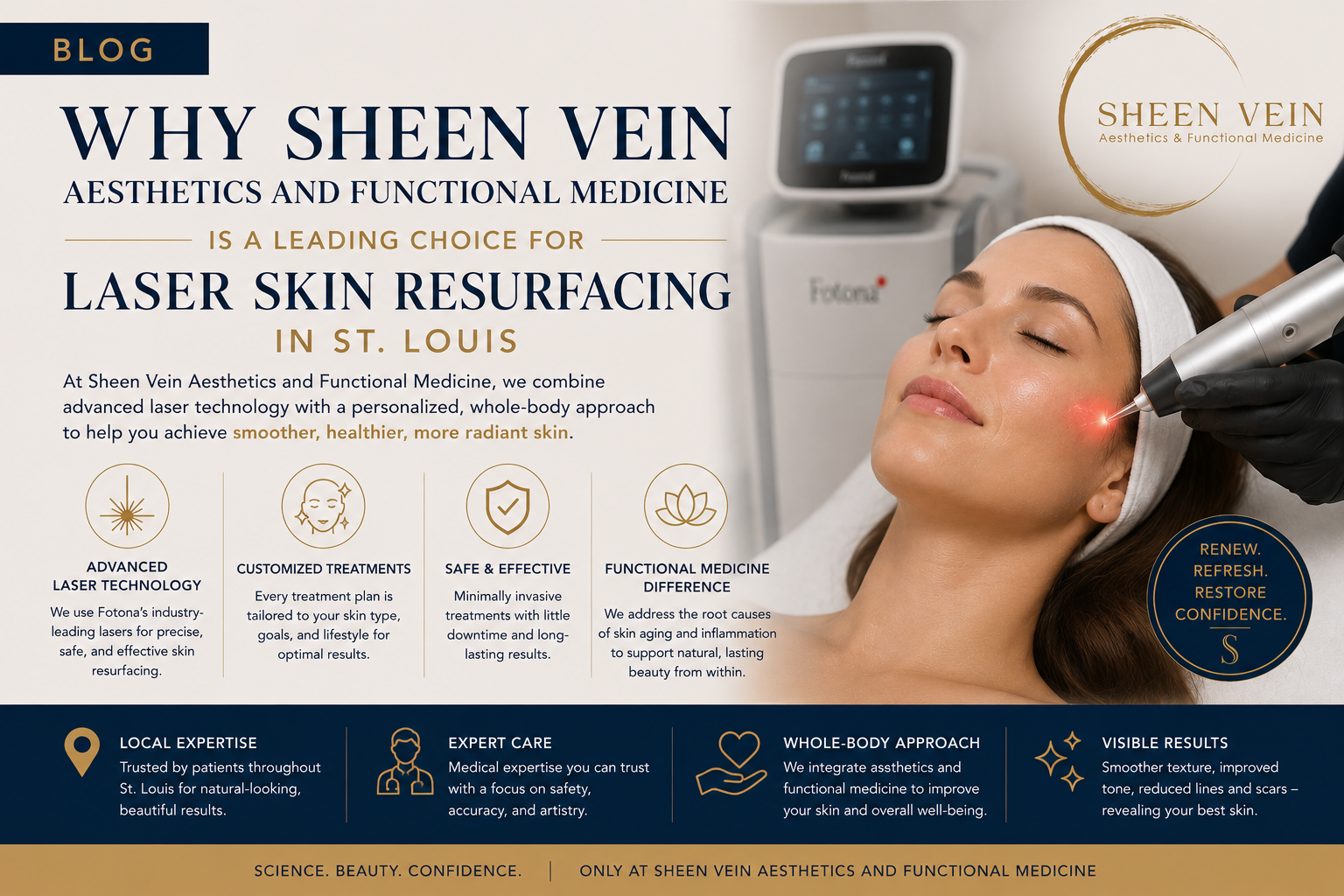
Laser Skin Resurfacing in St. Louis: Why Sheen Vein Aesthetics and Functional Medicine Offers a Different Level of Care
Skin changes gradually over time.
Years of sun exposure, repeated facial movement, hormonal changes, acne, environmental stress, smoking, inflammation, and the natural loss of collagen can all affect the way the skin looks and feels. Fine lines become more noticeable. Pores may appear larger. Skin texture may become rougher or less even. Brown spots, acne scars, and areas of discoloration may become harder to conceal.
Many patients begin with skincare products, chemical peels, facials, or at-home devices. These options may improve hydration and surface appearance, but they often cannot reach the deeper layers involved in collagen loss, scarring, and more advanced texture changes.
This is where laser skin resurfacing can make a meaningful difference.
Laser resurfacing uses carefully controlled laser energy to remove damaged surface tissue, stimulate collagen remodeling, improve texture, and encourage the development of healthier-looking skin. Depending on the technology and treatment depth, it may be used to address fine lines, wrinkles, acne scars, surgical scars, sun damage, enlarged pores, rough texture, and uneven pigmentation.
At Sheen Vein Aesthetics and Functional Medicine, we believe excellent laser resurfacing requires more than owning a laser.
Successful treatment depends on:
- Accurate skin evaluation
- Correct patient selection
- Knowledge of laser physics
- Understanding of skin type
- Careful treatment depth
- Appropriate energy settings
- Realistic expectations
- Thoughtful aftercare
- A long-term skin-health plan
Our physician-led practice combines advanced Fotona laser technology, personalized treatment planning, regenerative options, functional medicine, and a natural-looking aesthetic philosophy.
That comprehensive approach is why many patients consider Sheen Vein Aesthetics and Functional Medicine one of the leading choices for laser skin resurfacing in St. Louis.
What Is Laser Skin Resurfacing?
Laser skin resurfacing is a treatment that uses concentrated light energy to create controlled changes within the skin.
Depending on the laser and treatment settings, this energy may:
- Remove damaged outer skin cells
- Create microscopic treatment zones
- Heat deeper collagen
- Stimulate new collagen production
- Improve the organization of existing collagen
- Encourage smoother skin texture
- Reduce the appearance of scars and wrinkles
Laser resurfacing is not one single procedure.
Treatment intensity can range from gentle superficial polishing with limited downtime to deeper ablative resurfacing requiring a more significant healing period.
The best treatment is not necessarily the most aggressive one. It is the treatment that matches the patient’s skin, goals, medical history, and tolerance for recovery.
Why Collagen Matters
Collagen provides strength, structure, and support to the skin.
As we age, collagen production gradually declines. Existing collagen also becomes more fragmented and less organized.
This contributes to:
- Fine lines
- Wrinkles
- Skin laxity
- Enlarged pores
- Uneven texture
- Crepey skin
- Reduced elasticity
Laser resurfacing creates a controlled wound-healing response that encourages the body to produce and reorganize collagen.
The improvement is not always immediate.
Surface changes may become visible first, while deeper collagen remodeling can continue for weeks or months after treatment.
Ablative vs. Non-Ablative Laser Treatment
One of the most important distinctions in laser medicine is the difference between ablative and non-ablative treatment.
Ablative Laser Resurfacing
Ablative lasers remove part of the skin surface.
Depending on the treatment depth, they may provide more dramatic improvement in:
- Deep wrinkles
- Significant sun damage
- Acne scars
- Rough texture
- Advanced skin aging
Because the skin surface is intentionally disrupted, recovery may involve:
- Redness
- Swelling
- Peeling
- Crusting
- Oozing
- Temporary sensitivity
- Strict aftercare
The deeper the resurfacing, the greater the potential improvement—but also the longer the recovery and the greater the risk.
Non-Ablative Laser Treatment
Non-ablative treatments heat tissue beneath the skin surface while leaving most of the epidermis intact.
These treatments may improve:
- Mild skin laxity
- Fine lines
- Early texture changes
- Mild acne scarring
- Overall skin quality
Downtime is generally lower, but multiple sessions may be needed.
Fractional Resurfacing
Fractional lasers treat only a portion of the skin during each pass.
Instead of removing the entire surface, they create microscopic columns of treatment surrounded by untreated skin.
This allows the skin to heal more quickly while still stimulating remodeling.
Fractional treatment may be ablative or non-ablative depending on the device and settings.
Why Fotona Technology Is Different
At Sheen Vein Aesthetics and Functional Medicine, we use advanced Fotona laser technology.
Fotona systems use complementary wavelengths that can target different tissue depths and treatment goals.
This allows us to customize treatment for concerns such as:
- Fine lines
- Wrinkles
- Sun damage
- Enlarged pores
- Uneven texture
- Acne scars
- Surgical scars
- Skin laxity
- Crepey skin
- Facial rejuvenation
- Neck and décolleté aging
The versatility of the platform is important because not every patient needs the same kind of resurfacing.
A younger patient with mild acne scarring may need a very different protocol from an older patient with advanced sun damage and wrinkles.
Er Laser Resurfacing
Fotona’s Er wavelength is highly absorbed by water in the skin.
Because skin tissue contains a large amount of water, this wavelength allows precise removal of very thin layers of tissue.
Potential advantages include:
- Controlled ablation
- Precise treatment depth
- Efficient resurfacing
- Reduced unnecessary thermal damage
- Customizable recovery
- Treatment of delicate areas
This precision allows treatment to be tailored from very superficial polishing to deeper resurfacing depending on the patient’s needs.
Laser Resurfacing for Fine Lines and Wrinkles
Fine lines develop for several reasons.
These include:
- Collagen loss
- Repeated facial movement
- Sun exposure
- Thinning skin
- Reduced elasticity
- Dehydration
- Smoking
- Hormonal changes
Laser resurfacing can improve fine lines by removing damaged surface tissue and stimulating collagen remodeling.
Common treatment areas include:
- Around the mouth
- Cheeks
- Forehead
- Lower face
- Neck
- Décolleté
Very deep dynamic wrinkles caused primarily by muscle movement may also benefit from other treatments. Resurfacing may be combined with complementary procedures when appropriate.
Laser Resurfacing for Acne Scars
Acne scars can remain long after active acne has improved.
Scars may be:
- Shallow
- Deep
- Rolling
- Boxcar
- Ice-pick
- Pigmented
- Red
- Texturally uneven
No single treatment corrects every scar type.
Laser resurfacing may help improve acne scars by:
- Remodeling abnormal collagen
- Softening sharp scar edges
- Smoothing uneven texture
- Encouraging new collagen formation
- Blending scars with surrounding skin
Deeper ice-pick scars may require additional treatments, while rolling scars may sometimes benefit from subcision or regenerative therapy.
A thoughtful acne-scar plan often combines several methods rather than relying on one laser session.
Laser Resurfacing for Sun Damage
Ultraviolet exposure gradually changes the skin.
Signs of sun damage may include:
- Brown spots
- Roughness
- Fine lines
- Uneven tone
- Reduced elasticity
- Dullness
- Precancerous changes
Laser resurfacing may improve the texture and appearance of sun-damaged skin, but it does not make the skin immune to future damage.
Daily sun protection remains essential.
Patients who undergo resurfacing but continue unprotected sun exposure may develop recurrent pigmentation and accelerated aging.
Enlarged Pores and Uneven Texture
Pores may appear larger because of:
- Genetics
- Oil production
- Loss of collagen support
- Acne
- Sun damage
- Aging
Laser resurfacing can improve the appearance of pores by smoothing the surface and supporting collagen around the follicular openings.
The pores do not permanently disappear, but they may become less noticeable as the skin texture improves.
Laser Scar Revision
Scars form when the body repairs an injury, surgery, burn, or acne lesion.
The resulting collagen may become:
- Raised
- Depressed
- Thickened
- Discolored
- Uneven
- Firm
Laser scar revision may help:
- Soften scar texture
- Improve flexibility
- Blend the scar edges
- Reduce redness
- Improve uneven pigmentation
- Stimulate more organized collagen
Multiple sessions may be needed, especially for older or deeper scars.
Complete scar removal is rarely possible, but meaningful improvement may be achievable.
Laser Resurfacing Around the Mouth
The area around the mouth is especially vulnerable to fine lines because of:
- Repeated movement
- Collagen loss
- Sun exposure
- Smoking
- Reduced skin thickness
These “lip lines” can be difficult to treat with skincare alone.
Carefully controlled resurfacing may improve the texture around the mouth and soften fine vertical lines.
Depending on the patient, this may be combined with LipLase, PRP, PRF, or other treatments designed to support collagen and lip quality.
Laser Treatment Around the Eyes
The skin around the eyes is thin and delicate.
Common concerns include:
- Fine lines
- Crepey texture
- Mild laxity
- Crow’s feet
- Tired appearance
Aggressive resurfacing around the eyes requires experience and careful protection.
Fotona SmoothEye may be used to stimulate collagen in the eyelid and periorbital region, while resurfacing may improve surface texture in selected patients.
The best approach depends on whether the main issue is skin texture, muscle movement, volume loss, laxity, or a combination.
Laser Resurfacing vs. CO2 Laser
CO2 lasers are powerful ablative resurfacing tools.
They can provide significant improvement in deep wrinkles, scars, and severe sun damage, but they often involve:
- More thermal injury
- Longer downtime
- Greater redness
- More wound care
- Higher pigmentation risk in selected skin types
- Longer recovery
Er laser resurfacing can offer more precise tissue removal with less surrounding thermal damage.
This may allow:
- More controlled treatment
- Faster healing in selected patients
- Reduced prolonged redness
- Customized resurfacing depth
Neither laser is automatically best for every patient.
The correct choice depends on the skin condition, desired improvement, skin type, and tolerance for downtime.
How We Customize Treatment Depth
One of the most important parts of laser resurfacing is selecting the correct treatment depth.
A very superficial treatment may improve:
- Dullness
- Mild roughness
- Early texture changes
A moderate treatment may target:
- Fine wrinkles
- Enlarged pores
- Acne scars
- More significant sun damage
A deeper treatment may be considered for:
- Advanced wrinkles
- Deeper scarring
- Significant texture damage
More aggressive treatment is not always better.
Excessive depth may increase the risk of:
- Prolonged redness
- Pigment changes
- Infection
- Scarring
- Delayed healing
We aim to create the safest treatment capable of producing meaningful improvement.
Patient Selection Matters
Not every patient is an ideal candidate for resurfacing.
Factors we consider include:
- Skin type
- History of pigmentation problems
- Active acne
- Active infection
- History of cold sores
- Smoking
- Tendency toward abnormal scarring
- Medication use
- Autoimmune disease
- Poor wound healing
- Recent sun exposure
- Treatment expectations
- Ability to follow aftercare
A consultation helps determine whether resurfacing is appropriate and how aggressive the treatment should be.
Skin Type and Pigmentation Risk
Patients with more melanin-rich skin may have a higher risk of post-inflammatory hyperpigmentation after aggressive resurfacing.
This does not automatically mean they cannot receive treatment.
It means the protocol should be selected carefully.
Considerations may include:
- Conservative settings
- Pre-treatment skincare
- Strict sun protection
- Longer preparation
- Test spots
- Alternative treatments
- Close follow-up
Safety should always come before aggressiveness.
What to Expect During Treatment
The treatment experience depends on the resurfacing depth and area.
A typical session may include:
- Cleansing
- Photography
- Topical anesthetic when appropriate
- Eye protection
- Carefully controlled laser passes
- Cooling or soothing products afterward
- Detailed recovery instructions
Patients may feel:
- Heat
- Prickling
- Stinging
- Tightness
- Warmth after treatment
Comfort measures are customized to the intensity of the procedure.
Recovery After Laser Resurfacing
Recovery depends on how deeply the skin is treated.
Possible temporary effects include:
- Redness
- Swelling
- Peeling
- Dryness
- Tightness
- Mild crusting
- Sensitivity
- Temporary darkening
- Temporary breakouts
A lighter treatment may involve limited redness and flaking.
A deeper treatment may require several days or longer of visible healing.
Patients should understand the expected recovery before scheduling the procedure.
The Importance of Aftercare
Aftercare is essential for both safety and results.
Patients may be instructed to:
- Keep the skin clean
- Use recommended ointments or moisturizers
- Avoid picking or peeling
- Avoid harsh skincare products
- Avoid exercise temporarily
- Avoid heat and sweating
- Protect the skin from sunlight
- Follow antiviral instructions when prescribed
- Contact the office for unusual pain, drainage, or worsening redness
Proper aftercare reduces the risk of infection, pigmentation problems, and delayed healing.
Sun Protection After Resurfacing
Freshly resurfaced skin is especially sensitive to ultraviolet exposure.
Patients should use:
- Broad-spectrum sunscreen
- Protective hats
- Shade
- Avoidance of peak sun hours
Sun protection is not only part of recovery. It is essential for maintaining the result.
Laser resurfacing can improve previous damage, but it cannot prevent future damage.
Can Laser Resurfacing Be Combined With PRP or PRF?
Yes, depending on the patient and treatment plan.
PRP and PRF are derived from the patient’s own blood and contain platelets and regenerative signaling proteins.
They may be incorporated into selected skin-rejuvenation plans to support:
- Recovery
- Collagen remodeling
- Skin quality
- Texture improvement
PRP or PRF does not replace the laser.
The laser creates controlled tissue stimulation, while regenerative treatment may support the healing environment.
The combination should be personalized rather than automatically offered to everyone.
Combining Resurfacing With Fotona4D
Fotona4D is a multi-step facial-rejuvenation treatment designed to address several tissue depths.
It may include:
- Intraoral collagen stimulation
- Deeper heating
- Skin tightening
- Surface polishing
For patients with both laxity and texture concerns, a combined plan may provide more complete rejuvenation than surface resurfacing alone.
One treatment improves the skin surface, while another may focus more heavily on deeper collagen support and facial tightening.
Combining Resurfacing With Medical-Grade Skincare
Laser procedures create change, but daily skincare helps maintain it.
A personalized routine may include:
- Gentle cleanser
- Antioxidants
- Retinoids when appropriate
- Moisturizer
- Pigment-control products
- Broad-spectrum sunscreen
Skincare should be adjusted before and after resurfacing to avoid unnecessary irritation.
The most expensive routine is not always the best. Consistency and correct product selection matter more.
The Functional Medicine Difference
Skin health does not exist separately from overall health.
Factors that may affect healing and aging include:
- Nutrition
- Hormones
- Sleep
- Chronic inflammation
- Insulin resistance
- Smoking
- Alcohol use
- Gut health
- Nutrient deficiencies
- Stress
At Sheen Vein Aesthetics and Functional Medicine, we may consider these broader factors when a patient has:
- Poor healing
- Recurrent inflammation
- Premature aging
- Hair thinning
- Fatigue
- Hormonal symptoms
- Metabolic dysfunction
Functional medicine does not replace laser treatment, but it may help address internal factors that influence skin quality and recovery.
Why Smoking Matters
Smoking decreases oxygen delivery to tissues and damages collagen.
It may contribute to:
- Premature wrinkles
- Dull skin
- Slower healing
- Greater complication risk
- Poorer long-term results
Patients who smoke may need to stop before and after more aggressive resurfacing.
This is not simply about aesthetics. It is about safety and wound healing.
Nutrition and Collagen Production
The body requires nutrients to produce collagen and heal skin.
Important factors include:
- Adequate protein
- Vitamin C
- Zinc
- Copper
- Vitamin A
- Healthy fats
- Hydration
Supplements are not a substitute for a balanced diet, and excessive dosing may be harmful.
The goal is to correct genuine nutritional gaps rather than sell every patient a large supplement regimen.
How Many Treatments Are Needed?
The number of treatments depends on:
- The condition
- Treatment depth
- Age
- Skin quality
- Scar severity
- Downtime preference
- Healing response
- Desired result
Some patients may achieve meaningful improvement after one deeper session.
Others may prefer a series of lighter treatments with less downtime.
Maintenance treatments may also be considered over time.
When Will Results Appear?
Surface improvement may appear as the skin heals.
Collagen remodeling develops more gradually.
Patients may notice continued improvement over several months.
The final result depends on:
- Treatment depth
- Skin condition
- Age
- Sun exposure
- Smoking
- Skincare
- Healing response
Laser treatment can create meaningful improvement, but it does not stop the natural aging process.
Frequently Asked Questions
Is laser skin resurfacing painful?
Discomfort depends on the treatment depth. Patients may feel warmth, stinging, or a sunburn-like sensation. Topical anesthetic and other comfort measures may be used.
How long is the downtime?
Downtime may range from mild redness and flaking to more significant healing lasting several days or longer. The treatment plan should reflect how much recovery time the patient can realistically manage.
Can laser resurfacing remove all wrinkles?
No. It may soften fine lines and improve deeper wrinkles, but it cannot erase every line or stop facial movement. Combination treatment may be appropriate.
Can laser resurfacing eliminate acne scars?
It can improve many acne scars, but complete removal is unlikely. Different scar types may require different treatments.
Is laser resurfacing safe for darker skin?
It may be appropriate for selected patients, but pigmentation risk must be considered carefully. Conservative settings, preparation, and strict sun protection may be necessary.
How long do the results last?
Improvements may last for years, but the skin continues to age. Sun protection, skincare, healthy habits, and maintenance treatments can help preserve results.
Is laser resurfacing better than a chemical peel?
It depends on the concern. Chemical peels may be effective for superficial pigmentation and texture. Laser treatment allows more precise control of treatment depth and may provide greater collagen stimulation.
Can I wear makeup after treatment?
The timing depends on treatment depth and skin healing. Makeup should not be applied until the skin barrier has sufficiently recovered and the provider has cleared it.
Can laser resurfacing tighten loose skin?
Resurfacing may create mild tightening through collagen remodeling. More significant laxity may require Fotona4D, deeper tightening treatments, or surgery.
When should I schedule treatment?
Many patients prefer fall or winter because sun avoidance is easier. However, treatment may be performed at other times when strict sun protection is possible.
Why Choose Sheen Vein Aesthetics and Functional Medicine for Laser Skin Resurfacing in St. Louis?
Patients choose Sheen Vein Aesthetics and Functional Medicine because we offer more than a standardized laser session.
Our physician-led approach includes:
- Comprehensive skin evaluation
- Advanced Fotona laser technology
- Customized treatment depth
- Treatment for wrinkles and sun damage
- Acne-scar treatment
- Surgical-scar revision
- Treatment of enlarged pores and uneven texture
- Fotona4D facial rejuvenation
- SmoothEye
- LipLase
- PRP and PRF options
- Functional medicine support
- Medical-grade skincare guidance
- Detailed aftercare
- Honest expectations
We do not believe a clinic becomes the best by promising the most aggressive treatment or the most dramatic result.
A leading laser practice earns trust by selecting patients carefully, using technology precisely, protecting skin safety, explaining limitations honestly, and designing a long-term plan rather than selling one procedure.
That is the standard we strive to provide at Sheen Vein Aesthetics and Functional Medicine.
Schedule a Laser Skin Resurfacing Consultation in St. Louis
If wrinkles, acne scars, sun damage, enlarged pores, uneven texture, or dull skin are affecting your confidence, begin with a personalized consultation.
At Sheen Vein Aesthetics and Functional Medicine, we will evaluate:
- Your skin type
- Your primary concerns
- Your medical history
- Your tolerance for downtime
- Your previous treatments
- Your long-term goals
Your customized plan may include:
- Laser skin resurfacing
- Fotona4D
- SmoothEye
- LipLase
- PRP
- PRF
- Medical-grade skincare
- Functional medicine support
Our goal is to help you achieve smoother, healthier-looking, more radiant skin while preserving a natural appearance and protecting long-term skin health.
Contact Sheen Vein Aesthetics and Functional Medicine to schedule your laser skin resurfacing consultation and learn why patients throughout St. Louis trust our physician-led practice for advanced laser rejuvenation.