Why Sheen Vein Aesthetics and Functional Medicine Is a Leading Choice for PRP and PRF Treatments in St. Louis
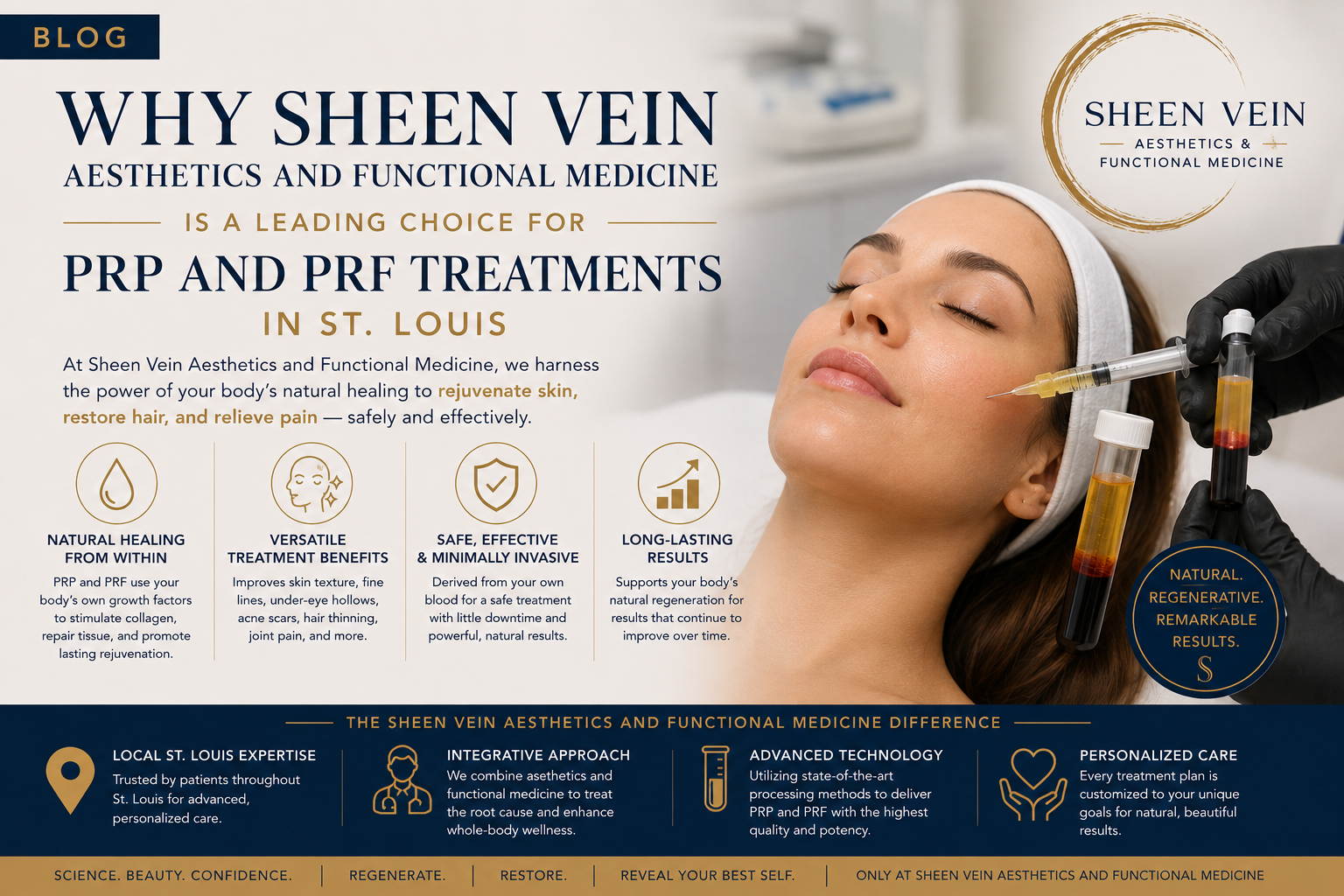
Why Sheen Vein Aesthetics and Functional Medicine Is a Leading Choice for PRP and PRF in St. Louis
Platelet-rich plasma and platelet-rich fibrin have become two of the most exciting areas of regenerative medicine. Commonly known as PRP and PRF, these treatments use components obtained from a patient’s own blood to support natural tissue repair, collagen remodeling, hair restoration, skin rejuvenation, and healing.
As interest in regenerative treatments has grown, so has the number of clinics offering them. However, PRP and PRF are not standardized products that produce identical results regardless of where they are performed. The quality of a treatment can be influenced by the patient evaluation, blood-processing technique, platelet preparation, treatment location, injection method, diagnosis, and the provider’s understanding of anatomy and regenerative medicine.
At Sheen Vein Aesthetics and Functional Medicine, we take PRP and PRF seriously. These are not simply trendy add-on treatments. They are part of a comprehensive, physician-led approach to aesthetics, hair restoration, musculoskeletal health, and whole-body wellness.
Our St. Louis practice offers PRP-based options for facial rejuvenation, biological filler treatments, hair restoration, and knee rejuvenation, alongside advanced technologies such as Fotona laser treatments, Alma TED hair restoration, photobiomodulation, and functional medicine.
We believe our combination of medical experience, individualized treatment planning, regenerative technology, and compassionate patient care makes Sheen Vein Aesthetics and Functional Medicine one of the leading destinations for PRP and PRF treatments in the St. Louis area.
What Are PRP and PRF?
PRP and PRF are autologous treatments, meaning they are produced from the patient’s own blood.
During treatment, a small amount of blood is drawn and processed in a centrifuge to separate and concentrate selected blood components. The resulting platelet concentrate is then applied or injected into a targeted treatment area.
Platelets are best known for their role in blood clotting, but they also contain signaling proteins and growth factors involved in healing and tissue repair. PRP is a concentration of platelets suspended within a relatively small amount of plasma.
Depending on the preparation system and intended application, PRP may be used to support:
- Facial skin rejuvenation
- Hair restoration
- Tendon healing
- Ligament injuries
- Joint discomfort
- Wound healing
- Collagen production
- Recovery after selected aesthetic procedures
PRF is a related platelet concentrate that includes a fibrin matrix. This fibrin network can act as a scaffold and may allow regenerative signaling molecules to be released over time. Reviews have described PRF as a next-generation autologous platelet treatment with potential applications in skin rejuvenation, wound healing, hair restoration, and soft-tissue support.
PRP and PRF Are Not the Same Treatment
Patients sometimes hear the terms PRP and PRF used interchangeably, but they are not identical.
PRP is generally prepared to produce a liquid platelet-rich plasma that can be injected, used with microneedling, or combined with other regenerative or aesthetic treatments.
PRF is processed differently and is designed to preserve a fibrin network. Depending on how it is prepared, PRF may remain injectable for a limited period or form a gel-like matrix.
Neither option is automatically better for every patient.
PRP may be preferable for one concern, while PRF may be more appropriate for another. The choice depends on factors such as:
- The treatment area
- The patient’s age
- Skin thickness
- Hair-loss pattern
- Severity of tissue damage
- The desired speed and duration of growth-factor release
- Whether treatment will be combined with another procedure
- The patient’s medical history
This is why we do not approach regenerative medicine with a one-protocol-fits-everyone mentality.
Why the Provider Matters
A vial labeled “PRP” does not guarantee that every patient receives the same biological product.
Published research shows substantial variation in how PRP is prepared and administered. Differences may include platelet concentration, leukocyte content, centrifugation method, activation, injection technique, treatment frequency, and the amount of product delivered. This lack of standardization is one reason study results can vary.
A thoughtful PRP or PRF treatment should begin with questions such as:
- What condition are we treating?
- Is the diagnosis correct?
- Is the patient an appropriate candidate?
- What preparation is most suitable?
- Where should the product be placed?
- Should ultrasound guidance be considered?
- Would PRP, PRF, laser therapy, photobiomodulation, or a combination be more appropriate?
- Are nutritional, hormonal, metabolic, or circulatory issues limiting recovery?
At Sheen Vein Aesthetics and Functional Medicine, we evaluate the entire clinical picture rather than simply drawing blood and performing an injection.
Physician-Led Regenerative Care
One of the most important reasons patients choose our practice is that their care occurs within a physician-owned medical environment.
Regenerative medicine requires more than technical ability. It requires an understanding of:
- Anatomy
- Vascular structures
- Nerve pathways
- Tissue depth
- Sterile technique
- Healing biology
- Medical contraindications
- Medication interactions
- The differences among inflammatory, degenerative, vascular, hormonal, and mechanical conditions
Our physician-led approach allows us to evaluate whether PRP or PRF is truly appropriate instead of automatically recommending it to everyone who walks through the door.
Sometimes PRP is an excellent option. In other situations, the patient may benefit more from physical therapy, imaging, medication adjustment, vein evaluation, laser treatment, hair-loss testing, nutritional correction, or referral to another specialist.
Good care includes knowing when to treat—and when not to treat.
Personalized PRP and PRF Treatment Plans
Patients are not interchangeable, and neither are their regenerative needs.
A younger patient seeking support for acne scars has very different needs from a menopausal woman experiencing diffuse hair thinning. A patient with mild knee osteoarthritis requires a different plan from someone with an acute ligament injury. A person seeking under-eye rejuvenation should not receive the same protocol used for scalp treatment.
At Sheen Vein Aesthetics and Functional Medicine, treatment planning may consider:
- Age and general health
- Symptoms and diagnosis
- Skin quality
- Degree of tissue degeneration
- Hair-loss pattern
- Hormonal status
- Nutritional deficiencies
- Medication use
- Platelet count
- Metabolic health
- Previous treatments
- Lifestyle and recovery goals
This individualized process helps us choose the treatment strategy that makes sense for the person—not simply the procedure that happens to be popular.
PRP and PRF for Skin Rejuvenation
Facial aging is not caused by one isolated change.
Over time, the skin produces less collagen and elastin. It may become thinner, drier, less resilient, and more uneven in texture. Sun exposure, inflammation, smoking, hormonal changes, stress, poor sleep, and metabolic dysfunction can further accelerate this process.
PRP and PRF may support skin rejuvenation by delivering platelets and regenerative signaling proteins to targeted areas.
Depending on the patient and treatment method, potential benefits may include improvement in:
- Fine lines
- Crepey skin
- Uneven texture
- Dullness
- Mild acne scarring
- Skin quality
- Under-eye skin
- Collagen remodeling
Systematic reviews have found encouraging evidence for PRP in aesthetic dermatology, particularly for skin rejuvenation, hair restoration, wound healing, and selected pigmentation concerns. Research comparing PRP and PRF suggests that both may offer aesthetic benefits, although their strengths may differ and longer-term evidence remains limited.
We explain these limitations honestly. Regenerative treatments can be valuable, but they are not magic, and results vary among patients.
PRP Facial Treatments in St. Louis
A PRP facial generally combines platelet-rich plasma with a procedure designed to create controlled skin stimulation.
Depending on the treatment plan, PRP may be applied or delivered after microneedling or paired with other collagen-stimulating procedures.
The goal is not to artificially change the face. It is to support the skin’s own repair process and encourage healthier-looking texture and tone.
Patients who want to learn more should visit our PRP Facial service page when publishing this article and internally link that phrase to the corresponding treatment page.
A PRP facial may be considered for patients who want:
- Natural-looking rejuvenation
- Improved skin texture
- Support for collagen remodeling
- Minimal use of synthetic materials
- A treatment that can complement laser rejuvenation
The best results often come from matching the treatment to the patient rather than assuming PRP alone will correct every form of facial aging.
PRF and Biological Filler Treatments
PRF may be considered in selected facial areas where gradual regenerative support is desired.
Unlike a conventional hyaluronic acid filler, PRF does not create the same predictable or immediate volume. Instead, it is intended to support tissue quality through the patient’s own fibrin and platelet components.
This distinction is important.
PRF should not be presented as an exact replacement for dermal filler. It may be a good option for patients who:
- Prefer an autologous treatment
- Want gradual improvement
- Are seeking better skin quality rather than dramatic volume
- Wish to complement other aesthetic procedures
- Understand that multiple sessions may be necessary
Our Biological Filler Treatments page should be internally linked here so readers can explore how regenerative facial treatments may fit into a broader aesthetic plan.
PRP and PRF for Hair Restoration
Hair loss can be emotionally difficult for both men and women. Unfortunately, hair thinning is often treated as though every case has the same cause.
It does not.
Hair loss may be influenced by:
- Genetics
- Hormonal changes
- Menopause
- Thyroid disorders
- Iron deficiency
- Vitamin D deficiency
- Nutritional problems
- Stress
- Illness
- Medications
- Autoimmune disease
- Scalp inflammation
PRP has been studied as an adjunctive treatment for androgenetic alopecia, and PRF is increasingly being explored as another regenerative option for hair restoration.
At Sheen Vein Aesthetics and Functional Medicine, we do not view hair restoration as simply injecting the scalp. When appropriate, we consider the medical and functional factors that may interfere with healthy hair growth.
A personalized hair-restoration plan may combine:
- PRP
- PRF
- Alma TED hair restoration
- Nutritional evaluation
- Hormone assessment
- Scalp-health support
- Appropriate medical therapy
- Lifestyle recommendations
Our PRP Hair Rejuvenation and Alma TED Hair Restoration pages should be internally linked in this section.
PRP for Joint and Tendon Concerns
PRP is also used in musculoskeletal medicine.
It has been investigated for conditions such as:
- Knee osteoarthritis
- Tennis elbow
- Achilles tendinopathy
- Patellar tendinopathy
- Rotator cuff problems
- Plantar fasciitis
- Selected ligament injuries
The American Academy of Orthopaedic Surgeons describes PRP as a blood-derived treatment that has been used for several orthopedic injuries, while reviews of knee osteoarthritis include dozens of moderate- and high-quality studies. Results remain dependent on the condition, protocol, and patient.
At our practice, PRP may be incorporated into a broader regenerative plan instead of being treated as an isolated injection.
For example, selected patients may also benefit from:
- Photobiomodulation
- Red and near-infrared light therapy
- Activity modification
- Strengthening
- Weight optimization
- Improved metabolic health
- Nutritional support
- Physical therapy
Patients interested in knee care should be directed through an internal link to our Knee Rejuvenation Program page.
Combining PRP or PRF With Photobiomodulation
One feature that distinguishes our practice is the ability to combine regenerative treatments with photobiomodulation, commonly called PBM or red light therapy.
PBM uses specific wavelengths of red and near-infrared light to influence cellular activity without cutting, burning, or removing tissue.
Depending on the treatment area and clinical situation, PBM may be used to support:
- Cellular energy production
- Recovery
- Circulation
- Inflammatory balance
- Tissue repair
At Sheen Vein Aesthetics and Functional Medicine, PRP or PRF may be combined with PBM when the physician believes the therapies are complementary.
This provides patients with a broader regenerative strategy than receiving an injection and being sent home without consideration of recovery support.
The phrases Photobiomodulation, Red Light Therapy Bed, and Joint and Arthritic Pain should be linked to their respective service pages.
Combining Regenerative Medicine With Fotona Laser Treatments
Patients seeking facial rejuvenation may benefit from more than one treatment modality.
PRP and PRF focus on biological signaling and tissue support, while Fotona laser treatments can be used to deliver controlled thermal or ablative stimulation at specific skin depths.
Depending on the patient’s goals, a plan may combine regenerative treatments with:
- Fotona4D
- Laser skin resurfacing
- SmoothEye
- LipLase
- Laser acne-scar treatment
- Scar revision
The advantage is not simply having more equipment. The advantage is being able to select the right tool—or combination of tools—for the patient’s specific concern.
For example, a patient with skin laxity and poor texture may require a different plan from someone with under-eye crepiness or acne scarring.
Internal links should be added to the Fotona4D, Laser Skin Resurfacing, SmoothEye, and Laser Acne Treatments pages.
The Functional Medicine Difference
Healing does not occur in isolation.
PRP and PRF depend on the patient’s own biological resources. This makes underlying health especially important.
Factors that may influence recovery include:
- Poorly controlled diabetes
- Insulin resistance
- Smoking
- Inadequate protein intake
- Vitamin or mineral deficiencies
- Hormonal imbalance
- Chronic inflammation
- Poor sleep
- Excessive alcohol use
- Certain medications
- Significant vascular disease
Our functional medicine perspective allows us to look beyond the injection site.
When clinically appropriate, we may evaluate whether nutrition, metabolic dysfunction, hormones, inflammation, or other medical issues could be affecting the patient’s skin, hair, joints, or healing response.
This whole-person approach is one of the most meaningful differences between receiving PRP at a physician-led regenerative practice and purchasing a generic aesthetic package.
The phrase Functional and Integrative Medicine should be internally linked to the corresponding service page.
Honest Expectations and Patient Education
We believe one of the most important parts of being a leading PRP and PRF provider is setting honest expectations.
PRP and PRF do not guarantee:
- Permanent hair regrowth
- Complete reversal of arthritis
- Surgical-level facial lifting
- Instant volume
- Identical results for every patient
Results depend on the diagnosis, treatment area, protocol, age, general health, and individual healing response.
Some patients notice gradual improvements over several weeks or months. Others may need a series of treatments. Maintenance may be appropriate depending on the condition.
During consultation, we discuss:
- What the treatment may realistically accomplish
- How many sessions may be considered
- Possible discomfort
- Bruising or swelling
- Recovery recommendations
- Alternatives
- Limitations
- Cost
- Whether another treatment may be more appropriate
Patients deserve education—not exaggerated promises.
Who May Not Be an Ideal Candidate?
PRP and PRF are not appropriate for everyone.
Additional evaluation may be required for patients with:
- Active infection
- Certain blood disorders
- Significant anemia
- Low platelet counts
- Uncontrolled medical conditions
- Certain cancers
- Pregnancy, depending on the procedure
- Use of anticoagulant or antiplatelet medications
- Unrealistic expectations
Medications should never be stopped merely to receive a regenerative treatment unless the prescribing clinician has approved the change.
A careful medical history is essential for safe treatment planning.
Frequently Asked Questions About PRP and PRF
Is PRP the same as a filler?
No. PRP is a platelet-rich liquid produced from your blood. It may support collagen remodeling and tissue repair but does not behave like a traditional hyaluronic acid filler.
Is PRF better than PRP?
Not necessarily. PRP and PRF have different biological and handling characteristics. One may be more appropriate depending on the treatment area, goal, and patient.
How many treatments will I need?
The number of sessions varies. Facial rejuvenation, hair restoration, and joint treatments all use different protocols. Many patients receive a series followed by reassessment or maintenance.
How quickly will I see results?
Regenerative treatments generally produce gradual rather than immediate changes. Improvement may develop over several weeks or months as tissue remodeling occurs.
Is there downtime?
Downtime is usually limited, but temporary soreness, swelling, redness, or bruising may occur. Recovery depends on where and how the treatment is performed.
Can PRP help with hair loss?
PRP has evidence supporting its use as an adjunctive treatment for certain forms of hair loss, particularly androgenetic alopecia. It is important to identify the type and possible causes of hair loss before treatment.
Can PRP help knee arthritis?
PRP has been studied extensively for knee osteoarthritis, but outcomes vary. The severity of arthritis, preparation method, injection protocol, body composition, and rehabilitation can influence the response.
Are PRP and PRF natural?
They are autologous, meaning they are prepared from the patient’s own blood. However, “natural” does not mean risk-free or appropriate for every person. Treatment should still be performed in a professional medical setting.
Why Choose Sheen Vein Aesthetics and Functional Medicine for PRP and PRF in St. Louis?
Patients choose Sheen Vein Aesthetics and Functional Medicine because we offer more than a single injection.
Our approach includes:
- Physician-led medical evaluation
- Individualized PRP and PRF planning
- A broad understanding of anatomy and healing
- Facial rejuvenation options
- Hair-restoration programs
- Knee and musculoskeletal care
- Photobiomodulation and red light therapy
- Fotona laser technology
- Functional and integrative medicine
- Honest patient education
- Natural-looking treatment goals
- Compassionate, personalized care
Our physician-owned St. Louis practice currently features PRP facial treatments, biological filler treatments, PRP hair rejuvenation, and a knee rejuvenation program, with complementary services that include Fotona4D, laser skin resurfacing, Alma TED, PBM, and functional medicine.
We do not believe being the “best” comes from simply saying it.
It comes from listening carefully, selecting patients appropriately, using medical judgment, combining complementary therapies thoughtfully, and caring enough to tell someone when a treatment may not be right for them.
That is the standard we strive to provide at every visit.
Schedule a PRP or PRF Consultation in St. Louis
Whether you are interested in facial rejuvenation, hair restoration, knee discomfort, a tendon problem, or a regenerative approach to healthier aging, the first step is a personalized consultation.
At Sheen Vein Aesthetics and Functional Medicine, we will evaluate your concerns, discuss your goals, review your medical history, and determine whether PRP, PRF, or another treatment strategy is most appropriate.
Our goal is not to sell every patient the same procedure. Our goal is to help you make an informed decision and create a treatment plan that supports natural-looking, medically responsible results.
Contact Sheen Vein Aesthetics and Functional Medicine to schedule your PRP or PRF consultation and discover why patients throughout St. Louis choose our physician-led practice for personalized regenerative care.