Why Sheen Vein Aesthetics and Functional Medicine Offers Some of the Best Sclerotherapy in St. Louis
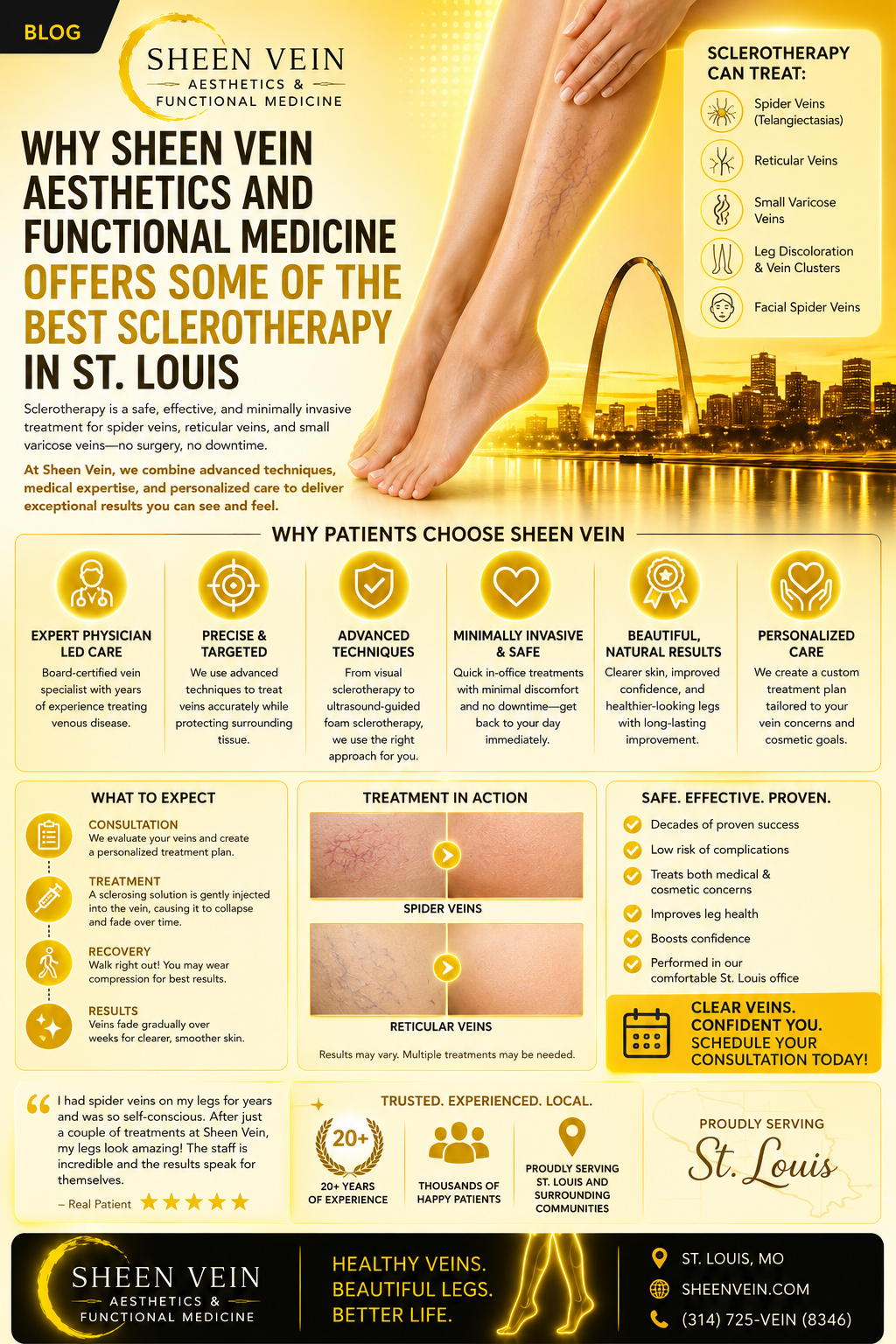
Spider veins and varicose veins can affect far more than the appearance of your legs. They may cause embarrassment, itching, burning, tenderness, aching, heaviness, swelling, nighttime cramping, or fatigue after standing. For some patients, visible veins are mainly cosmetic. For others, they are signs of an underlying circulation problem known as chronic venous insufficiency.
Sclerotherapy remains one of the most effective and trusted treatments for unwanted spider veins, reticular veins, and selected varicose veins. However, not every sclerotherapy treatment is performed the same way.
The quality of the outcome depends on much more than simply placing a needle into a visible vein. It depends on proper diagnosis, knowledge of venous anatomy, medication selection, concentration, injection technique, patient positioning, ultrasound use when necessary, post-treatment care, and whether larger sources of reflux have been identified and treated first.
At Sheen Vein Aesthetics and Functional Medicine, we provide physician-led sclerotherapy designed around the patient’s unique vein anatomy and treatment goals. We offer both visual sclerotherapy for surface spider and reticular veins and ultrasound-guided foam sclerotherapy for deeper or less visible abnormal veins.
Our goal is not to rush through a cosmetic injection session. It is to understand why the veins developed, determine whether underlying venous disease is present, and create a personalized treatment plan that supports healthier circulation and better-looking legs.
That comprehensive approach is why patients throughout the St. Louis area choose Sheen Vein Aesthetics and Functional Medicine when looking for experienced sclerotherapy care.
What Is Sclerotherapy?
Sclerotherapy is a minimally invasive vein treatment in which a specialized medication, called a sclerosant, is injected into an abnormal vein.
The medication irritates the inner lining of the vein. This causes the vein walls to collapse and seal together. Over time, the treated vessel is gradually broken down and absorbed by the body.
Blood naturally redirects through healthier veins.
Depending on the type and size of the vein, sclerotherapy may be used for:
- Spider veins
- Reticular veins
- Small varicose veins
- Residual veins after laser treatment
- Recurrent varicose veins
- Tortuous veins
- Deeper tributary veins
- Selected perforator veins
The exact method should be chosen based on the location, size, depth, and source of the abnormal vein.
Not All Sclerotherapy Is the Same
Patients often assume sclerotherapy is one standard procedure.
In reality, there are several important forms.
Visual Sclerotherapy
Visual sclerotherapy is used for veins that can be clearly seen through the skin.
It is commonly used to treat:
- Spider veins
- Reticular veins
- Small surface varicosities
The physician uses a very small needle to inject the medication directly into the visible vessel.
This requires careful hand control, experience, and a detailed understanding of the superficial vein network.
Ultrasound-Guided Foam Sclerotherapy
Some abnormal veins are not visible from the surface.
They may be:
- Too deep
- Too twisted
- Hidden beneath fatty tissue
- Connected to larger refluxing veins
- Recurrent after previous treatment
Ultrasound-guided foam sclerotherapy allows the physician to see the vein in real time and direct the medication precisely into the abnormal vessel.
The medication is prepared as a foam, which can improve contact with the vein wall and allow treatment of larger or more complex venous segments.
This is not the same as cosmetic spider-vein treatment. It is a medically guided procedure used to address deeper venous disease.
Why Diagnosis Comes Before Injection
One of the most important differences between high-quality sclerotherapy and a quick cosmetic treatment is determining whether the visible vein is the actual problem or merely the end result of deeper reflux.
A cluster of spider veins may be fed by:
- A reticular vein
- A varicose tributary
- A refluxing saphenous vein
- A perforator vein
- Pelvic venous pressure
- A combination of several sources
If the underlying source is not recognized, the visible veins may respond poorly, require repeated treatment, or return more quickly.
At Sheen Vein Aesthetics and Functional Medicine, we evaluate the pattern of veins, symptoms, medical history, and, when indicated, the deeper venous circulation before recommending treatment.
This allows us to treat the veins in the correct order.
The Importance of Venous Duplex Ultrasound
A venous duplex ultrasound is a painless, non-invasive test that uses sound waves to assess blood flow and vein-valve function.
It may identify:
- Venous reflux
- Damaged valves
- Previous blood clots
- Deep vein obstruction
- Abnormal superficial veins
- Tributary pathways
- Perforator veins
- Veins contributing to swelling or skin changes
Not every patient with a few isolated spider veins needs a full venous ultrasound. However, ultrasound may be appropriate when spider or varicose veins are associated with:
- Leg aching
- Heaviness
- Swelling
- Nighttime cramping
- Restless legs
- Skin discoloration
- Itching
- Burning
- Previous blood clots
- Recurrent veins after prior treatment
The decision should be based on the patient’s symptoms and clinical findings rather than automatically applying the same process to everyone.
Why Physician-Led Sclerotherapy Matters
Sclerotherapy is a medical procedure.
Although it is minimally invasive, it still requires knowledge of:
- Venous anatomy
- Arterial anatomy
- Nerve pathways
- Injection depth
- Medication concentration
- Vascular complications
- Blood clot risk
- Skin healing
- Medical contraindications
At Sheen Vein Aesthetics and Functional Medicine, treatment is performed within a physician-led vein practice.
That matters because leg-vein concerns sometimes overlap with other medical conditions.
For example, leg pain or swelling may also be caused by:
- Deep vein thrombosis
- Peripheral artery disease
- Lymphedema
- Heart failure
- Kidney disease
- Neuropathy
- Infection
- Medication effects
- Orthopedic problems
A physician-led evaluation helps determine whether sclerotherapy is appropriate or whether another diagnosis needs attention.
Treating the Underlying Venous Circulation First
In patients with chronic venous insufficiency, the best cosmetic outcome often begins with medical treatment of the underlying reflux.
For example, a patient may have:
- Reflux in the great saphenous vein
- Large varicose tributaries
- Reticular veins
- Surface spider veins
Treating the smallest veins first may not address the pressure feeding them.
A more effective plan may involve:
- Treating the main refluxing vein.
- Treating residual varicose tributaries.
- Treating reticular veins.
- Finishing with cosmetic spider-vein sclerotherapy.
At Sheen Vein Aesthetics and Functional Medicine, we often view sclerotherapy as one part of a broader vein-treatment strategy rather than an isolated procedure.
Visual Sclerotherapy for Spider Veins
Spider veins are tiny red, purple, or blue vessels located close to the skin surface.
They often appear on the:
- Thighs
- Calves
- Ankles
- Behind the knees
- Outer legs
Visual sclerotherapy is one of the most effective treatments for leg spider veins.
During the procedure, a very fine needle is used to inject the targeted vessel.
The treated vein may initially appear darker, irritated, or slightly raised before gradually fading over the following weeks or months.
Multiple sessions are often necessary because most patients have many connected veins rather than one isolated vessel.
Reticular Veins
Reticular veins are slightly larger blue or green veins located beneath the skin.
They may serve as “feeder veins” for clusters of spider veins.
If the reticular source is not treated, the overlying spider veins may not respond as well.
Treating feeder veins is one example of why experience matters.
The most obvious vein is not always the most important vein.
Foam Sclerotherapy for Larger or Deeper Veins
Foam sclerotherapy is often used when a vein is too large, deep, or tortuous for standard liquid visual injection.
The foam can displace blood within the vein and increase contact between the medication and the vessel wall.
Ultrasound guidance allows the physician to monitor:
- Needle placement
- Vein access
- Foam distribution
- Target-vessel response
This approach may be especially useful for:
- Recurrent varicose veins
- Tributary veins
- Residual veins after EVLT
- Tortuous veins that cannot accept a catheter
- Selected veins near venous ulcers
Sclerotherapy After Endovenous Laser Therapy
Endovenous Laser Therapy, or EVLT, is used to close certain large refluxing veins.
After the main vein is treated, smaller tributary veins may remain visible.
Sclerotherapy can then be used to treat those remaining vessels.
This staged approach often produces better medical and cosmetic outcomes than attempting to treat every visible vein in one session.
At Sheen Vein Aesthetics and Functional Medicine, we evaluate which veins require ablation and which are better suited for sclerotherapy.
Sclerotherapy for Recurrent Varicose Veins
Varicose veins can return after previous treatment.
This does not always mean the original procedure failed. Vein disease is often progressive, and new pathways may develop over time.
Recurrent veins may be caused by:
- New reflux
- Untreated tributaries
- Recanalization
- Perforator veins
- Pelvic sources
- Progression of genetic vein disease
Ultrasound-guided foam sclerotherapy can be an excellent option for selected recurrent veins, especially when scar tissue or twisting anatomy makes another catheter procedure difficult.
Is Sclerotherapy Safe?
Sclerotherapy has been used for decades and is generally considered safe when performed by an experienced medical professional.
However, no medical procedure is completely without risk.
Possible temporary effects include:
- Bruising
- Redness
- Tenderness
- Itching
- Swelling
- Firmness
- Darkened pigmentation
- Small trapped-blood areas
Less common complications may include:
- Skin ulceration
- Infection
- Superficial phlebitis
- Deep vein thrombosis
- Allergic reaction
- Tissue injury
- Visual disturbance
- Neurological symptoms
- Small new surface vessels called matting
Appropriate technique, medication selection, patient screening, and follow-up help reduce risk.
Hyperpigmentation After Sclerotherapy
Some patients develop brown discoloration along a treated vein.
This can occur when blood becomes trapped inside the vessel or when iron-containing pigment remains in the skin.
In many patients, discoloration gradually fades over several months. However, it may occasionally persist longer.
Factors that may influence pigmentation include:
- Vein size
- Skin type
- Medication concentration
- Amount of trapped blood
- Sun exposure
- Individual healing response
We explain this possibility before treatment so patients know what to expect.
Trapped Blood and Follow-Up Care
After sclerotherapy, some veins may trap coagulated blood.
These areas may feel firm or tender and may appear darker.
In selected cases, the physician may drain the trapped blood through a tiny opening.
This can improve comfort and may reduce the risk of prolonged pigmentation.
Follow-up is one of the reasons we do not treat sclerotherapy as a simple walk-in cosmetic service.
Monitoring the healing process matters.
How Many Sclerotherapy Sessions Will I Need?
The number of treatments varies.
Factors include:
- Number of veins
- Vein size
- Vein depth
- Underlying reflux
- Previous treatment
- Skin type
- Treatment goals
- Individual response
Some patients have a small isolated cluster and need limited treatment.
Others have widespread spider and reticular veins requiring several sessions.
It is more accurate to think of sclerotherapy as a process rather than a one-time cure.
How Quickly Will Veins Fade?
Veins do not disappear immediately.
Small spider veins may begin fading within several weeks, while larger vessels may take several months.
The treated area may temporarily look worse before it looks better because of:
- Bruising
- Inflammation
- Darkened blood
- Firmness
- Pigmentation
Patients should allow adequate healing time before judging the final result.
What Happens During a Sclerotherapy Appointment?
A typical visit may include:
- Review of symptoms and medical history
- Examination of the treatment area
- Marking or mapping veins
- Cleaning the skin
- Injection with a fine needle
- Compression after selected injections
- Walking after treatment
- Detailed aftercare instructions
The length of the appointment depends on the number and complexity of veins being treated.
Is Sclerotherapy Painful?
Most patients tolerate sclerotherapy well.
Common sensations include:
- A small needle stick
- Brief burning
- Mild stinging
- Pressure
- Cramping along the treated vein
Discomfort is usually brief.
Larger or more sensitive veins may feel more noticeable than very small spider veins.
Recovery After Sclerotherapy
Most patients return to normal daily activities shortly after treatment.
Walking is usually encouraged because it supports circulation.
Depending on the treatment, patients may be advised to temporarily avoid:
- Heavy exercise
- Hot tubs
- Saunas
- Very hot baths
- Prolonged sun exposure
- Extended immobility
- Long-distance travel
Compression stockings may be recommended based on the type of vein treated and the individual treatment plan.
The Role of Compression Stockings
Compression stockings apply external pressure to the legs.
After sclerotherapy, they may help:
- Reduce swelling
- Improve vein-wall contact
- Support circulation
- Decrease discomfort
- Limit trapped blood
Compression recommendations vary.
Not every patient receives the same compression strength or duration. The plan should be individualized based on the procedure, circulation, and medical history.
Cosmetic vs. Medical Sclerotherapy
Sclerotherapy may be cosmetic or medically necessary depending on the veins being treated.
Cosmetic Sclerotherapy
Cosmetic treatment generally involves spider or reticular veins that do not cause significant medical symptoms.
Insurance usually does not cover treatment performed only for appearance.
Medical Sclerotherapy
Medical sclerotherapy may be used for symptomatic varicose veins, deeper tributaries, or veins associated with documented venous reflux.
Coverage depends on:
- Symptoms
- Ultrasound findings
- Vein size
- Insurance criteria
- Conservative-treatment requirements
- Prior authorization
Our team helps patients understand whether a recommended treatment is considered cosmetic or medically necessary.
Sclerotherapy for Men
Vein treatment is not only for women.
Men may develop:
- Varicose veins
- Leg heaviness
- Swelling
- Nighttime cramps
- Skin discoloration
- Venous ulcers
- Spider veins
Men sometimes delay care because their veins are less visible beneath leg hair or because they assume vein treatment is purely cosmetic.
By the time they seek evaluation, the disease may be more advanced.
Sclerotherapy can be an important part of treatment for both men and women.
Sclerotherapy and Pregnancy
Sclerotherapy is generally postponed during pregnancy.
Pregnancy increases blood volume, hormonal changes, and pressure within the pelvic and leg veins.
Some veins improve after delivery, while others remain.
Patients are often advised to wait until after pregnancy and postpartum recovery before undergoing elective treatment.
A personalized consultation can help determine the best timing.
Who May Not Be a Good Candidate?
Sclerotherapy may not be appropriate for everyone.
Additional caution or alternative treatment may be necessary in patients with:
- Active deep vein thrombosis
- Acute infection
- Severe arterial disease
- Certain clotting disorders
- Pregnancy
- Allergy to the medication
- Significant immobility
- Certain uncontrolled medical conditions
Medication use, including anticoagulants, should be reviewed carefully.
Patients should never stop prescribed medication without guidance from the clinician who manages it.
Why Patients Choose Sheen Vein Aesthetics and Functional Medicine for Sclerotherapy
Patients throughout the St. Louis area choose our practice because we provide more than cosmetic vein injections.
Our approach includes:
- Physician-led evaluation
- Detailed medical history
- Assessment for chronic venous insufficiency
- Venous duplex ultrasound when indicated
- Visual sclerotherapy
- Ultrasound-guided foam sclerotherapy
- Treatment of feeder veins
- Treatment of residual veins after EVLT
- Care for recurrent varicose veins
- Cosmetic and medical vein treatment
- Personalized medication selection
- Follow-up care
- Long-term vein monitoring
We do not believe the best sclerotherapy is defined by how many injections are performed.
It is defined by making the correct diagnosis, treating the correct vein, using the correct technique, setting realistic expectations, and remaining involved during recovery.
A Personalized Approach to Every Leg
No two patients have the same venous anatomy.
One patient may have a few isolated spider veins. Another may have deep reflux, large varicose tributaries, swelling, and skin damage.
Even when two patients appear similar, their treatment plans may differ based on:
- Vein pattern
- Skin type
- Symptoms
- Medical history
- Prior treatment
- Ultrasound findings
- Cosmetic goals
At Sheen Vein Aesthetics and Functional Medicine, we do not use a one-size-fits-all injection protocol.
Every plan is tailored to the patient.
Natural-Looking Cosmetic Results
Our aesthetic goal is not merely to erase one vein while ignoring the surrounding pattern.
We look at:
- Symmetry
- Feeder veins
- Networks of connected vessels
- Vein depth
- Skin tone
- Overall leg appearance
Results develop gradually, and perfection cannot be guaranteed. However, thoughtful treatment planning can create smoother, more natural-looking improvement.
Frequently Asked Questions
Is sclerotherapy the best treatment for spider veins?
For many leg spider veins, sclerotherapy is considered one of the most effective treatment options. The best choice depends on vein size, location, skin type, symptoms, and whether deeper reflux is present.
Is laser better than sclerotherapy?
Neither is automatically better. Laser treatment may be useful for certain very small vessels or areas where injections are difficult. Sclerotherapy is often preferred for many leg spider and reticular veins. Some patients benefit from a combination.
Do treated veins come back?
A successfully closed vein usually remains closed. However, new veins may develop because genetics, hormones, aging, and venous pressure continue to influence the circulation.
Can sclerotherapy treat large varicose veins?
Selected varicose veins may be treated with ultrasound-guided foam. Larger refluxing saphenous veins may require EVLT, Varithena, or another ablation method before residual veins are treated.
How many injections are given?
The number varies based on the vein pattern and treatment area. Safety and medication limits are more important than treating every vein in one session.
Does insurance cover sclerotherapy?
Cosmetic spider-vein treatment is usually self-pay. Medical sclerotherapy may be covered when symptoms, ultrasound findings, and plan-specific criteria are met.
Can I exercise afterward?
Walking is generally encouraged. Strenuous activity may need to be limited temporarily depending on the treatment. Individual instructions are provided after the procedure.
Will I need compression stockings?
Many patients are advised to wear compression after treatment, but the strength and duration vary.
Can sclerotherapy cause blood clots?
Blood clots are an uncommon but possible complication. Proper screening, technique, walking, and follow-up help reduce risk.
How soon before an event should I schedule treatment?
Because bruising, pigmentation, and fading may take weeks or months, patients should begin treatment well before vacations, weddings, or special events.
Schedule a Sclerotherapy Consultation in St. Louis
If spider veins, reticular veins, or varicose veins are affecting your confidence or causing discomfort, begin with a comprehensive evaluation.
At Sheen Vein Aesthetics and Functional Medicine, we will assess your vein pattern, symptoms, medical history, and treatment goals.
When appropriate, we may recommend:
- Visual sclerotherapy
- Ultrasound-guided foam sclerotherapy
- Endovenous laser therapy
- Varithena
- Compression
- A staged medical and cosmetic treatment plan
Our goal is to improve both the appearance and health of your legs while providing honest expectations and individualized care.
Contact Sheen Vein Aesthetics and Functional Medicine to schedule your sclerotherapy consultation and discover why patients throughout St. Louis trust our physician-led practice for comprehensive vein treatment.