Why Sheen Vein Aesthetics and Functional Medicine Is a Leading Vein Clinic for Spider Vein and Varicose Vein Treatment in St. Louis
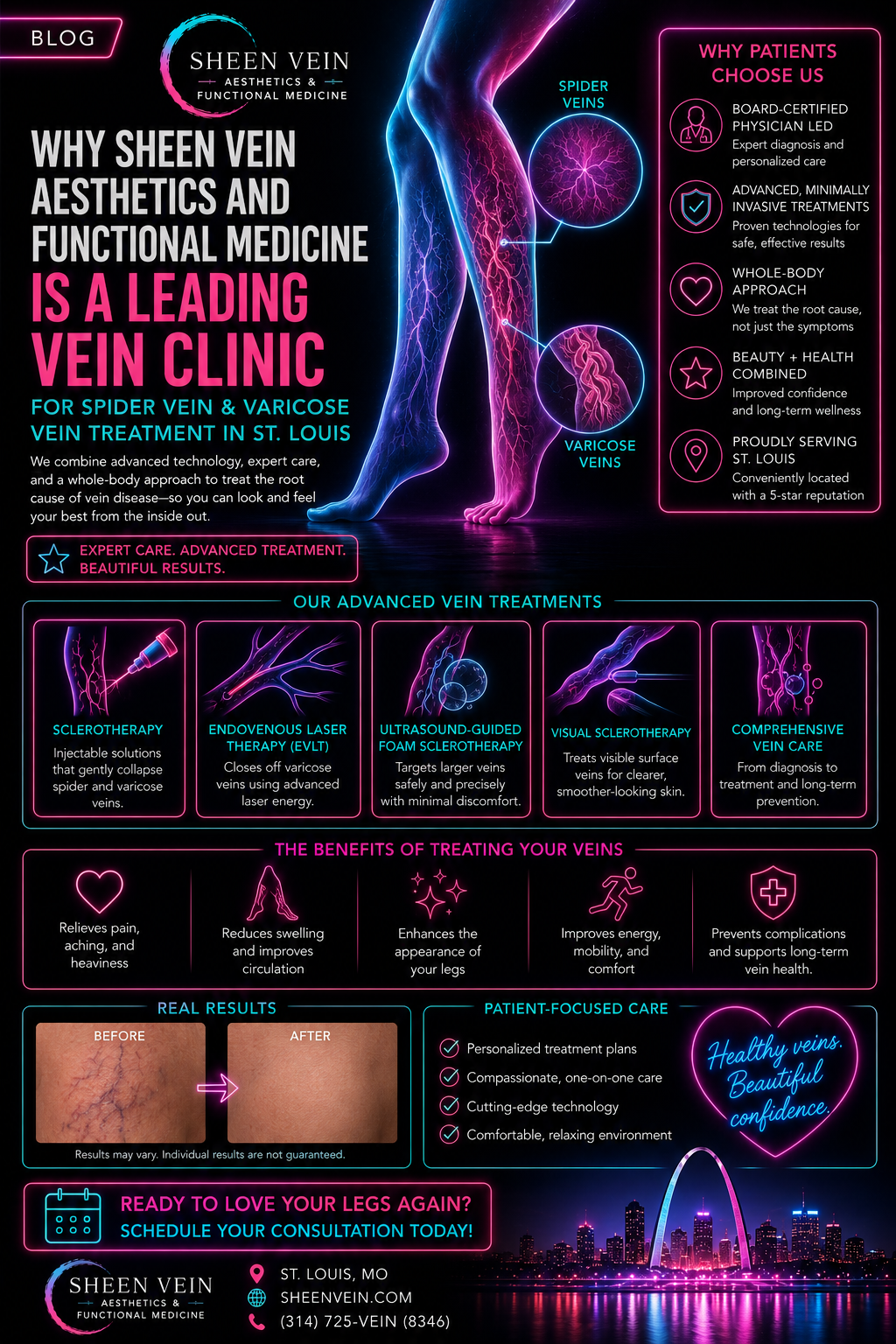
Spider veins and varicose veins are extremely common, but that does not mean they should be ignored.
Some patients are mainly concerned about how their legs look. Others experience aching, heaviness, swelling, burning, itching, nighttime cramping, restless legs, or fatigue after standing. In more advanced cases, abnormal venous circulation may contribute to skin discoloration, inflammation, hardened tissue, or open wounds near the ankle.
The important point is that not every visible vein is simply cosmetic.
Spider veins and varicose veins may be signs of chronic venous insufficiency, a condition in which weakened or damaged vein valves allow blood to flow backward and pool in the legs. When that underlying circulation problem is not identified, treatment may focus only on the veins visible at the skin while missing the source of the pressure creating them.
At Sheen Vein Aesthetics and Functional Medicine, we approach spider-vein and varicose-vein treatment as both a medical and aesthetic specialty. Our physician-led St. Louis practice uses detailed evaluation, venous duplex ultrasound when appropriate, and a range of minimally invasive procedures to create a treatment plan based on each patient’s anatomy, symptoms, and goals.
Depending on the findings, treatment may include:
- Visual sclerotherapy
- Ultrasound-guided foam sclerotherapy
- Endovenous Laser Therapy
- Varithena microfoam
- Compression therapy
- Follow-up vein care
- A staged combination of medical and cosmetic treatment
Our goal is not simply to make the legs look better. It is to understand why the veins developed, improve abnormal circulation when possible, relieve symptoms, protect the skin, and create natural-looking cosmetic improvement.
That comprehensive approach is why patients throughout St. Louis choose Sheen Vein Aesthetics and Functional Medicine for spider-vein and varicose-vein care.
Spider Veins and Varicose Veins Are Not the Same
Although the terms are sometimes used interchangeably, spider veins and varicose veins are different.
Spider Veins
Spider veins are small red, blue, or purple vessels located close to the surface of the skin.
They often appear in branching or web-like patterns and are commonly found on the:
- Thighs
- Calves
- Ankles
- Behind the knees
- Outer legs
Spider veins are usually flatter and smaller than varicose veins.
For many patients, they are primarily cosmetic. However, some spider veins occur alongside symptoms of venous insufficiency or are connected to larger feeder veins beneath the skin.
Varicose Veins
Varicose veins are larger superficial veins that have become stretched, enlarged, and twisted.
They may bulge above the skin and appear blue, green, or purple.
Varicose veins may cause:
- Aching
- Heaviness
- Throbbing
- Burning
- Leg fatigue
- Swelling
- Tenderness
- Itching
- Nighttime cramps
- Restless legs
Because varicose veins are often connected to deeper refluxing veins, they require a more thorough medical evaluation than isolated cosmetic spider veins.
Why Visible Veins Develop
Healthy veins contain one-way valves that move blood upward toward the heart.
When these valves function properly, they open as blood moves upward and close to prevent it from falling backward.
When the valves weaken, blood can flow in the wrong direction. This is called venous reflux.
Over time, reflux increases pressure within the superficial veins.
That pressure can cause veins to:
- Stretch
- Twist
- Enlarge
- Bulge
- Become visible
- Feed clusters of spider veins
This is why the vein that can be seen at the surface is not always the original problem.
A visible spider-vein cluster may be connected to a larger reticular vein. A bulging calf vein may be receiving pressure from a refluxing saphenous vein higher in the leg.
Treating only what is visible may improve the appearance temporarily but leave the underlying source untreated.
What Makes a Vein Clinic Different From a Cosmetic Injection Office?
A high-quality vein clinic should do more than inject visible veins.
Comprehensive vein care requires:
- Medical history
- Symptom review
- Examination
- Knowledge of venous anatomy
- Understanding of chronic venous insufficiency
- Recognition of blood-clot risk
- Appropriate ultrasound evaluation
- Multiple treatment options
- Long-term follow-up
At Sheen Vein Aesthetics and Functional Medicine, we evaluate whether a patient’s concern is:
- Primarily cosmetic
- Medically symptomatic
- Related to underlying reflux
- A combination of medical and cosmetic issues
That distinction helps determine the correct treatment order.
Physician-Led Vein Care
Spider-vein and varicose-vein treatment may appear simple from the outside, but it involves complex anatomy.
The legs contain:
- Superficial veins
- Deep veins
- Perforator veins
- Arteries
- Nerves
- Lymphatic vessels
A physician-led evaluation is important because leg pain or swelling may also result from:
- Deep vein thrombosis
- Peripheral artery disease
- Lymphedema
- Heart disease
- Kidney disease
- Infection
- Neuropathy
- Arthritis
- Spinal disease
- Medication effects
Not every painful or swollen leg should automatically receive a vein procedure.
Being a trusted vein clinic means knowing when vein treatment is appropriate and when another condition should be evaluated first.
The Role of Venous Duplex Ultrasound
Venous duplex ultrasound is one of the most important tools in modern vein care.
The test uses sound waves to evaluate the structure and function of the veins.
It may show:
- Direction of blood flow
- Venous reflux
- Valve failure
- Previous blood clots
- Deep-vein obstruction
- Superficial-vein disease
- Abnormal tributaries
- Veins contributing to swelling or skin changes
Not every patient with a few isolated spider veins requires a full ultrasound. However, ultrasound may be appropriate when visible veins occur with:
- Aching
- Heaviness
- Swelling
- Nighttime cramping
- Restless legs
- Skin discoloration
- Recurrent veins
- Previous blood clots
- Venous ulcers
At Sheen Vein Aesthetics and Functional Medicine, ultrasound findings help us determine whether the patient needs cosmetic treatment alone or a broader medical treatment plan.
Why Treatment Should Follow the Vein Anatomy
Veins are interconnected.
A cluster of spider veins may be fed by a reticular vein. A reticular vein may be connected to a varicose tributary. That tributary may receive pressure from a refluxing saphenous vein.
This is why treatment often works best in stages.
A logical plan may include:
- Treating the main refluxing vein.
- Treating larger residual varicose veins.
- Treating reticular feeder veins.
- Treating remaining spider veins.
- Monitoring for recurrence.
This sequence addresses the circulation from larger sources to smaller surface veins.
Treating the veins in the wrong order may lead to slower improvement, repeated sessions, or earlier recurrence.
Visual Sclerotherapy for Spider Veins
Visual sclerotherapy is one of the most effective treatments for leg spider veins.
During treatment, a fine needle is used to inject a sclerosant directly into the visible vein.
The medication irritates the inner lining of the vessel, causing the vein walls to close together.
Over time, the treated vein is gradually absorbed by the body.
Blood naturally redirects through healthier vessels.
Visual sclerotherapy may be used for:
- Spider veins
- Reticular veins
- Small surface varicosities
- Residual cosmetic veins after medical treatment
The procedure requires careful technique because spider veins may vary greatly in size, depth, pressure, and connection to feeder vessels.
Treating Reticular Feeder Veins
Reticular veins are slightly larger blue or green vessels located below the surface of the skin.
They often feed clusters of smaller spider veins.
If the feeder vein is not treated, the surface veins may respond less completely or return more quickly.
This is one example of why experience matters.
The vein that is most visible is not always the vein that should be treated first.
At Sheen Vein Aesthetics and Functional Medicine, we evaluate the vein pattern rather than focusing only on the smallest vessels.
Ultrasound-Guided Foam Sclerotherapy
Some abnormal veins cannot be treated effectively with visual injection alone.
They may be:
- Too deep
- Too large
- Too twisted
- Hidden beneath the skin
- Recurrent after prior treatment
- Connected to larger refluxing pathways
Ultrasound-guided foam sclerotherapy allows the physician to see the targeted vein in real time.
A specialized foam medication is injected into the vessel while ultrasound is used to monitor placement and distribution.
This treatment may be considered for:
- Varicose tributaries
- Recurrent varicose veins
- Residual veins after EVLT
- Tortuous veins
- Selected perforator veins
- Deeper abnormal veins associated with symptoms
Ultrasound guidance improves precision and allows treatment of veins that cannot be seen from the skin.
Endovenous Laser Therapy for Underlying Reflux
Endovenous Laser Therapy, commonly called EVLT, is used to treat certain larger superficial veins with abnormal reflux.
During the procedure, a small laser fiber is placed inside the vein under ultrasound guidance.
Laser energy closes the diseased vein from within.
After the vein closes, blood reroutes through healthier veins with better-functioning valves.
EVLT may be considered for patients with:
- Great saphenous vein reflux
- Small saphenous vein reflux
- Selected accessory vein reflux
- Symptomatic varicose veins
- Leg swelling
- Skin changes
- Venous ulcers associated with reflux
The procedure is typically performed in the office using local anesthesia.
Patients are usually encouraged to walk immediately afterward and may return to many normal activities quickly.
Varithena for Selected Varicose Veins
Varithena is a prescription microfoam used to treat selected incompetent veins and varicose tributaries.
It may be especially helpful when the vein is twisted and cannot easily be treated with a catheter-based laser procedure.
The microfoam fills the targeted vein and causes it to close.
Varithena may be considered depending on:
- Vein anatomy
- Ultrasound findings
- Symptoms
- Previous treatment
- Medical history
- Insurance criteria
Having multiple treatment options allows us to select the technique that best fits the patient rather than forcing every patient into the same procedure.
Why One Treatment May Not Be Enough
Vein disease often involves more than one level of the venous system.
A patient may have:
- A refluxing saphenous vein
- Bulging varicose tributaries
- Reticular feeder veins
- Surface spider veins
Treating only one level may not achieve the full medical or cosmetic result.
A staged plan may involve EVLT or Varithena first, followed by ultrasound-guided foam and then visual sclerotherapy.
This does not mean the initial treatment failed.
It means the patient has several connected vein problems that require different techniques.
Medical and Cosmetic Treatment Under One Roof
One of the strengths of Sheen Vein Aesthetics and Functional Medicine is the ability to treat both medical vein disease and cosmetic vein concerns.
Medical treatment may address:
- Venous reflux
- Symptomatic varicose veins
- Leg swelling
- Skin changes
- Venous ulcers
- Painful tributaries
Cosmetic treatment may then address:
- Spider veins
- Reticular veins
- Residual surface veins
- Overall leg appearance
This allows patients to receive care in the correct order without moving between unrelated practices.
Symptoms That Suggest More Than a Cosmetic Problem
Patients should consider a medical vein evaluation when visible veins are associated with:
- Aching
- Heaviness
- Swelling
- Burning
- Itching
- Nighttime cramps
- Restless legs
- Leg fatigue
- Skin discoloration
- Hardened skin
- Bleeding veins
- Open wounds
These symptoms may indicate chronic venous insufficiency rather than a cosmetic issue alone.
Leg Swelling and Venous Disease
When venous pressure rises, fluid may leak into surrounding tissue.
Venous swelling often:
- Begins near the ankles
- Worsens later in the day
- Increases after prolonged standing
- Leaves sock marks
- Improves with elevation
However, swelling can also result from heart, kidney, liver, lymphatic, medication-related, or orthopedic conditions.
A complete evaluation is important, particularly when swelling is sudden, severe, painful, or affects one leg more than the other.
Nighttime Cramps and Restless Legs
Some patients with venous insufficiency report nighttime leg cramps or uncomfortable sensations that improve with movement or elevation.
Venous pooling may contribute to:
- Tissue pressure
- Muscle fatigue
- Swelling
- Local inflammatory signaling
Not every cramp or restless sensation is caused by veins. Electrolyte abnormalities, neuropathy, medications, arterial disease, and spinal problems may also contribute.
However, when nighttime symptoms occur with varicose veins, swelling, or heaviness, a vein evaluation may be worthwhile.
Skin Discoloration and Venous Eczema
Long-standing venous pressure can damage the skin around the lower leg and ankle.
Patients may notice:
- Brown discoloration
- Redness
- Dryness
- Itching
- Scaling
- Thickened skin
- Tenderness
Brown discoloration often occurs when red blood cells leak into the tissue and leave iron-containing pigment behind.
These skin changes may indicate more advanced venous disease and should not be dismissed as cosmetic.
Venous Stasis Ulcers
A venous stasis ulcer is an open wound caused by prolonged venous hypertension.
These ulcers commonly develop near the inner ankle.
They may be:
- Shallow
- Irregularly shaped
- Draining
- Painful
- Surrounded by brown or hardened skin
- Slow to heal
- Recurrent
Wound care and compression are important, but the ulcer may continue to return if the abnormal venous circulation is not addressed.
When appropriate, treating the underlying reflux may become an important part of the healing strategy.
What Patients Can Expect From Spider-Vein Treatment
Spider veins do not disappear immediately after treatment.
Following sclerotherapy, patients may experience:
- Redness
- Bruising
- Mild tenderness
- Temporary swelling
- Darkened veins
- Small areas of firmness
- Trapped blood
- Temporary pigmentation
The treated veins usually fade gradually over several weeks or months.
Multiple sessions may be necessary because most patients have interconnected networks of veins rather than one isolated vessel.
What Patients Can Expect From Varicose-Vein Treatment
Recovery depends on the treatment performed.
After EVLT, Varithena, or ultrasound-guided foam treatment, patients are generally encouraged to walk.
Temporary effects may include:
- Soreness
- Tightness
- Bruising
- Firmness
- Tenderness
- Mild swelling
Most patients return to routine activities quickly, although temporary restrictions may apply to heavy exercise, hot tubs, saunas, or long-distance travel.
Individual aftercare instructions are provided based on the procedure.
Compression Stockings
Compression stockings may help:
- Reduce swelling
- Improve comfort
- Support circulation
- Reduce venous pressure
- Assist recovery after selected procedures
Compression may improve symptoms but does not permanently repair damaged valves.
The recommended strength and duration depend on the patient’s circulation, treatment, and medical history.
Can Treated Veins Return?
A successfully closed vein generally remains closed.
However, vein disease may progress because the underlying risk factors remain.
New veins may develop because of:
- Genetics
- Aging
- Pregnancy
- Hormonal changes
- Prior blood clots
- Weight changes
- Disease progression
Long-term follow-up allows new abnormalities to be identified before they become more advanced.
Why Experience Matters in Spider-Vein Treatment
Spider-vein treatment requires more than injecting every visible vessel.
An experienced vein clinician considers:
- Feeder veins
- Vein pressure
- Vessel depth
- Skin type
- Medication concentration
- Injection volume
- Treatment order
- Risk of pigmentation
- Risk of matting
- Prior procedures
- Healing response
Using too much medication, treating the wrong vein first, or failing to identify underlying reflux can affect the final result.
Thoughtful planning matters as much as the injection itself.
Why Experience Matters in Varicose-Vein Treatment
Varicose veins may involve complex anatomy.
A successful treatment plan requires the clinician to determine:
- Which veins are refluxing
- Which veins are symptoms-producing
- Whether the deep veins are functioning properly
- Whether a catheter can pass through the vein
- Whether EVLT, Varithena, or foam is most appropriate
- Whether additional treatment will be needed later
- Whether the patient is safe for treatment
The best procedure is not the newest or most expensive one.
It is the procedure that fits the patient’s anatomy and diagnosis.
Insurance Coverage
Insurance may cover medically necessary varicose-vein treatment when specific criteria are met.
Requirements may include:
- Documented symptoms
- Ultrasound-confirmed reflux
- Vein-size criteria
- Conservative-care trial
- Compression use
- Prior authorization
- Clinical photographs
Cosmetic spider-vein treatment is generally self-pay.
Our team helps patients understand the difference between medical and cosmetic treatment, although final coverage decisions are made by the insurance carrier.
Frequently Asked Questions
Are spider veins always cosmetic?
No. Some spider veins are cosmetic, while others occur alongside venous reflux, swelling, aching, or other symptoms. A medical evaluation may be appropriate when symptoms are present.
What is the best treatment for spider veins?
Visual sclerotherapy is one of the most effective treatments for many leg spider veins. The best option depends on vein size, pattern, skin type, feeder veins, and whether underlying reflux is present.
What is the best treatment for varicose veins?
There is no single best procedure for every patient. EVLT, Varithena, and ultrasound-guided foam sclerotherapy may each be appropriate depending on the vein anatomy and ultrasound findings.
Will closing a vein hurt my circulation?
A refluxing superficial vein is already functioning abnormally. Once it is closed, blood typically reroutes through healthier veins that return blood more efficiently toward the heart.
Is treatment painful?
Most procedures involve brief needle sticks, pressure, warmth, or stinging. Local anesthesia is used for EVLT. Temporary soreness or tenderness may occur after treatment.
How many sessions will I need?
The number depends on the extent of the disease, number of visible veins, treatment method, and healing response. Many patients require a staged plan.
Can spider veins return?
Treated veins may remain closed, but new vessels can appear over time because the tendency to develop vein disease remains.
Is sclerotherapy safe?
Sclerotherapy is generally safe when performed by an experienced medical professional, but bruising, pigmentation, trapped blood, superficial inflammation, and rare clotting or skin complications can occur.
Can men receive vein treatment?
Yes. Varicose veins and spider veins affect both men and women.
When should I seek urgent care?
Seek urgent evaluation for sudden one-sided swelling, severe calf pain, chest pain, shortness of breath, progressive redness, fever, or symptoms suggestive of a blood clot.
Why Choose Sheen Vein Aesthetics and Functional Medicine?
Patients choose our St. Louis vein clinic because we offer:
- Physician-led vein care
- Comprehensive medical evaluation
- Venous duplex ultrasound
- Visual sclerotherapy
- Ultrasound-guided foam sclerotherapy
- Endovenous Laser Therapy
- Varithena
- Varicose-vein treatment
- Spider-vein treatment
- Medical and cosmetic care
- Personalized treatment planning
- Follow-up monitoring
- Patient education
- Long-term vein management
We do not believe a clinic becomes the best simply by saying it is the best.
A leading vein clinic earns trust by making an accurate diagnosis, treating the correct veins in the correct order, explaining expectations honestly, offering several appropriate treatment options, and remaining involved throughout recovery.
That is the standard we strive to provide at Sheen Vein Aesthetics and Functional Medicine.
Schedule a Spider-Vein or Varicose-Vein Consultation in St. Louis
If visible veins are affecting your confidence—or if your legs feel swollen, heavy, painful, restless, or tired—begin with a comprehensive vein evaluation.
At Sheen Vein Aesthetics and Functional Medicine, we assess your symptoms, medical history, visible vein pattern, and underlying circulation.
Depending on your needs, your personalized treatment plan may include:
- Visual sclerotherapy
- Ultrasound-guided foam sclerotherapy
- Endovenous Laser Therapy
- Varithena
- Compression
- A staged medical and cosmetic approach
Our goal is to help your legs feel better, look healthier, and remain protected from the long-term effects of chronic venous insufficiency.
Contact Sheen Vein Aesthetics and Functional Medicine to schedule your consultation and discover why patients throughout St. Louis trust our physician-led practice for spider-vein and varicose-vein treatment.