Joint Pain and Systemic Inflammation: Understanding the Hidden Causes of Chronic Aches and Stiffness
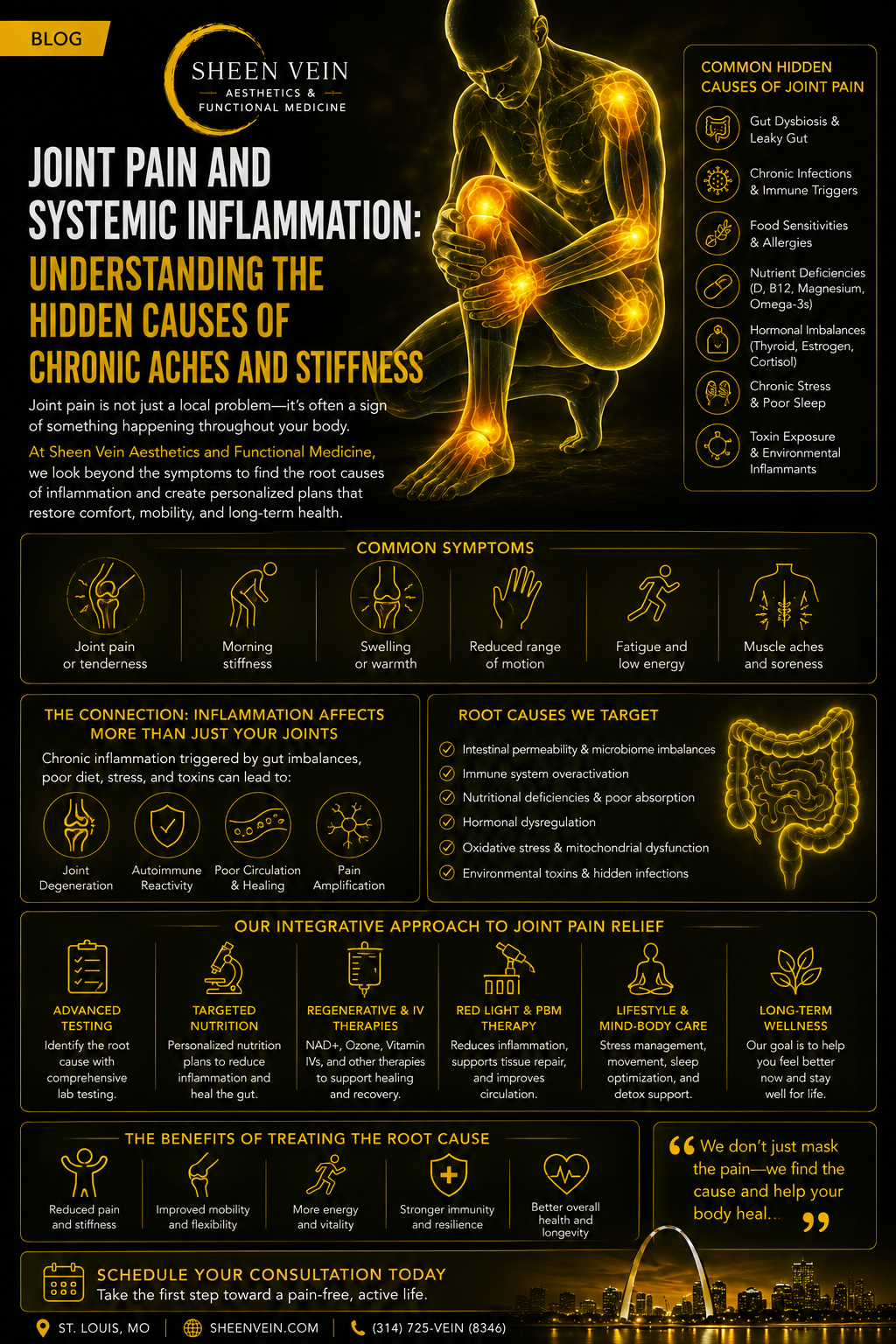
Joint Pain and Systemic Inflammation: Looking Beyond the Joint
Joint pain is one of the most common reasons adults seek medical care. Whether it's aching knees after climbing stairs, stiff hands in the morning, sore shoulders, or painful hips that make walking difficult, chronic joint pain can significantly affect quality of life.
Many people assume that joint pain is simply an unavoidable part of getting older. While age-related wear and tear certainly plays a role, modern research has shown that systemic inflammation often contributes to joint pain, stiffness, and slower healing. In many cases, the painful joint is only one part of a much larger picture involving metabolism, immune function, nutrition, body composition, sleep, and overall health.
Inflammation is a normal and necessary part of the body's healing response. However, when inflammation becomes chronic and persists throughout the body, it can contribute to cartilage breakdown, tendon degeneration, muscle soreness, and worsening symptoms in many orthopedic and rheumatologic conditions.
At Sheen Vein & Aesthetics in St. Louis, we believe successful treatment begins by identifying the underlying contributors to chronic inflammation while combining evidence-based medical care with functional medicine principles and regenerative therapies when appropriate.
What Is Systemic Inflammation?
Inflammation is the body's natural defense mechanism.
When you cut your finger or sprain your ankle, inflammation helps:
- Remove damaged tissue
- Fight infection
- Recruit immune cells
- Begin the healing process
This short-term inflammatory response is healthy and essential.
Systemic inflammation, however, is different.
Instead of remaining localized and temporary, low-grade inflammation persists throughout the body for months or even years. Although it may not produce obvious symptoms initially, chronic inflammation can gradually contribute to a wide range of medical conditions, including cardiovascular disease, insulin resistance, obesity, fatty liver disease, autoimmune disorders, and chronic musculoskeletal pain.
Acute vs. Chronic Inflammation
Understanding the difference between acute and chronic inflammation is important.
Acute Inflammation
Acute inflammation is:
- Short-lived
- Protective
- Necessary for healing
- Triggered by injury or infection
Examples include:
- A sprained ankle
- A cut
- Pneumonia
- A broken bone
Chronic Inflammation
Chronic inflammation is:
- Persistent
- Low grade
- Often driven by multiple factors
- Potentially harmful over time
Contributors may include:
- Obesity
- Smoking
- Poor diet
- Physical inactivity
- Chronic stress
- Sleep deprivation
- Autoimmune disease
- Metabolic dysfunction
Rather than helping tissues heal, chronic inflammation may interfere with normal repair and contribute to ongoing pain.
How Does Systemic Inflammation Affect the Joints?
Healthy joints rely on a delicate balance between tissue breakdown and tissue repair.
Chronic inflammation disrupts this balance.
Inflammatory molecules called cytokines can increase the activity of enzymes that break down cartilage while slowing the body's ability to rebuild healthy tissue.
Over time this may contribute to:
- Cartilage degeneration
- Tendon injury
- Ligament weakness
- Joint stiffness
- Pain
- Reduced mobility
Inflammation also sensitizes nerves, making painful joints feel even more uncomfortable.
Osteoarthritis Is More Than "Wear and Tear"
For many years osteoarthritis was considered a simple consequence of aging and mechanical wear.
We now know the story is much more complex.
While joint mechanics certainly matter, osteoarthritis also involves:
- Chronic inflammation
- Low-grade immune activation
- Cartilage breakdown
- Bone remodeling
- Changes in the joint lining (synovium)
Inflammatory cytokines such as interleukin-1 (IL-1) and tumor necrosis factor-alpha (TNF-α) contribute to progressive cartilage damage.
This explains why some individuals with similar X-rays have dramatically different pain levels.
Rheumatoid Arthritis: When the Immune System Attacks the Joints
Unlike osteoarthritis, rheumatoid arthritis (RA) is an autoimmune disease.
The immune system mistakenly attacks the lining of the joints, leading to:
- Swelling
- Warmth
- Pain
- Morning stiffness
- Joint destruction over time
RA highlights how inflammation itself can become the primary driver of joint damage.
Early diagnosis and treatment are essential to prevent irreversible injury.
Tendon Pain and Chronic Inflammation
Many people experience:
- Tennis elbow
- Golfer's elbow
- Achilles tendinopathy
- Rotator cuff pain
- Patellar tendinopathy
Although these injuries often begin with repetitive stress, chronic inflammation and poor healing frequently prevent complete recovery.
Modern research suggests that many chronic tendon problems involve failed healing and collagen degeneration rather than inflammation alone.
This is one reason regenerative therapies have become increasingly popular for chronic tendon injuries.
Obesity and Joint Pain
Body weight affects joints in two important ways.
Mechanical Stress
Every extra pound increases force across weight-bearing joints.
For example, each step places several times your body weight across the knees.
Even modest weight loss may significantly reduce joint loading.
Inflammatory Fat Tissue
Fat tissue is not simply stored energy.
It acts as an active endocrine organ that releases inflammatory chemicals known as adipokines.
These molecules can increase systemic inflammation and may worsen joint pain even in joints that do not bear weight, such as the hands.
This helps explain why obesity is associated with both osteoarthritis and increased pain sensitivity.
Insulin Resistance and Joint Health
Insulin resistance affects far more than blood sugar.
Chronically elevated insulin levels are associated with:
- Increased inflammation
- Oxidative stress
- Impaired tissue repair
- Poor circulation
- Metabolic dysfunction
Emerging research suggests insulin resistance may accelerate cartilage degeneration and contribute to chronic musculoskeletal pain.
Improving metabolic health may therefore benefit both overall health and joint function.
The Gut-Joint Connection
Scientists are increasingly studying the relationship between the gut microbiome and joint health.
The gut contains trillions of microorganisms that influence immune regulation throughout the body.
Alterations in the gut microbiome, known as dysbiosis, may contribute to chronic inflammation and immune dysfunction.
Although research is ongoing, gut health has been linked to several inflammatory joint diseases, including:
- Rheumatoid arthritis
- Psoriatic arthritis
- Ankylosing spondylitis
A healthy microbiome may help support balanced immune responses and reduce inflammatory signaling.
Autoimmune Diseases and Joint Pain
Joint pain is common in many autoimmune disorders, including:
- Lupus
- Psoriatic arthritis
- Ankylosing spondylitis
- Sjögren's syndrome
- Mixed connective tissue disease
These conditions require comprehensive evaluation and often involve collaboration with a rheumatologist.
Sleep and Inflammation
Poor sleep increases inflammatory signaling throughout the body.
Sleep deprivation has been associated with:
- Higher CRP levels
- Increased pain sensitivity
- Reduced tissue repair
- Greater fatigue
- Slower recovery from injury
Improving sleep quality is often an overlooked but important component of chronic pain management.
Chronic Stress and Pain
Stress affects nearly every organ system.
Long-term stress raises cortisol and other stress hormones, which may contribute to:
- Muscle tension
- Increased inflammation
- Poor sleep
- Heightened pain perception
Stress management is an important part of a comprehensive approach to chronic joint pain.
Nutrition and Inflammation
Diet influences inflammation in numerous ways.
Foods generally associated with healthier inflammatory balance include:
- Vegetables
- Fruits
- Legumes
- Fatty fish
- Olive oil
- Nuts
- Seeds
- Whole grains
These foods provide:
- Fiber
- Antioxidants
- Polyphenols
- Omega-3 fatty acids
Conversely, diets consistently high in ultra-processed foods, refined sugars, and excess saturated fats have been associated with increased inflammatory markers.
No single food causes or cures arthritis, but long-term dietary patterns matter.
The Importance of Muscle
Strong muscles protect joints.
Resistance training helps:
- Improve stability
- Reduce joint loading
- Improve insulin sensitivity
- Reduce inflammation
- Improve balance
- Maintain mobility
Even patients with arthritis often benefit from appropriately supervised strength training.
Physical Activity Helps Reduce Inflammation
Although painful joints often discourage exercise, appropriate movement remains one of the most effective therapies.
Regular activity:
- Lubricates joints
- Improves circulation
- Strengthens muscles
- Supports weight management
- Improves mood
- Reduces inflammatory markers
Low-impact activities such as walking, swimming, cycling, and resistance training are excellent options for many patients.
Regenerative Medicine for Chronic Joint Pain
Some patients continue to experience pain despite conservative treatments.
Depending on the diagnosis, regenerative medicine may be considered.
Platelet-Rich Plasma (PRP)
PRP uses a concentrated sample of the patient's own platelets, which contain numerous growth factors involved in tissue repair.
PRP has been studied for:
- Knee osteoarthritis
- Tennis elbow
- Rotator cuff tendinopathy
- Achilles tendinopathy
- Plantar fasciitis
The goal is to support the body's natural healing response rather than simply masking pain.
Platelet-Rich Fibrin (PRF)
PRF is a newer generation of platelet concentrate that forms a fibrin scaffold capable of slowly releasing growth factors over time.
This prolonged release may support tissue healing in selected patients.
Photobiomodulation (PBM) / Red Light Therapy
Photobiomodulation (PBM), also known as red light therapy, uses specific wavelengths of red and near-infrared light to stimulate cellular function.
Unlike surgical lasers, PBM does not damage tissue.
Instead, light energy is absorbed by mitochondria, where it may:
- Increase ATP production
- Improve circulation
- Reduce oxidative stress
- Support collagen synthesis
- Modulate inflammation
- Promote tissue repair
Clinical studies have demonstrated benefits for certain musculoskeletal conditions, including osteoarthritis, tendon injuries, muscle soreness, and recovery following exercise. While PBM is not a cure for arthritis, it may help reduce pain and improve function as part of a comprehensive treatment plan.
Weight Management
Even a 5–10% reduction in body weight may significantly improve:
- Knee pain
- Mobility
- Blood sugar
- Blood pressure
- Inflammatory markers
Healthy weight loss reduces both mechanical stress and systemic inflammation.
Frequently Asked Questions
Can inflammation cause joint pain?
Yes. Chronic inflammation can increase pain sensitivity, contribute to cartilage breakdown, and interfere with normal tissue repair. While inflammation is not the only cause of joint pain, it is an important factor in many conditions.
Is all joint pain arthritis?
No. Joint pain may result from tendon injuries, bursitis, ligament injuries, autoimmune diseases, overuse, fractures, infections, or referred pain from nearby structures. A proper evaluation is necessary to determine the underlying cause.
Can diet reduce inflammation?
A balanced dietary pattern rich in vegetables, fruits, healthy fats, fiber, and minimally processed foods may help support healthy inflammatory balance. Diet should complement—not replace—appropriate medical treatment.
Does red light therapy work for joint pain?
Research suggests photobiomodulation may help reduce pain and improve function in certain musculoskeletal conditions by supporting mitochondrial function, improving circulation, and modulating inflammation. Results vary depending on the condition being treated.
When should I see a healthcare provider?
You should seek evaluation if joint pain persists for several weeks, is associated with swelling, redness, warmth, fever, significant stiffness, injury, or progressively limits your ability to perform daily activities.
Why Choose Sheen Vein & Aesthetics for Joint Pain and Functional Medicine in St. Louis?
At Sheen Vein & Aesthetics, we believe chronic joint pain should be evaluated as more than an isolated orthopedic problem. In many patients, underlying factors such as systemic inflammation, metabolic dysfunction, obesity, insulin resistance, nutritional deficiencies, poor sleep, and chronic stress may all contribute to persistent pain and delayed healing.
Our comprehensive approach combines functional medicine, lifestyle optimization, and advanced regenerative therapies when appropriate. Depending on your condition, treatment may include Photobiomodulation (PBM/Red Light Therapy), Platelet-Rich Plasma (PRP), Platelet-Rich Fibrin (PRF), nutritional counseling, weight optimization, and personalized strategies to reduce inflammation and support your body's natural healing processes.
Rather than simply masking symptoms, our goal is to identify and address the factors contributing to chronic pain while helping you improve mobility, function, and overall quality of life.
Every patient receives an individualized treatment plan because no two people experience joint pain in exactly the same way.
Schedule Your Joint Pain Consultation Today
If chronic joint pain is limiting your ability to work, exercise, or enjoy everyday activities, don't assume it's simply part of getting older.
At Sheen Vein & Aesthetics, we're committed to helping patients throughout the St. Louis area better understand the relationship between inflammation, metabolism, and musculoskeletal health. Through personalized evaluations and evidence-based treatment options, we work to reduce pain, improve function, and support long-term wellness.
Whether your symptoms stem from osteoarthritis, tendon injuries, chronic inflammation, or multiple contributing factors, our team is here to help you develop a treatment plan tailored to your unique needs.