Low Back Pain Treatment in St. Louis: Traditional Medicine vs. Regenerative, Functional, and Red Light Therapy Options
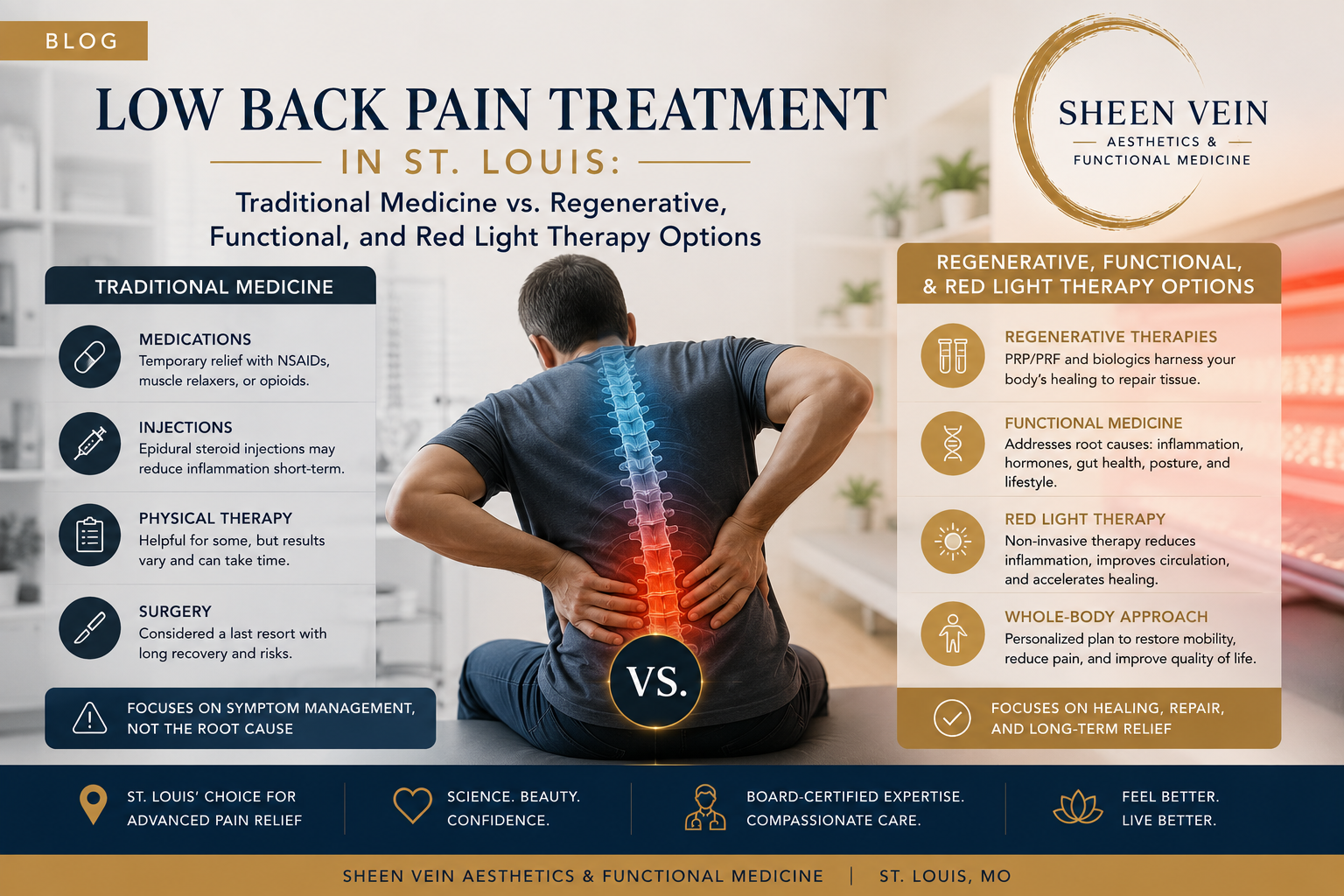
Low Back Pain Treatment Options: Traditional Medicine Compared With the Comprehensive Approach at Sheen Vein Aesthetics and Functional Medicine
Low back pain is one of the most common medical problems in the United States. It can begin after lifting something heavy, twisting incorrectly, sitting for long periods, playing sports, or experiencing an accident. In many patients, however, the pain develops gradually without one obvious injury.
For some people, low back pain improves after a few days of rest and gentle movement. For others, it becomes a persistent problem that affects sleep, work, exercise, travel, family life, and emotional well-being.
Patients with chronic back pain often feel trapped in a cycle. They may receive anti-inflammatory medications, muscle relaxers, steroid injections, physical therapy, or repeated imaging, yet the pain continues to return. Some are eventually told that surgery is the only remaining option, while others are told that their MRI findings are not severe enough to explain their symptoms.
The reality is that low back pain is rarely caused by one simple problem. It may involve discs, joints, muscles, ligaments, nerves, inflammation, posture, body composition, circulation, metabolic health, sleep, and the way the nervous system processes pain.
At Sheen Vein Aesthetics and Functional Medicine, we approach low back pain differently. Rather than focusing only on suppressing pain, we evaluate the underlying factors that may be preventing recovery. Depending on the diagnosis, our treatment plans may incorporate photobiomodulation, red and near-infrared light therapy, pulsed electromagnetic field therapy, PRP, PRF, functional medicine, nutritional support, metabolic optimization, and lifestyle strategies.
Traditional medicine remains extremely important, especially when serious disease, nerve compression, fracture, infection, or instability is present. Our goal is not to replace conventional care. It is to offer additional options for patients who want a more comprehensive and restorative approach.
Why Low Back Pain Is So Common
The lower back carries a tremendous mechanical burden.
It supports much of the body’s weight while allowing bending, rotation, extension, lifting, and walking. The lumbar spine also protects nerve structures that travel into the pelvis and legs.
The lower back includes:
- Vertebrae
- Intervertebral discs
- Facet joints
- Ligaments
- Muscles
- Tendons
- Nerves
- Connective tissue
- Fascia
Pain can begin when any one of these structures becomes irritated, injured, inflamed, weakened, or overloaded.
Common causes include:
- Muscle strain
- Ligament sprain
- Degenerative disc disease
- Facet joint arthritis
- Herniated or bulging discs
- Spinal stenosis
- Sacroiliac joint dysfunction
- Poor posture
- Core weakness
- Obesity
- Sedentary behavior
- Previous surgery
- Repetitive lifting
- Nerve irritation
In many patients, several of these factors occur together.
Acute Low Back Pain vs. Chronic Low Back Pain
Low back pain is often classified by duration.
Acute Low Back Pain
Acute pain generally lasts less than four weeks.
It may follow:
- Lifting
- Twisting
- Sports activity
- Falls
- Sudden muscle strain
- Minor disc irritation
Most acute episodes improve with conservative treatment.
Subacute Low Back Pain
Subacute pain lasts approximately four to twelve weeks.
This is an important stage because unresolved inflammation, weakness, poor movement patterns, and fear of activity may begin contributing to chronic pain.
Chronic Low Back Pain
Chronic back pain lasts longer than twelve weeks.
At this stage, the problem may involve more than the original injury. Chronic inflammation, deconditioning, altered nerve signaling, poor sleep, depression, metabolic dysfunction, scar tissue, and persistent muscle guarding may all influence symptoms.
How Traditional Medicine Usually Treats Low Back Pain
Traditional medical care typically follows a stepwise approach.
This approach is appropriate for many patients and helps identify serious problems that require urgent care. However, treatment may sometimes focus more heavily on symptom control than on tissue recovery or whole-body contributors.
Medications
Common medications include:
- Acetaminophen
- Nonsteroidal anti-inflammatory drugs
- Muscle relaxers
- Oral corticosteroids
- Nerve-pain medications
- Opioids in selected cases
These medications can reduce pain and help patients remain active, but they usually do not correct the structural, metabolic, or biomechanical cause of the problem.
Anti-Inflammatory Medications
NSAIDs such as ibuprofen or naproxen are commonly recommended.
They may help reduce pain and inflammation during acute episodes. However, prolonged use may increase the risk of:
- Stomach irritation
- Ulcers
- Kidney problems
- Fluid retention
- Elevated blood pressure
- Cardiovascular complications in susceptible patients
They can be useful tools, but they are not ideal long-term solutions for everyone.
Muscle Relaxers
Muscle relaxers may help when severe muscle spasm is present.
Possible side effects include:
- Drowsiness
- Dizziness
- Poor coordination
- Mental slowing
These medications generally provide temporary relief rather than repairing injured tissue.
Opioid Medications
Opioids may be appropriate for severe acute pain or selected surgical situations.
For chronic non-cancer back pain, however, long-term opioid use carries risks including:
- Dependence
- Tolerance
- Constipation
- Sedation
- Hormonal disruption
- Overdose
Most guidelines now emphasize non-opioid strategies whenever possible.
Physical Therapy
Physical therapy is one of the most valuable traditional treatments for low back pain.
A well-designed program may include:
- Core strengthening
- Hip strengthening
- Mobility exercises
- Posture correction
- Manual therapy
- Gait training
- Movement retraining
- Gradual return to activity
Physical therapy is especially effective when the program is individualized and the patient participates consistently.
However, some patients struggle to progress because pain, inflammation, joint degeneration, poor sleep, obesity, or tissue injury prevents them from exercising effectively. In these cases, regenerative or energy-based treatments may help create a better environment for rehabilitation.
Chiropractic Care and Manual Therapy
Spinal manipulation may provide short-term relief for certain patients with mechanical low back pain.
It is not appropriate for every condition, particularly when there is:
- Severe osteoporosis
- Fracture
- Spinal instability
- Progressive neurological weakness
- Certain inflammatory conditions
- Suspected cancer or infection
Manual treatment should be based on an accurate diagnosis.
Steroid Injections
Epidural steroid injections may be used when nerve irritation causes:
- Sciatica
- Radiating leg pain
- Numbness
- Tingling
- Disc-related inflammation
Facet joint or sacroiliac joint injections may also help identify and temporarily treat specific pain generators.
Steroids can provide meaningful relief in selected patients, but the results may be temporary. Repeated exposure can also affect blood sugar, bone health, immune function, and tissue quality.
Steroid injections are best viewed as one possible tool rather than a complete long-term strategy.
Nerve Ablation Procedures
Radiofrequency ablation may be used for pain arising from certain facet joints.
The procedure uses heat to interrupt pain signals from selected nerves.
This can provide months of relief in appropriately selected patients. However, it reduces pain signaling rather than reversing the underlying arthritis or improving tissue health.
Surgery
Surgery may be necessary when there is:
- Progressive muscle weakness
- Severe nerve compression
- Spinal instability
- Certain fractures
- Cauda equina syndrome
- Severe spinal stenosis
- Persistent disabling pain from a clearly correctable structural problem
Common procedures include:
- Discectomy
- Laminectomy
- Spinal fusion
- Artificial disc replacement
Surgery can be life-changing when the diagnosis and procedure are well matched.
However, not every patient with back pain needs surgery, and imaging abnormalities do not always identify the true pain source. Recovery may be lengthy, and pain can persist even after technically successful surgery.
Imaging Does Not Always Explain Pain
MRI and X-ray findings are important, but they must be interpreted in the context of symptoms and examination.
Many adults without pain have:
- Bulging discs
- Degenerative changes
- Facet arthritis
- Disc dehydration
- Mild spinal narrowing
Conversely, some patients experience severe pain despite relatively mild imaging abnormalities.
This is why treating the scan rather than the patient can be misleading.
The Sheen Vein Aesthetics and Functional Medicine Approach
At Sheen Vein Aesthetics and Functional Medicine, we view low back pain as a potentially multifactorial problem.
The painful structure matters, but so do the conditions surrounding that structure.
We may consider:
- Inflammation
- Mitochondrial function
- Muscle strength
- Circulation
- Sleep
- Body composition
- Insulin resistance
- Nutritional deficiencies
- Hormonal status
- Previous injury
- Scar tissue
- Recovery capacity
- Stress
- Activity level
Our goal is to support healing, improve function, and reduce the factors that keep pain recurring.
Photobiomodulation and Red Light Therapy
Photobiomodulation, often called PBM or red light therapy, uses specific wavelengths of red and near-infrared light to influence cellular activity.
Unlike surgical lasers, PBM does not cut, burn, or remove tissue.
Red and near-infrared light can penetrate tissue and interact with mitochondria, the structures inside cells responsible for producing energy.
This interaction may support:
- ATP production
- Circulation
- Cellular repair
- Inflammatory regulation
- Muscle recovery
- Collagen production
- Nerve function
For patients with low back pain, PBM may be used to address muscular pain, joint discomfort, inflammation, tissue recovery, and chronic soreness.
How PBM May Help Low Back Pain
PBM may support patients with low back discomfort through several potential mechanisms.
Improved Cellular Energy
Healing requires energy.
When mitochondria function more efficiently, cells may have more energy available for tissue repair and recovery.
Modulation of Inflammation
PBM does not simply suppress all inflammation. Instead, it may help regulate an excessive inflammatory response while supporting normal healing.
Improved Circulation
Better microcirculation may improve oxygen and nutrient delivery to injured tissues.
Reduced Muscle Spasm
Light therapy may help relax painful muscles and support recovery after strain or overuse.
Support for Nerve Health
Near-infrared light is being studied for its effects on nerve function and neuropathic pain.
PBM is not a replacement for emergency evaluation, surgery, or treatment of severe nerve compression. It may, however, be a valuable non-invasive part of a broader low back pain plan.
Full-Body Red Light Therapy Bed
Our red light therapy bed allows a broader portion of the body to receive red and near-infrared light during one session.
This can be especially helpful when low back pain occurs alongside:
- Hip discomfort
- Muscle tightness
- Generalized inflammation
- Arthritis
- Poor exercise recovery
- Chronic fatigue
Rather than focusing only on a single painful spot, whole-body treatment may support systemic recovery and overall wellness.
The phrase Red Light Therapy Bed should be internally linked to the corresponding service page on the Sheen Vein Aesthetics and Functional Medicine website.
Pulsed Electromagnetic Field Therapy
Pulsed electromagnetic field therapy, commonly called PEMF, uses low-frequency electromagnetic fields to influence cellular and tissue activity.
PEMF is used in some rehabilitation and wellness settings to support:
- Circulation
- Recovery
- Muscle relaxation
- Bone and tissue health
- Pain management
At our practice, PEMF may be combined with red light therapy for selected patients.
This combination is designed to provide a non-invasive treatment experience that supports cellular energy, circulation, and recovery from multiple directions.
PRP for Low Back Pain
Platelet-rich plasma is prepared from the patient’s own blood.
After processing, the platelet concentrate may be injected into selected structures to deliver growth factors and signaling proteins involved in tissue repair.
Depending on the diagnosis and physician assessment, PRP may be considered for:
- Sacroiliac joint pain
- Ligament injury
- Tendon attachment pain
- Facet-related pain
- Selected muscular or connective-tissue injuries
PRP is not appropriate for every cause of back pain. It cannot reverse severe spinal stenosis, correct major instability, or eliminate every type of disc disease.
Its value is greatest when the pain generator is carefully identified and the patient is an appropriate candidate.
PRF for Regenerative Support
Platelet-rich fibrin is also produced from the patient’s own blood.
PRF contains platelets within a fibrin matrix that may provide a slower release of regenerative signaling molecules.
Depending on the treatment area, PRF may be considered when prolonged biological support is desired.
The decision between PRP and PRF depends on:
- The target tissue
- The diagnosis
- The desired handling characteristics
- The patient’s medical history
- The treatment plan
We do not assume one preparation is better in every situation.
Functional Medicine and Chronic Back Pain
Chronic pain can be worsened by internal health factors that are rarely addressed during a routine orthopedic visit.
Our functional medicine approach may consider whether the following are interfering with recovery:
- Insulin resistance
- Obesity
- Chronic inflammation
- Vitamin D deficiency
- Magnesium deficiency
- Poor protein intake
- Hormonal imbalance
- Gut dysbiosis
- Sleep apnea
- Chronic stress
- Mitochondrial dysfunction
Addressing these factors may not eliminate a herniated disc or severe arthritis, but it can improve the body’s ability to recover, strengthen, and tolerate activity.
Metabolic Health and Low Back Pain
Metabolic health is closely connected to musculoskeletal health.
Insulin resistance and excess body fat may contribute to:
- Chronic inflammation
- Poor circulation
- Reduced tissue repair
- Greater joint loading
- Muscle weakness
- Increased pain sensitivity
Fat tissue is biologically active and releases inflammatory signals.
This means excess weight affects the spine not only mechanically but also metabolically.
A patient may benefit from strengthening and physical therapy, but if insulin resistance, poor sleep, and chronic inflammation remain unaddressed, progress may be slower.
Weight Management
Weight loss is not the answer to every case of low back pain, and patients should never be shamed for their symptoms.
However, reducing excess body weight may decrease mechanical stress on the lumbar spine and improve:
- Mobility
- Blood sugar regulation
- Inflammation
- Sleep
- Exercise tolerance
- Overall energy
Even modest changes in body composition may support better function.
Nutrition and Tissue Healing
Muscles, tendons, ligaments, discs, and connective tissue require adequate nutrition.
Important nutrients include:
- Protein
- Vitamin C
- Vitamin D
- Magnesium
- Zinc
- Copper
- Omega-3 fatty acids
- B vitamins
Deficiencies do not cause every case of back pain, but inadequate nutrition may interfere with recovery.
A functional medicine evaluation may help identify nutritional gaps when clinically appropriate.
Sleep and Pain Sensitivity
Poor sleep can amplify pain.
Sleep deprivation may:
- Increase inflammatory cytokines
- Reduce tissue repair
- Increase muscle tension
- Lower pain tolerance
- Worsen fatigue
- Impair exercise recovery
Patients with sleep apnea may be particularly vulnerable because repeated nighttime oxygen drops can worsen metabolic dysfunction and systemic inflammation.
Improving sleep is often one of the most underappreciated parts of chronic pain care.
Stress and the Nervous System
Chronic pain is real, but its intensity is influenced by the nervous system.
Long-term stress can lead to:
- Muscle guarding
- Elevated cortisol
- Poor sleep
- Increased pain sensitivity
- Reduced recovery
- Fear of movement
This does not mean the pain is “all in your head.”
It means the brain, spinal cord, muscles, hormones, and immune system all interact.
A comprehensive approach should address both the painful tissue and the nervous system environment surrounding it.
Combining Traditional and Regenerative Care
The best treatment plan is often not traditional medicine or regenerative medicine alone.
It may involve a combination such as:
- Appropriate imaging
- Physical therapy
- Red light therapy
- PEMF
- Strength training
- Weight optimization
- PRP or PRF when indicated
- Sleep improvement
- Nutritional support
- Specialist referral when necessary
For example, a patient may use PBM to reduce pain enough to participate more effectively in physical therapy. Another patient may receive PRP for a selected ligament injury while improving metabolic health and core strength.
The treatment plan should match the diagnosis.
Who May Benefit From Our Approach?
Patients may consider an evaluation at Sheen Vein Aesthetics and Functional Medicine if they have:
- Persistent low back pain
- Recurrent muscle strain
- Chronic stiffness
- Sacroiliac discomfort
- Arthritis-related pain
- Poor recovery after exercise
- Pain despite physical therapy
- A desire to reduce reliance on medication
- Chronic inflammation
- Metabolic risk factors
- Interest in non-invasive treatment options
Our approach is not a replacement for emergency or surgical evaluation when those are needed.
When Low Back Pain Requires Urgent Medical Attention
Seek prompt medical care if back pain occurs with:
- New loss of bladder or bowel control
- Numbness in the groin or saddle area
- Progressive leg weakness
- Severe trauma
- Fever
- Unexplained weight loss
- History of cancer
- Severe osteoporosis
- Constant night pain
- Suspected infection
- Inability to walk
These symptoms may indicate a serious condition requiring urgent evaluation.
Frequently Asked Questions
Is red light therapy effective for low back pain?
Photobiomodulation has been studied for several musculoskeletal pain conditions. It may help support cellular energy, circulation, inflammatory balance, and recovery. Results vary depending on the cause of pain and the treatment protocol.
Can PRP repair a herniated disc?
PRP is being studied for disc-related pain, but it is not a guaranteed repair for a herniated disc and is not appropriate for every patient. The location and source of pain must be carefully evaluated.
Is PBM the same as heat therapy?
No. Although some patients feel warmth during treatment, photobiomodulation works through interactions between light and cellular structures rather than simply heating the tissue.
Can red light therapy replace physical therapy?
Usually not. PBM may support pain reduction and recovery, but strengthening, mobility, posture, and movement retraining remain essential for many patients.
Can regenerative medicine prevent surgery?
Sometimes regenerative and conservative care may help a patient avoid or delay surgery, but not every spinal condition can be treated without an operation. Severe instability or progressive neurological compromise may still require surgical intervention.
How many treatments are needed?
The number of sessions depends on the diagnosis, severity, duration of symptoms, and treatment method. PBM may be performed as a series, while PRP or PRF protocols are individualized.
Is this covered by insurance?
Coverage varies. Many regenerative and wellness therapies are considered self-pay. Patients should review treatment costs and insurance benefits before proceeding.
Why Choose Sheen Vein Aesthetics and Functional Medicine for Low Back Pain Treatment in St. Louis?
At Sheen Vein Aesthetics and Functional Medicine, we understand how discouraging chronic low back pain can be.
Patients often arrive after trying medications, injections, physical therapy, chiropractic care, or even surgery. Many have been told to simply live with their pain.
We believe patients deserve a more complete evaluation.
Our physician-led approach considers the painful structure as well as the factors that influence healing and pain sensitivity.
Depending on your diagnosis and goals, your individualized plan may include:
- Photobiomodulation
- Red and near-infrared light therapy
- Full-body red light therapy
- PEMF
- PRP
- PRF
- Functional medicine
- Nutritional optimization
- Metabolic health strategies
- Weight management
- Exercise and recovery guidance
Our goal is not to promise a cure or criticize conventional medicine.
Our goal is to expand the treatment conversation and help patients explore evidence-informed options that may improve comfort, mobility, recovery, and quality of life.
Schedule a Low Back Pain Consultation in St. Louis
If low back pain is interfering with your sleep, work, exercise, or daily activities, it may be time to look beyond temporary symptom relief.
At Sheen Vein Aesthetics and Functional Medicine, we offer a comprehensive approach designed to identify the factors contributing to your pain and create a personalized treatment strategy.
Whether your plan includes photobiomodulation, red light therapy, PEMF, PRP, PRF, functional medicine, lifestyle optimization, or collaboration with another medical specialist, our focus is helping you move with less pain and greater confidence.
Contact Sheen Vein Aesthetics and Functional Medicine to schedule a consultation and learn which low back pain treatment options may be appropriate for you.