Neck Pain Treatment in St. Louis: Causes, Traditional Medical Care, and Regenerative Treatment Options
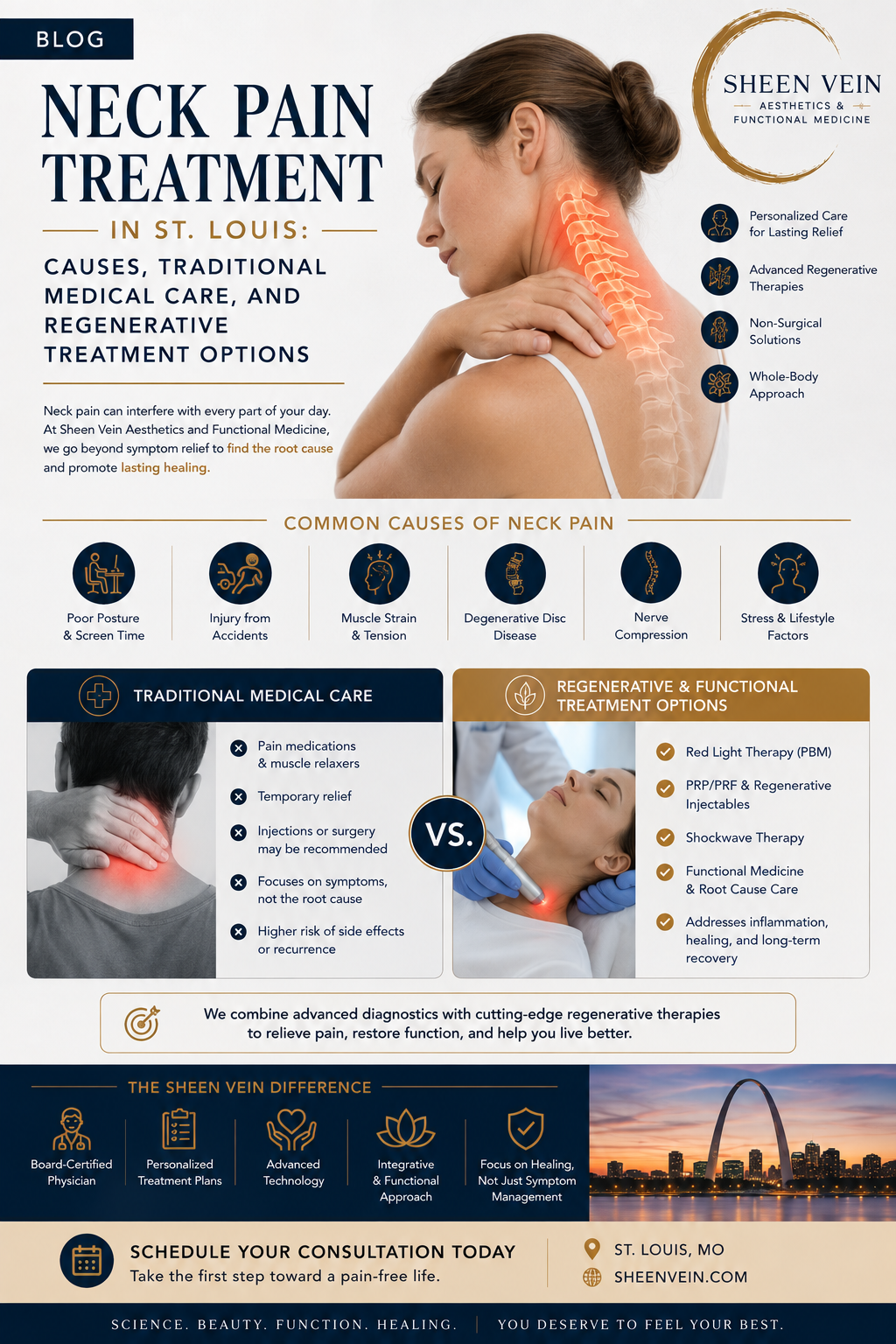
Neck Pain: Common Causes and Traditional Treatment Options Compared With the Comprehensive Approach at Sheen Vein Aesthetics and Functional Medicine
Neck pain can make nearly every part of the day more difficult. Turning your head while driving may hurt. Working at a computer can become uncomfortable. Sleep may be interrupted because no pillow position feels right. In some cases, pain travels into the shoulder, arm, or hand and is accompanied by numbness, tingling, weakness, or headaches.
Many patients initially assume their symptoms are caused by sleeping incorrectly or spending too much time looking at a phone. While posture and muscular strain are common contributors, neck pain may also arise from arthritis, disc degeneration, nerve compression, injury, inflammation, stress, or several problems occurring together.
The cervical spine is an especially complex area. It must support the head while allowing a wide range of movement and protecting the spinal cord and nerves. The neck contains seven cervical vertebrae, intervertebral discs, facet joints, muscles, tendons, ligaments, nerves, and blood vessels. Pain can develop when any of these structures becomes irritated, overloaded, injured, or degenerative.
Traditional medicine offers valuable treatments including medications, physical therapy, spinal injections, and surgery when necessary. However, some patients continue to experience pain despite these approaches or want to explore less invasive options that support tissue recovery rather than relying solely on temporary symptom control.
At Sheen Vein Aesthetics and Functional Medicine, we take a broader approach. Depending on the diagnosis, we may incorporate photobiomodulation, red and near-infrared light therapy, pulsed electromagnetic field therapy, PRP, PRF, functional medicine, nutritional optimization, metabolic support, and lifestyle strategies.
These treatments do not replace emergency care, physical therapy, orthopedic evaluation, or surgery when those are medically necessary. Instead, they expand the range of options available to appropriately selected patients.
Why Is the Neck So Vulnerable to Pain?
The average adult head weighs approximately 10 to 13 pounds. The cervical spine must hold that weight upright throughout the day while allowing the head to rotate, tilt, bend, and extend.
When the head remains centered over the shoulders, its weight is distributed more efficiently. When it repeatedly moves forward—as commonly happens while using phones, laptops, or poorly positioned computer monitors—the muscles and connective tissues of the neck must work harder.
Over time, this may contribute to:
- Muscle fatigue
- Tightness
- Trigger points
- Headaches
- Shoulder discomfort
- Reduced range of motion
- Chronic stiffness
Posture is not the only cause of neck pain, but it can amplify other problems such as arthritis, disc degeneration, or muscle weakness.
Common Causes of Neck Pain
Neck pain is a symptom, not a diagnosis.
Understanding the cause is important because muscular pain, nerve compression, arthritis, and spinal cord problems require different treatment strategies.
Muscle Strain and Ligament Sprain
Muscle strains and ligament sprains are among the most common causes of neck pain. They may develop after:
- Sudden twisting
- Lifting
- Sports activity
- A motor vehicle accident
- Poor sleeping position
- Prolonged desk work
- Repetitive phone or tablet use
- Emotional stress and muscle tension
Symptoms often include soreness, stiffness, muscle spasm, and pain with movement. Most uncomplicated sprains and strains improve with conservative treatment, although persistent symptoms deserve further evaluation.
Poor Posture and “Tech Neck”
Many people spend hours each day with the head angled downward toward a phone or pushed forward toward a computer screen.
This prolonged position can overload the muscles of the neck, upper back, and shoulders. It may also contribute to shortened chest muscles, weakened postural muscles, and chronic tension around the base of the skull.
Helpful ergonomic changes may include:
- Raising monitors to eye level
- Supporting the forearms
- Taking movement breaks
- Avoiding prolonged downward phone viewing
- Keeping the ears aligned over the shoulders
- Strengthening the upper back and deep neck muscles
Good posture does not require sitting rigidly all day. Frequent movement is usually more important than trying to hold one “perfect” position indefinitely.
Cervical Spondylosis
Cervical spondylosis is age-related degeneration involving the discs and joints of the neck.
Over time, discs may lose water content and height. Facet joints may develop arthritis, and bone spurs may form.
Possible symptoms include:
- Neck stiffness
- Aching
- Reduced mobility
- Headaches
- Shoulder discomfort
- Grinding or popping sensations
- Nerve-related symptoms when narrowing affects a nerve
Most cases are initially treated conservatively with medication, activity modification, and physical therapy.
Herniated or Bulging Cervical Disc
The discs between the vertebrae act as cushions and allow movement.
A disc may bulge or herniate after injury or as part of the degenerative process. If disc material irritates a nearby nerve, pain may radiate into the shoulder, arm, hand, or fingers.
A disc abnormality on MRI does not always mean it is causing symptoms. Imaging must be interpreted together with the medical history and physical examination.
Cervical Radiculopathy
Cervical radiculopathy occurs when a nerve root in the neck becomes compressed or inflamed.
Symptoms may include:
- Neck pain
- Shoulder-blade pain
- Burning arm pain
- Tingling
- Numbness
- Hand symptoms
- Muscle weakness
Initial treatment is often nonsurgical and may include physical therapy, medication, activity modification, and selected use of a soft cervical collar. Surgery may be considered when significant nerve compression causes persistent pain or progressive weakness.
Facet Joint Arthritis
Facet joints are small joints located at the back of the spine.
When these joints become arthritic or inflamed, they may cause:
- Localized neck pain
- Pain with extension or rotation
- Headaches
- Pain into the upper shoulder
- Stiffness after inactivity
Facet pain may sometimes be treated with physical therapy, medication, injections, medial branch blocks, or radiofrequency ablation.
Whiplash
Whiplash commonly occurs after a motor vehicle collision when the neck rapidly moves backward and forward.
Symptoms may include:
- Neck pain
- Headaches
- Muscle spasm
- Shoulder pain
- Dizziness
- Difficulty concentrating
- Reduced range of motion
Although many patients improve with conservative care, some develop persistent symptoms involving muscles, ligaments, joints, discs, or the nervous system.
Stress-Related Muscle Tension
Stress does not make neck pain imaginary.
Mental and emotional stress can increase muscle tension, alter breathing patterns, interfere with sleep, and heighten pain sensitivity.
Many people hold tension in the upper trapezius, shoulders, jaw, and muscles at the base of the skull.
A comprehensive treatment plan may therefore need to address both the painful tissues and the nervous system environment surrounding them.
Headaches Originating From the Neck
Some headaches are influenced by cervical muscles, joints, posture, and nerve irritation.
Patients may experience pain that begins near the base of the skull and travels toward the temples, forehead, or behind the eyes.
Not every headache originates from the neck. Migraine, tension-type headache, medication effects, blood-pressure problems, infection, and neurological disorders should also be considered.
Spinal Stenosis and Cervical Myelopathy
Cervical spinal stenosis occurs when the spinal canal becomes narrowed.
If the spinal cord is compressed, the condition is called cervical myelopathy.
Symptoms may include:
- Hand clumsiness
- Difficulty buttoning clothes
- Problems with balance
- Walking changes
- Arm or leg weakness
- Numbness
- Loss of coordination
- Bowel or bladder changes in advanced cases
Spinal cord compression requires prompt medical evaluation. Physical therapy may help maintain strength and mobility in selected cases, but progressive neurological symptoms may require surgical decompression.
How Traditional Medicine Treats Neck Pain
Conventional treatment usually begins with the least invasive appropriate option and progresses depending on the diagnosis, severity, and response.
Pain-Relieving Medications
Common options include:
- Acetaminophen
- Ibuprofen
- Naproxen
- Prescription anti-inflammatory medication
- Topical pain relievers
- Muscle relaxers
- Nerve-pain medications
These medications can be useful, particularly during acute episodes.
However, they generally control symptoms rather than correcting weakness, posture, tissue degeneration, metabolic inflammation, or the underlying mechanical problem.
Long-term NSAID use may increase the risk of stomach irritation, ulcers, kidney problems, fluid retention, elevated blood pressure, and cardiovascular complications in susceptible patients.
Muscle Relaxers
Muscle relaxers may help during episodes of severe spasm.
Possible side effects include:
- Sleepiness
- Dizziness
- Reduced alertness
- Poor coordination
- Mental slowing
These medications may be helpful for short-term symptom relief but are rarely a complete solution for chronic neck pain.
Physical Therapy
Physical therapy is one of the most valuable treatments for mechanical neck pain.
A personalized program may include:
- Range-of-motion exercises
- Deep neck-flexor strengthening
- Shoulder-blade stabilization
- Posture training
- Manual therapy
- Nerve-gliding exercises
- Ergonomic education
- Gradual return to activity
Physical therapy can reduce pain, improve strength, and increase flexibility in many cervical conditions.
Some patients, however, find it difficult to participate fully because pain and inflammation limit exercise. In these cases, supportive treatments such as photobiomodulation may help create a better environment for rehabilitation.
Chiropractic Manipulation and Manual Treatment
Manual therapy may provide relief for selected patients with uncomplicated mechanical neck pain.
It is not appropriate for every condition.
High-velocity cervical manipulation may be unsuitable when a patient has:
- Severe osteoporosis
- Fracture
- Spinal instability
- Significant spinal cord compression
- Progressive neurological weakness
- Certain vascular risks
- Cancer or infection involving the spine
An accurate diagnosis should come before aggressive treatment.
Steroid Injections
Spinal injections may be considered when severe neck or arm pain has not responded to conservative treatment.
They may be used diagnostically to identify the pain source or therapeutically to reduce inflammation and pain.
Examples include:
- Cervical epidural steroid injections
- Facet joint injections
- Medial branch blocks
- Trigger-point injections
Steroids can provide valuable relief, particularly when nerve inflammation is present. However, the benefit may be temporary, and repeated exposure can affect blood sugar, bone health, immune function, and tissue quality.
Radiofrequency Ablation
Radiofrequency ablation may be used when carefully performed diagnostic blocks suggest that facet-joint nerves are contributing to the pain.
The procedure uses controlled heat to interrupt pain signaling.
It may provide months of relief in selected patients, but it does not rebuild damaged cartilage or reverse arthritis.
Cervical Spine Surgery
Surgery may be recommended when there is:
- Progressive arm or hand weakness
- Significant spinal cord compression
- Severe nerve compression
- Spinal instability
- Certain fractures
- Persistent disabling symptoms linked to a surgically correctable problem
Common procedures include:
- Anterior cervical discectomy and fusion
- Cervical disc replacement
- Laminectomy
- Laminoplasty
- Posterior cervical fusion
The goal of surgery for cervical radiculopathy is generally to decompress the affected nerve.
Surgery may be extremely effective when appropriately indicated, but it is not necessary for every patient with arthritis, disc degeneration, or a bulging disc.
The Sheen Vein Aesthetics and Functional Medicine Approach to Neck Pain
At Sheen Vein Aesthetics and Functional Medicine, we recognize that chronic neck pain often involves more than one factor.
The painful structure matters, but the patient’s ability to heal also matters.
Our evaluation may consider:
- Muscle and connective-tissue injury
- Joint degeneration
- Nerve symptoms
- Posture and ergonomics
- Chronic inflammation
- Sleep quality
- Metabolic health
- Insulin resistance
- Body composition
- Nutritional status
- Hormonal balance
- Stress
- Mitochondrial function
- Previous injuries or surgery
Depending on the diagnosis, treatment may combine several approaches rather than relying on one medication or procedure.
Photobiomodulation and Red Light Therapy
Photobiomodulation, commonly called PBM or red light therapy, uses selected wavelengths of red and near-infrared light to influence cellular activity.
Unlike surgical lasers, PBM does not cut, burn, or remove tissue.
Light energy interacts with structures inside cells, including mitochondria, which are responsible for producing cellular energy.
PBM may support:
- ATP production
- Tissue recovery
- Microcirculation
- Inflammatory regulation
- Muscle relaxation
- Collagen production
- Nerve health
For neck pain, photobiomodulation may be considered for muscular soreness, chronic stiffness, arthritis-related discomfort, soft-tissue injury, and recovery support.
It cannot remove severe spinal cord compression or correct instability, but it may help selected patients reduce pain and participate more effectively in exercise and rehabilitation.
How PBM May Help Chronic Neck Pain
Supporting Cellular Energy
Damaged and overworked tissues need energy to recover.
By supporting mitochondrial activity, PBM may provide cells with more energy for maintenance and repair.
Regulating Inflammation
Inflammation is necessary for healing, but excessive or prolonged inflammation may contribute to chronic pain.
PBM may help modulate inflammatory signaling rather than simply suppressing all inflammation.
Improving Microcirculation
Healthy circulation helps deliver oxygen and nutrients while removing metabolic waste products.
Improved local microcirculation may support recovery in chronically tight or irritated muscles.
Reducing Muscle Guarding
Persistent pain often causes the neck and shoulder muscles to tighten protectively.
This guarding may create a cycle of pain, restricted movement, and further muscle fatigue.
PBM may help reduce discomfort enough for the patient to move, stretch, and strengthen more comfortably.
Full-Body Red Light Therapy
Neck pain does not always occur in isolation.
Many patients also experience:
- Shoulder tightness
- Upper-back discomfort
- Headaches
- Generalized arthritis
- Chronic fatigue
- Poor exercise recovery
- Systemic inflammation
Our full-body red light therapy bed allows broader exposure to red and near-infrared light during one session.
This may be useful when the treatment goal includes both localized neck recovery and whole-body wellness support.
Pulsed Electromagnetic Field Therapy
Pulsed electromagnetic field therapy, or PEMF, uses low-frequency electromagnetic fields to influence cellular and tissue activity.
Depending on the patient, PEMF may be used to support:
- Circulation
- Muscle relaxation
- Recovery
- Tissue health
- Pain management
At Sheen Vein Aesthetics and Functional Medicine, PEMF may be paired with photobiomodulation as part of a non-invasive treatment plan.
PRP for Selected Neck Pain Conditions
Platelet-rich plasma is prepared from the patient’s own blood.
After processing, a platelet concentrate may be injected into selected structures to deliver growth factors and signaling proteins involved in tissue repair.
Depending on the diagnosis and clinical evaluation, PRP may be considered for selected:
- Ligament injuries
- Tendon attachment injuries
- Facet-related problems
- Muscular or connective-tissue injuries
PRP is not appropriate for every source of neck pain.
It cannot reverse severe spinal stenosis, remove a large disc herniation, or correct spinal cord compression. Proper patient selection and accurate localization of the pain source are essential.
PRF and Regenerative Support
Platelet-rich fibrin is also prepared from the patient’s blood.
PRF contains platelets within a fibrin network that may provide a slower release of regenerative signaling molecules.
The decision to use PRP, PRF, or neither depends on:
- The diagnosis
- Target tissue
- Patient health
- Medication use
- Treatment goals
- Expected healing response
We do not assume that every painful area should receive a regenerative injection.
Functional Medicine and Chronic Neck Pain
Chronic pain may be intensified by internal health factors that are not visible on an MRI.
These may include:
- Insulin resistance
- Chronic systemic inflammation
- Vitamin D deficiency
- Magnesium deficiency
- Inadequate protein intake
- Hormonal imbalance
- Poor sleep
- Sleep apnea
- Excess body fat
- Chronic stress
- Mitochondrial dysfunction
Addressing these factors will not remove severe nerve compression or rebuild a collapsed disc. However, improving the patient’s overall health may support tissue recovery, muscle function, exercise tolerance, and pain resilience.
Nutrition and Tissue Recovery
The muscles, tendons, ligaments, nerves, and connective tissues of the neck require adequate nutrients.
Important nutritional considerations may include:
- Protein
- Vitamin C
- Vitamin D
- Magnesium
- Zinc
- Copper
- Omega-3 fatty acids
- B vitamins
Supplementation should be individualized rather than based on guesswork. Excessive doses can cause side effects or interact with medications.
Metabolic Health and Inflammation
Insulin resistance and poor metabolic health may increase systemic inflammation and impair normal tissue recovery.
Excess fat tissue is biologically active and releases inflammatory signaling molecules.
Improving metabolic health may help support:
- Better energy
- Reduced inflammation
- Improved circulation
- Healthier muscle mass
- Better exercise recovery
- More restorative sleep
This whole-body perspective is particularly important for patients whose neck pain persists despite repeated localized treatments.
Sleep and Neck Pain
Poor sleep can worsen pain even when the underlying structural problem has not changed.
Sleep deprivation may:
- Increase pain sensitivity
- Raise inflammatory signaling
- Reduce tissue repair
- Increase muscle tension
- Worsen fatigue
- Reduce motivation to exercise
Neck pain itself may make sleep difficult, creating a self-perpetuating cycle.
Addressing pillow position, sleep posture, insomnia, snoring, and possible sleep apnea may therefore be an important part of treatment.
Stress, Muscle Tension, and the Nervous System
Chronic stress often produces muscle tension around the jaw, shoulders, upper back, and base of the skull.
Stress may also increase pain sensitivity and interfere with sleep.
Helpful strategies may include:
- Controlled breathing
- Exercise
- Counseling
- Mindfulness
- Relaxation training
- Regular movement breaks
- Improving work ergonomics
These approaches do not imply that the pain is psychological. They recognize that muscles, hormones, immune signals, and the nervous system influence one another.
Traditional Medicine vs. Our Approach
Traditional care and regenerative or functional medicine should not be viewed as enemies.
Each has strengths.
Traditional medicine is essential for:
- Diagnosing fractures
- Evaluating neurological deficits
- Identifying spinal cord compression
- Managing severe nerve pain
- Performing necessary surgery
- Treating infection or cancer
- Providing physical therapy
- Using medication or injections appropriately
Our approach adds options designed to support:
- Cellular energy
- Tissue recovery
- Inflammatory balance
- Circulation
- Metabolic health
- Nutritional status
- Sleep
- Whole-body resilience
A personalized plan may combine:
- Appropriate imaging
- Physical therapy
- Photobiomodulation
- Red light therapy
- PEMF
- PRP or PRF when indicated
- Strengthening
- Postural retraining
- Nutritional optimization
- Functional medicine
- Referral to a spine specialist when needed
The best treatment is the one that matches the diagnosis and the patient.
When Neck Pain Requires Urgent Medical Care
Seek prompt medical evaluation when neck pain is associated with:
- Significant trauma
- Progressive arm or leg weakness
- Difficulty walking
- Loss of coordination
- New bowel or bladder dysfunction
- Fever
- Severe headache with neck stiffness
- Unexplained weight loss
- History of cancer
- Constant night pain
- Chest pain
- Difficulty breathing
- Sudden dizziness, speech changes, or facial weakness
These symptoms may indicate a serious condition and should not be treated solely with home remedies, massage, red light therapy, or regenerative injections.
Frequently Asked Questions
Is neck pain usually caused by poor posture?
Posture is a common contributor, but it is not the only cause. Neck pain may also result from muscle injury, arthritis, disc problems, nerve compression, whiplash, stress, spinal stenosis, or other medical conditions.
Can red light therapy help neck pain?
Photobiomodulation may help selected patients by supporting cellular energy, circulation, muscle recovery, and inflammatory regulation. Results depend on the underlying cause, severity, and treatment protocol.
Can PBM replace physical therapy?
Usually not. PBM may reduce discomfort and support recovery, but strengthening, mobility, posture, and ergonomic correction remain important for many patients.
Can PRP fix a herniated cervical disc?
PRP cannot be assumed to repair every herniated disc. Its use for cervical disc-related problems remains specialized and is not appropriate for every patient. Severe nerve or spinal cord compression requires conventional specialist evaluation.
Is neck arthritis reversible?
Current treatments cannot fully reverse advanced cervical arthritis. However, pain and function may improve through exercise, physical therapy, medication, lifestyle changes, PBM, injections, and other individualized treatments.
How many PBM sessions are needed?
The number of treatments depends on the condition, duration of symptoms, treatment intensity, and individual response. Chronic problems typically require a series rather than a single session.
Will I still need imaging?
Possibly. Imaging is not necessary for every minor neck strain, but X-rays or MRI may be appropriate when symptoms persist, follow significant trauma, involve neurological deficits, or suggest a more serious condition.
Why Choose Sheen Vein Aesthetics and Functional Medicine for Neck Pain Treatment in St. Louis?
At Sheen Vein Aesthetics and Functional Medicine, we understand that persistent neck pain can affect far more than your ability to turn your head.
It may interfere with sleep, work, exercise, driving, concentration, and your overall quality of life.
Our physician-led approach looks beyond temporary pain suppression. We evaluate the possible source of your symptoms while considering the broader factors that influence healing, inflammation, muscle function, and pain sensitivity.
Depending on your diagnosis and goals, your personalized plan may include:
- Photobiomodulation
- Red and near-infrared light therapy
- Full-body red light therapy
- PEMF
- PRP
- PRF
- Functional medicine
- Nutritional optimization
- Metabolic-health support
- Exercise and recovery guidance
We also recognize the limitations of these treatments. When symptoms suggest nerve compression, spinal cord involvement, fracture, or another condition requiring orthopedic, neurological, or surgical care, an appropriate referral is essential.
Our goal is not to promise a cure or criticize conventional medicine. It is to offer patients a thoughtful, comprehensive range of options and help them make informed decisions about their care.
Schedule a Neck Pain Consultation in St. Louis
If neck pain is interfering with your sleep, work, driving, exercise, or daily activities, it may be time to look beyond repeated short-term relief.
At Sheen Vein Aesthetics and Functional Medicine, we provide personalized evaluations that consider both the painful area and the health factors that may be influencing your recovery.
Your plan may include photobiomodulation, red light therapy, PEMF, PRP, PRF, functional medicine, nutritional support, lifestyle changes, or collaboration with another medical specialist.
Contact Sheen Vein Aesthetics and Functional Medicine to schedule a consultation and learn which neck-pain treatment options may be appropriate for you.