Plantar Fasciitis Treatment in St. Louis: How Red Light Therapy, PBM, and Regenerative Medicine Can Help Relieve Heel Pain
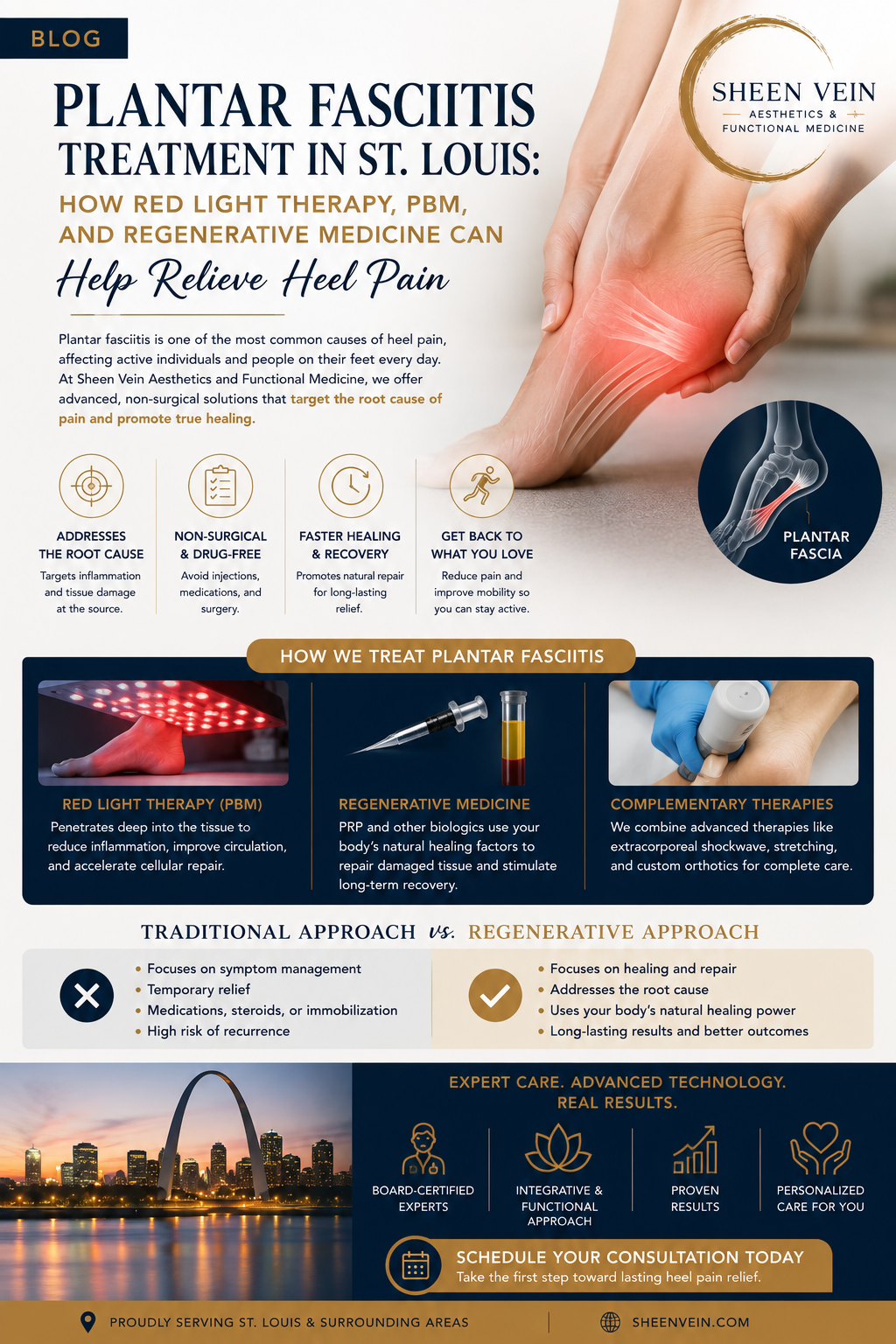
Plantar Fasciitis: Understanding Heel Pain and How Modern Treatments Like Red Light Therapy May Help
If you've ever stepped out of bed in the morning only to feel a sharp, stabbing pain in the bottom of your heel, you're not alone. That first painful step is one of the hallmark symptoms of plantar fasciitis, one of the most common causes of heel pain in adults.
Millions of Americans develop plantar fasciitis each year, affecting everyone from runners and athletes to teachers, healthcare workers, warehouse employees, and individuals who simply spend long hours on their feet. While many people recover with conservative care, others struggle with persistent pain that interferes with work, exercise, and everyday activities.
Fortunately, treatment options have evolved significantly over the past decade. In addition to stretching, supportive footwear, and physical therapy, newer technologies such as photobiomodulation (PBM), also known as red light therapy, are showing promise in reducing pain, improving tissue healing, and helping patients return to normal activity more quickly.
At Sheen Vein & Aesthetics in St. Louis, we believe in identifying the underlying cause of pain while utilizing evidence-based therapies that support your body's natural healing processes.
What Is Plantar Fasciitis?
The plantar fascia is a thick band of connective tissue that extends from your heel bone (calcaneus) to the base of your toes. Think of it as the bowstring that supports the arch of your foot.
Every time you stand, walk, run, or jump, the plantar fascia absorbs tremendous forces. In fact, the plantar fascia may experience forces that are several times your body weight during activities such as running.
When this tissue becomes overloaded, microscopic tears can develop. Rather than being a simple inflammatory condition, we now know that many chronic cases involve degenerative changes, disorganized collagen fibers, and impaired healing—a process sometimes referred to as plantar fasciosis.
What Causes Plantar Fasciitis?
Plantar fasciitis usually develops from repetitive stress rather than a single injury.
Common contributing factors include:
- Standing for prolonged periods
- Running
- Walking on hard surfaces
- Sudden increases in exercise
- Tight calf muscles
- Tight Achilles tendon
- Flat feet
- High arches
- Poor footwear
- Obesity
- Aging
- Occupations requiring prolonged standing
Many patients cannot identify one specific injury. Instead, symptoms gradually worsen over weeks or months.
Why Does It Hurt More in the Morning?
One of the classic symptoms is severe pain during the first few steps after getting out of bed.
While you sleep, your foot remains in a relaxed position and the plantar fascia shortens slightly.
When you suddenly stand, the tissue stretches quickly, placing stress on microscopic areas of injury.
As you continue walking, the fascia warms up and becomes more flexible, often causing the pain to improve temporarily.
Unfortunately, it commonly returns after prolonged standing or later in the day.
Common Symptoms
Patients often describe:
- Sharp heel pain
- Pain at the inside of the heel
- Morning pain
- Pain after sitting
- Tenderness when pressing the heel
- Pain during prolonged standing
- Pain after exercise rather than during exercise
- Tight calves
- Difficulty walking barefoot
The pain may gradually become constant if left untreated.
Is It Really Inflammation?
Interestingly, chronic plantar fasciitis often contains relatively little active inflammation.
Instead, researchers frequently find:
- Degenerated collagen fibers
- Thickened fascia
- Poor blood supply
- Fibrosis
- Disorganized tissue architecture
This helps explain why some patients fail to improve with anti-inflammatory medications alone.
Modern treatments increasingly focus on stimulating tissue repair rather than simply reducing inflammation.
Who Is at Risk?
Risk factors include:
Athletes
Running, soccer, basketball, tennis, and other high-impact sports place repetitive stress on the plantar fascia.
Healthcare Workers
Nurses, physicians, therapists, and other healthcare professionals often spend long shifts standing on hard floors.
Teachers
Standing throughout the school day increases cumulative stress.
Warehouse and Factory Workers
Concrete floors significantly increase impact loading.
Individuals with Excess Body Weight
Higher body weight increases force across the plantar fascia during every step.
Older Adults
Natural collagen changes reduce tissue resilience over time.
How Is Plantar Fasciitis Diagnosed?
Diagnosis usually begins with:
- Medical history
- Physical examination
- Gait evaluation
- Foot biomechanics assessment
Pain is typically located near the medial (inside) aspect of the heel where the plantar fascia attaches.
Most patients do not require advanced imaging initially.
However, ultrasound or MRI may be recommended if:
- symptoms persist
- a tear is suspected
- another condition needs to be ruled out
Is It a Heel Spur?
Many patients assume a heel spur is causing their pain.
While heel spurs are common, they are often not the source of symptoms.
Many people have large heel spurs without pain.
Conversely, many patients with severe plantar fasciitis have no heel spur at all.
The plantar fascia itself—not the spur—is usually responsible for the discomfort.
Conservative Treatment Options
Most patients improve with conservative care.
Treatment may include:
Stretching
Stretching remains one of the most effective therapies.
Target areas include:
- calf muscles
- Achilles tendon
- plantar fascia
Consistent stretching helps reduce mechanical stress.
Supportive Footwear
Shoes with adequate arch support and cushioning help decrease repetitive strain.
Walking barefoot on hard floors often worsens symptoms.
Orthotics
Custom or over-the-counter orthotics may improve foot mechanics and reduce stress on the plantar fascia.
Night Splints
Night splints gently stretch the plantar fascia while sleeping.
Many patients experience reduced morning pain after several weeks of use.
Physical Therapy
Physical therapists often incorporate:
- stretching
- strengthening
- manual therapy
- gait retraining
- balance exercises
These treatments help address underlying biomechanical issues.
Activity Modification
Reducing repetitive impact while maintaining general fitness allows healing to occur without complete inactivity.
What Is Photobiomodulation (PBM)?
Photobiomodulation (PBM), commonly called red light therapy or low-level laser therapy (LLLT), uses specific wavelengths of red and near-infrared light to stimulate cellular function.
Unlike surgical lasers, PBM does not burn or destroy tissue.
Instead, light energy is absorbed by structures inside cells called mitochondria.
This may increase cellular energy production (ATP), helping support tissue repair and recovery.
How PBM May Help Plantar Fasciitis
Research suggests PBM may provide several benefits for plantar fasciitis by:
- Reducing pain signaling
- Supporting collagen synthesis
- Improving local circulation
- Decreasing oxidative stress
- Modulating inflammation
- Promoting tissue repair
- Enhancing mitochondrial function
Because chronic plantar fasciitis often involves poor healing rather than ongoing inflammation alone, therapies that improve cellular repair are especially appealing.
What Does the Research Show?
Multiple clinical studies and systematic reviews have found that PBM can improve pain and function in patients with plantar fasciitis, particularly when combined with stretching and exercise programs.
Patients treated with PBM have demonstrated:
- Reduced morning heel pain
- Improved walking ability
- Better functional scores
- Faster symptom improvement
- Reduced tenderness
While results vary depending on treatment parameters, PBM is increasingly recognized as a valuable adjunct to conservative care.
Why Mitochondria Matter
Healing requires energy.
Every repair process—from collagen production to new blood vessel formation—depends on healthy mitochondria.
PBM stimulates cytochrome c oxidase, a key enzyme within mitochondria that helps generate ATP, the energy currency of the cell.
With more available cellular energy, tissues may be better equipped to repair microscopic damage.
Can Red Light Therapy Reduce Inflammation?
Rather than simply suppressing inflammation, PBM appears to modulate the inflammatory response.
This means it may help reduce excessive inflammation while supporting the normal healing processes that are essential for tissue repair.
This balanced approach is one reason PBM has gained attention in sports medicine, rehabilitation, and regenerative medicine.
Regenerative Medicine for Chronic Cases
Some patients continue to experience heel pain despite months of conservative treatment.
For these individuals, regenerative medicine may be considered.
Platelet-Rich Plasma (PRP)
PRP uses a concentrated sample of the patient's own platelets, which contain numerous growth factors involved in tissue healing.
When injected into the damaged plantar fascia under ultrasound guidance, PRP may stimulate collagen remodeling and improve chronic degeneration.
Several studies have demonstrated longer-lasting improvements with PRP compared with corticosteroid injections, particularly in chronic plantar fasciitis.
Platelet-Rich Fibrin (PRF)
PRF is a newer generation of platelet concentrate that forms a fibrin matrix capable of slowly releasing growth factors over time.
This extended release may support tissue healing for a longer duration and can be an attractive option for patients seeking regenerative approaches.
What About Cortisone Injections?
Corticosteroid injections may provide short-term pain relief for some patients.
However, repeated injections should be approached with caution because they may weaken the plantar fascia and, in rare cases, increase the risk of rupture or fat pad atrophy.
For this reason, many clinicians reserve steroid injections for carefully selected cases while considering other therapies for long-term healing.
Can Surgery Be Avoided?
The good news is that over 90% of patients improve without surgery.
Surgery is generally reserved for patients who continue to have disabling symptoms after six to twelve months of comprehensive conservative treatment.
Whenever possible, less invasive therapies should be exhausted first.
Preventing Future Episodes
After recovery, several habits can reduce the risk of recurrence:
- Stretch your calves daily.
- Replace worn-out athletic shoes.
- Wear supportive footwear indoors.
- Gradually increase exercise intensity.
- Maintain a healthy weight.
- Strengthen the muscles of the feet and lower legs.
- Warm up before activity.
- Avoid sudden increases in running mileage or training volume.
Consistency is often the key to preventing symptoms from returning.
Frequently Asked Questions
How long does plantar fasciitis last?
Many patients improve within several months with appropriate treatment. Chronic cases may take longer, particularly if the underlying biomechanical issues are not addressed.
Is walking good for plantar fasciitis?
Gentle walking is usually encouraged, but prolonged walking on hard surfaces may aggravate symptoms. Activity should be modified based on pain levels.
Does red light therapy really work?
A growing body of research suggests that photobiomodulation can reduce pain and improve function in patients with plantar fasciitis, especially when combined with stretching, strengthening, and other conservative treatments. Results vary from person to person, but PBM is considered a safe, non-invasive option with minimal side effects.
Is PRP better than cortisone?
They serve different purposes. Cortisone may offer quicker short-term pain relief, while PRP aims to support tissue healing and may provide longer-lasting benefits for chronic plantar fasciitis. The right choice depends on your symptoms, medical history, and treatment goals.
Can plantar fasciitis come back?
Yes. Without addressing contributing factors such as footwear, calf tightness, or foot mechanics, symptoms can recur. Ongoing stretching, supportive shoes, and strengthening exercises can help reduce the risk.
Why Choose Sheen Vein & Aesthetics for Plantar Fasciitis Treatment in St. Louis?
At Sheen Vein & Aesthetics, we understand that chronic heel pain affects far more than just your feet—it can limit your work, exercise, hobbies, and overall quality of life. Our approach focuses on identifying the underlying cause of your plantar fasciitis while utilizing advanced, evidence-based therapies that promote healing rather than simply masking symptoms.
For appropriate candidates, we offer Photobiomodulation (PBM)/Red Light Therapy, an innovative, non-invasive treatment designed to support the body's natural repair processes by improving mitochondrial function, enhancing circulation, and promoting collagen remodeling. Depending on your condition, this may be combined with regenerative medicine options such as Platelet-Rich Plasma (PRP) or Platelet-Rich Fibrin (PRF), along with stretching programs, footwear recommendations, and activity modifications tailored to your needs.
Every patient receives an individualized treatment plan because no two cases of plantar fasciitis are exactly alike. Whether you're an athlete, healthcare worker, teacher, or someone simply tired of waking up with heel pain every morning, our goal is to help you return to the activities you enjoy with less pain and better function.
Schedule Your Plantar Fasciitis Consultation Today
If heel pain is interfering with your daily life, don't ignore it. Early evaluation and treatment can often prevent a short-term problem from becoming a chronic condition.
Contact Sheen Vein & Aesthetics to learn whether Photobiomodulation (Red Light Therapy), PRP, PRF, or other conservative treatments may be appropriate for your plantar fasciitis. Together, we'll create a personalized treatment plan focused on reducing pain, improving healing, and helping you get back on your feet.