PRP Facials With Laser Technology in St. Louis: Benefits, Results, and the Sheen Vein Aesthetics Difference
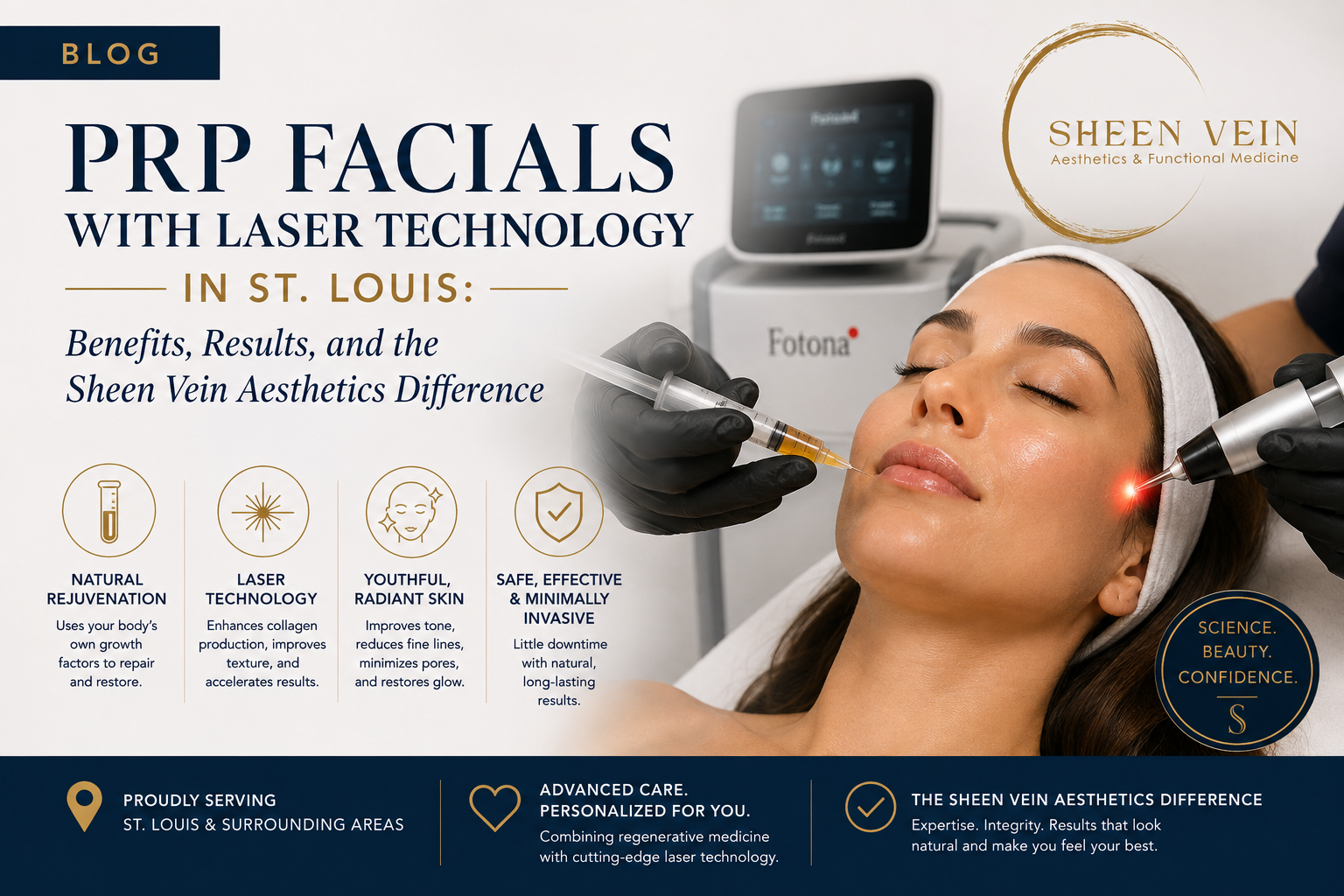
PRP Facials With Laser Technology: How Sheen Vein Aesthetics and Functional Medicine Takes Skin Rejuvenation Further
Many patients want healthier, younger-looking skin but do not want surgery, dramatic facial changes, or prolonged recovery. They may notice that their skin has gradually become thinner, duller, rougher, or less resilient. Fine lines become more visible, pores appear larger, and old acne scars or sun damage become increasingly difficult to conceal.
A platelet-rich plasma facial, commonly called a PRP facial, offers a regenerative approach to these concerns. Rather than relying only on synthetic products, PRP is prepared from a small sample of the patient’s own blood and contains concentrated platelets and biological signaling proteins involved in healing and tissue repair.
At Sheen Vein Aesthetics and Functional Medicine, we take the concept of the PRP facial a step further by combining platelet-rich plasma with advanced Fotona laser technology when appropriate.
The laser creates controlled stimulation within the skin, while PRP is used to support the recovery and remodeling environment. This combination allows us to address skin texture, fine lines, acne scarring, enlarged pores, sun damage, and overall skin quality through two complementary approaches.
Our goal is not to completely change your face. It is to help your skin look smoother, brighter, healthier, and naturally refreshed.
What Is a PRP Facial?
A PRP facial is a regenerative aesthetic procedure that uses platelet-rich plasma prepared from the patient’s own blood.
The process begins with a standard blood draw. The blood is then placed in a centrifuge, which separates its components according to density.
The platelet-rich portion is collected and may then be:
- Applied to the skin after laser treatment
- Delivered into selected areas
- Combined with another collagen-stimulating procedure
- Used as part of a broader facial-rejuvenation plan
Platelets are commonly associated with blood clotting, but they also contain growth factors and signaling proteins involved in tissue repair, collagen activity, blood-vessel formation, and wound healing.
PRP does not act like traditional dermal filler. It does not immediately create predictable volume or physically lift tissue. Instead, it is used to encourage gradual biological changes within the treated skin.
Why Platelets Matter
When the body experiences an injury, platelets travel to the affected area and release chemical signals that help coordinate the healing process.
These signals influence processes such as:
- Fibroblast activity
- Collagen production
- Tissue remodeling
- Formation of new small blood vessels
- Cellular communication
- Wound repair
By concentrating platelets and placing them in a carefully selected treatment area, PRP is intended to create a localized regenerative signal.
Clinical research suggests that PRP may provide modest improvements in facial skin texture, wrinkles, dermal density, hydration, and overall appearance. However, protocols remain inconsistent, and the scientific evidence does not support guaranteeing a particular result for every patient.
At Sheen Vein Aesthetics and Functional Medicine, we believe honest expectations are essential. PRP is promising, but it is not magic, and outcomes depend on preparation quality, treatment technique, age, skin condition, general health, and the procedure with which it is combined.
How Is a PRP Facial Different From a Traditional Facial?
A traditional spa facial generally focuses on the skin’s surface.
It may include:
- Cleansing
- Exfoliation
- Hydration
- Extraction
- Masks
- Topical products
These treatments may temporarily improve moisture, smoothness, and radiance, but they generally do not create the same controlled tissue stimulation associated with medical laser or regenerative procedures.
A PRP facial is performed in a medical setting and is intended to influence the skin’s healing and remodeling response.
It may be appropriate for patients seeking improvement in:
- Fine lines
- Uneven texture
- Enlarged pores
- Mild acne scars
- Dull skin
- Crepey texture
- Early skin aging
- Overall skin quality
The best treatment depends on the patient’s primary concern. Someone with deep acne scars may need a different protocol from someone seeking brighter skin and early wrinkle prevention.
Why We Combine PRP With Laser Technology
PRP and laser treatments influence the skin in different but potentially complementary ways.
The laser creates controlled stimulation within the skin. Depending on the wavelength, settings, and treatment mode, laser energy may remove damaged surface tissue, create fractional treatment channels, heat deeper collagen, or stimulate remodeling.
PRP then introduces a concentration of the patient’s own platelets and signaling proteins into the treatment environment.
The intended combination is straightforward:
- The laser creates controlled tissue stimulation.
- The skin begins a repair response.
- PRP supplies concentrated platelet-derived signals to the treated area.
- Collagen remodeling and tissue recovery continue over time.
Reviews of PRP facial rejuvenation have included patients treated with PRP alongside laser procedures. Some reports suggest higher patient satisfaction, improved elasticity, and reduced post-treatment redness, but the certainty of this evidence remains low because techniques and study quality vary considerably.
We therefore present laser-assisted PRP facials as a promising combination rather than claiming that every patient will experience dramatic or identical results.
Advanced Fotona Laser Technology
Sheen Vein Aesthetics and Functional Medicine uses advanced Fotona laser technology for facial rejuvenation and skin resurfacing.
Fotona systems include Er and Nd wavelengths, which can be used for different tissue depths and treatment goals. Fotona’s Er technology can provide full-field or fractional skin resurfacing, while the Nd wavelength may be used for deeper thermal stimulation and collagen remodeling.
This versatility allows us to customize treatment according to:
- Skin type
- Skin thickness
- Scar depth
- Degree of sun damage
- Wrinkle severity
- Desired downtime
- Previous procedures
- Patient goals
Not every patient receives the same laser setting or resurfacing depth.
The best PRP facial is not the one using the highest energy. It is the one that safely creates enough stimulation to address the patient’s concerns without causing unnecessary injury or downtime.
Fractional Laser Resurfacing and PRP
Fractional resurfacing creates microscopic treatment zones within the skin while leaving areas of surrounding tissue untreated.
The untreated skin helps support a faster recovery compared with treating the entire skin surface at the same depth.
Fractional resurfacing may help improve:
- Fine lines
- Acne scars
- Enlarged pores
- Uneven texture
- Sun damage
- Mild skin laxity
Following laser stimulation, PRP may be placed on or delivered into the treated area according to the customized protocol.
The microscopic channels created by fractional treatment may also improve the penetration of selected topical substances during the immediate treatment period.
Er Laser Resurfacing
The Er wavelength is highly absorbed by water within the skin.
This allows precise removal of very thin tissue layers with controlled thermal effects.
Depending on treatment settings, Er resurfacing may range from a gentle superficial polish to a more substantial ablative treatment.
Potential advantages include:
- Precise treatment depth
- Controlled resurfacing
- Customizable downtime
- Improvement of damaged surface tissue
- Collagen stimulation
- Treatment of delicate facial areas
PRP may be incorporated after selected Er procedures to support recovery and regenerative signaling.
The Potential Benefits of a Laser-Assisted PRP Facial
A combined laser and PRP treatment may offer several potential advantages.
Improved Skin Texture
One of the most consistently reported potential benefits of PRP is improvement in skin texture.
Patients may notice that the skin feels:
- Smoother
- Softer
- More even
- Better hydrated
- More resilient
Systematic reviews have found that evidence for PRP appears strongest for modest improvement in facial texture, although treatment methods and outcome measurements remain highly variable.
Collagen Remodeling
Both laser treatment and PRP are intended to influence collagen activity.
Laser energy creates controlled tissue stimulation, while platelet-derived signals may support fibroblast activity and dermal remodeling.
Collagen production is gradual. Patients should not expect a dramatic transformation immediately after the procedure.
Instead, improvement may continue developing for several weeks or months.
Softening Fine Lines
Fine lines often develop because of collagen loss, sun damage, repeated facial movement, and thinning skin.
Laser-assisted PRP treatment may help soften mild lines, particularly when texture and collagen loss are major contributors.
Deep wrinkles caused by substantial skin laxity or repeated muscle movement may require additional treatment options.
Improvement in Acne Scars
Acne scars involve abnormal collagen structure and changes in skin depth.
Fractional laser resurfacing can stimulate remodeling within the scar, while PRP may be used to support the healing environment.
This combination may be considered for:
- Rolling scars
- Shallow boxcar scars
- Uneven texture
- Post-acne skin irregularity
Deep ice-pick scars may require additional treatments such as focal chemical reconstruction, subcision, or another specialized procedure.
Complete scar removal is rarely realistic, but visible improvement may be achievable through a carefully designed series.
Smaller-Looking Pores
Pores cannot be permanently erased.
However, collagen loss and uneven skin texture may make them appear larger.
By improving skin texture and collagen support around follicular openings, laser and PRP treatment may make pores appear less noticeable.
Brighter, Healthier-Looking Skin
Patients often describe their skin as dull or tired.
Controlled exfoliation and resurfacing can remove damaged surface tissue, while improved hydration and remodeling may create a brighter appearance during recovery.
PRP does not artificially bleach the skin or create an unnatural shine. The goal is healthier-looking tone and texture.
Support for Post-Laser Recovery
Some research suggests that PRP used after fractional laser resurfacing may support healing or reduce redness. However, the quality of the available evidence is limited, and this benefit cannot be guaranteed.
What Conditions May Be Treated?
A laser-assisted PRP facial may be considered for patients with:
- Fine lines
- Early wrinkles
- Dull skin
- Uneven texture
- Enlarged pores
- Mild to moderate acne scars
- Sun-damaged skin
- Crepey texture
- Reduced skin elasticity
- Early facial aging
The treatment is not intended to replace a surgical facelift, eliminate severe pigmentation disorders, or create the same immediate volume as dermal filler.
What Happens During Treatment?
A typical treatment process may include several steps.
Consultation and Skin Assessment
Before treatment, we evaluate:
- Skin type
- Pigmentation risk
- Degree of sun damage
- Scar pattern
- Wrinkle severity
- Current skincare
- Previous procedures
- Medical conditions
- Medication use
- History of cold sores
- Healing history
This helps determine whether PRP and laser treatment are appropriate and how aggressive the laser settings should be.
Blood Collection and PRP Preparation
A small amount of blood is drawn from the patient.
The sample is processed in a centrifuge to separate and concentrate the platelet-rich component.
PRP quality can vary according to the collection system, centrifugation process, platelet concentration, and blood-cell composition. Research has repeatedly noted that a lack of standardized PRP preparation contributes to inconsistent outcomes across studies.
Laser Treatment
The skin is cleansed, and topical anesthetic may be applied depending on treatment depth.
Protective eyewear is used.
Fotona laser energy is then delivered according to the personalized protocol.
Patients may feel:
- Heat
- Prickling
- Stinging
- Tightness
- A sunburn-like sensation
PRP Application or Delivery
After laser treatment, the PRP is applied or delivered to the selected areas.
The technique depends on the patient’s goals, the depth of treatment, and the condition being addressed.
Recovery and Downtime
Recovery varies according to the laser intensity.
After a lighter fractional treatment, patients may experience:
- Redness
- Mild swelling
- Tightness
- Dryness
- Light flaking
A deeper treatment may cause:
- More noticeable swelling
- Peeling
- Crusting
- Temporary darkening
- Several days of visible healing
Temporary bruising may occur if PRP is injected.
Patients should plan treatment around work, travel, exercise, and social commitments.
Aftercare Matters
Appropriate aftercare is essential for both safety and results.
Patients may be instructed to:
- Use a gentle cleanser
- Apply recommended healing products
- Avoid picking or peeling
- Avoid retinoids and acids temporarily
- Limit heat and heavy sweating
- Avoid swimming until cleared
- Use broad-spectrum sunscreen
- Avoid unnecessary sun exposure
- Follow antiviral instructions when prescribed
- Contact the office for increasing pain, drainage, or unusual redness
Freshly treated skin is more vulnerable to ultraviolet damage.
Strict sun protection helps reduce the risk of pigmentation and preserves the results.
Who May Not Be a Good Candidate?
PRP and laser treatment may not be appropriate for every patient.
Additional evaluation or postponement may be necessary with:
- Active skin infection
- Active cold sores
- Significant blood disorders
- Low platelet counts
- Severe anemia
- Uncontrolled diabetes
- Certain autoimmune conditions
- Poor wound healing
- Pregnancy
- Active cancer treatment
- Recent tanning
- Use of certain medications
- Unrealistic expectations
Blood-thinning medication should never be stopped solely for an aesthetic treatment unless the prescribing clinician has approved the change.
How Many Treatments Are Needed?
The ideal number of sessions depends on:
- Age
- Skin condition
- Scar severity
- Laser depth
- Desired improvement
- Healing response
- Tolerance for downtime
Some patients may see noticeable improvement after one treatment.
Others may benefit from a series of three or more sessions spaced several weeks apart.
Deeper treatments may be performed less frequently, while lighter treatments may be used as a series or maintenance program.
When Will Results Appear?
Redness and swelling during the first few days are part of healing, not the final result.
Surface improvements may become visible as peeling resolves.
Collagen remodeling occurs more gradually and may continue for several months.
Patients may notice:
- Smoother texture
- Healthier-looking tone
- Softened fine lines
- Less-visible pores
- Gradual scar improvement
Results vary, and no ethical provider should guarantee a specific outcome.
PRP Facial vs. PRF Facial
PRP and platelet-rich fibrin are related but different preparations.
PRF contains platelets within a fibrin matrix and may release signaling molecules over a longer period.
PRP generally remains more liquid and may be easier to apply across broader treatment areas.
Neither is automatically better.
The choice depends on:
- Treatment goal
- Delivery technique
- Skin concern
- Desired consistency
- Patient factors
- Whether laser treatment is being performed
At Sheen Vein Aesthetics and Functional Medicine, the regenerative product should match the treatment rather than following a one-size-fits-all trend.
Can PRP Be Combined With Fotona4D?
Yes, in appropriate patients.
Fotona4D is a multi-step facial-rejuvenation treatment that may address:
- Deeper collagen
- Skin tightening
- Facial support
- Texture
- Surface quality
PRP may complement Fotona4D when the treatment goal includes broader collagen stimulation and regenerative support.
A customized combination may be considered for patients with both skin laxity and texture concerns.
Can PRP Replace Fillers?
PRP does not behave like hyaluronic-acid filler.
Fillers create immediate and predictable volume in a targeted area.
PRP is intended to support gradual tissue remodeling.
Patients seeking substantial cheek enhancement, lip volume, or restoration of advanced facial-volume loss may still require filler or another procedure.
PRP may be more appealing to patients who prefer:
- Gradual improvement
- An autologous product
- Better skin quality
- Natural-looking rejuvenation
- Less emphasis on immediate volume
Frequently Asked Questions
Is a PRP facial painful?
Most patients tolerate the procedure with topical anesthetic and other comfort measures. The laser may feel warm or prickly, while injected PRP may produce brief pressure or stinging.
Is PRP safe?
PRP is prepared from the patient’s own blood, reducing the risk of an allergic reaction to the platelet product. Bruising, redness, swelling, tenderness, infection, and other complications remain possible.
Does PRP really stimulate collagen?
Laboratory and clinical evidence suggests platelet-derived signals may influence fibroblast activity and collagen remodeling. Clinical results are promising but variable, and additional high-quality research is still needed.
Can PRP remove deep wrinkles?
PRP may soften fine lines and improve texture, but it is unlikely to completely eliminate deep wrinkles or severe skin laxity.
Can a PRP facial treat acne scars?
It may improve selected acne scars, particularly when combined with fractional laser resurfacing. Scar type and depth determine the most appropriate treatment.
How long do results last?
Results vary according to age, skin quality, sun exposure, smoking, skincare, and maintenance. The skin continues to age after treatment.
Is there downtime?
Yes, although the amount depends primarily on laser depth and whether PRP is injected. Redness, swelling, peeling, dryness, and bruising may occur.
Can darker skin types receive treatment?
Some patients with melanin-rich skin may be candidates, but laser settings must be chosen carefully because of the increased risk of post-inflammatory pigmentation.
Can I wear makeup afterward?
Makeup should not be applied until the skin barrier has recovered sufficiently and the treating provider has given approval.
Why Choose Sheen Vein Aesthetics and Functional Medicine for a PRP Facial in St. Louis?
Patients choose our practice because we provide more than a generic blood draw followed by a standard facial.
Our physician-led approach includes:
- Comprehensive skin evaluation
- Personalized PRP preparation
- Advanced Fotona laser technology
- Fractional and ablative resurfacing options
- Treatment for acne scars and uneven texture
- Collagen-stimulating facial rejuvenation
- Fotona4D options
- PRP and PRF treatment choices
- Medical-grade skincare guidance
- Functional medicine support
- Detailed aftercare
- Honest expectations
Sheen Vein Aesthetics and Functional Medicine offers both PRP-based regenerative treatment and Fotona facial technology within the same medical practice, allowing the treatment plan to be tailored rather than limited to one device or technique.
We do not believe excellent results come from using every available treatment on every patient.
They come from selecting the appropriate patient, choosing the correct laser depth, preparing the regenerative product carefully, and developing a plan that fits the individual’s skin and goals.
Schedule a Laser-Assisted PRP Facial Consultation in St. Louis
If fine lines, acne scars, enlarged pores, uneven texture, dullness, or sun damage are affecting how you feel about your skin, a laser-assisted PRP facial may provide a personalized path toward healthier-looking rejuvenation.
At Sheen Vein Aesthetics and Functional Medicine, we will evaluate your skin, medical history, previous treatments, recovery preferences, and long-term goals.
Your plan may include:
- PRP facial treatment
- Fractional laser resurfacing
- Er resurfacing
- Fotona4D
- PRF
- SmoothEye
- LipLase
- Medical-grade skincare
- Functional medicine support
Our goal is to help your skin look refreshed, smoother, and naturally healthier without changing the features that make you look like yourself.
Contact Sheen Vein Aesthetics and Functional Medicine to schedule your PRP facial consultation and learn whether combining PRP with advanced Fotona laser technology is right for you.