Shoulder Pain Treatment in St. Louis: Traditional Medicine vs. Regenerative and Red Light Therapy Options
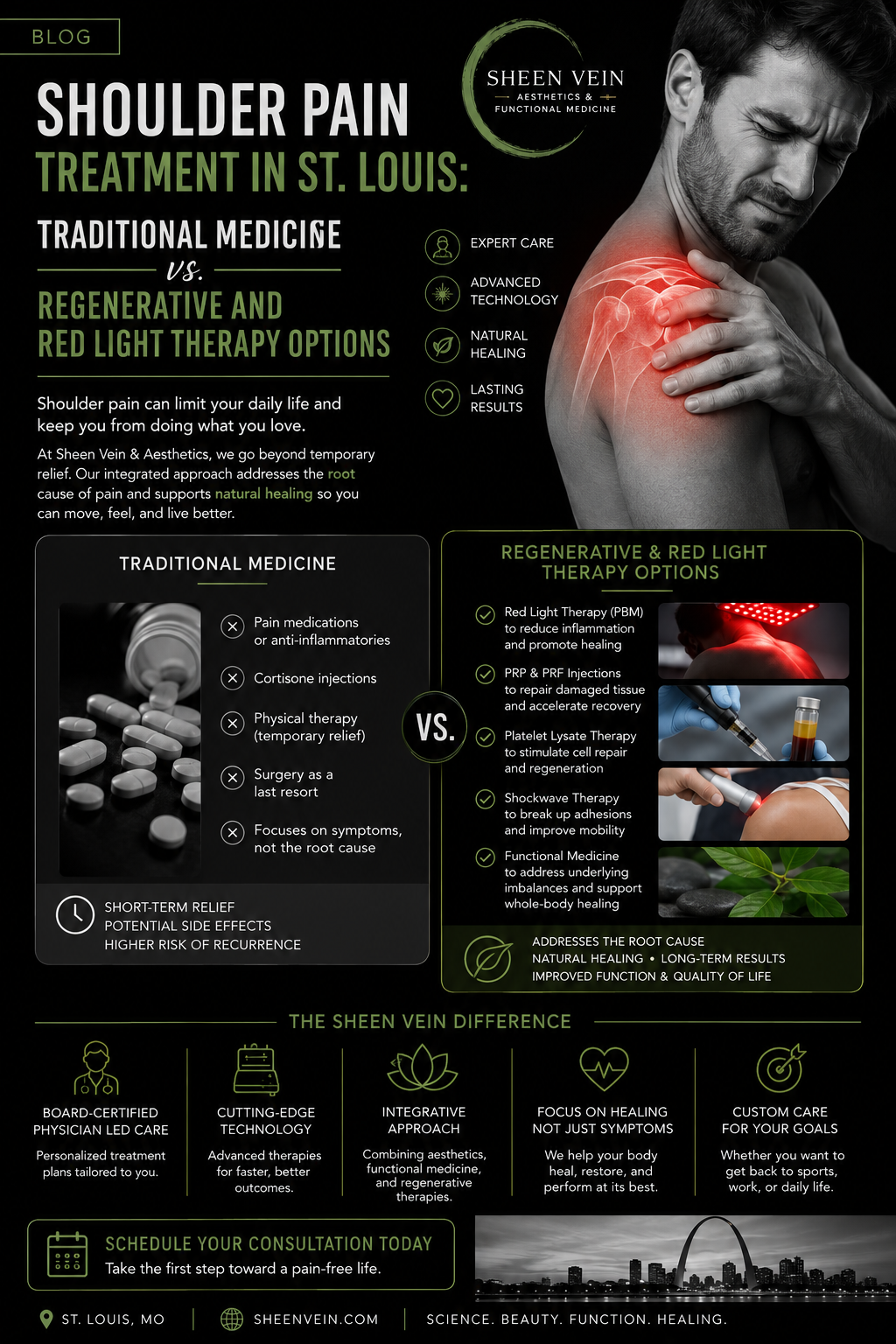
Shoulder Pain: Causes and Traditional Treatment Options Compared With the Comprehensive Approach at Sheen Vein Aesthetics and Functional Medicine
Shoulder pain can make even simple activities unexpectedly difficult. Reaching into a cabinet, putting on a jacket, fastening a seat belt, washing your hair, lifting groceries, exercising, or sleeping on one side may become painful or nearly impossible.
Some people remember a specific injury. Others gradually develop aching, stiffness, weakness, clicking, or reduced movement without one obvious event. Because the shoulder is involved in so many daily activities, symptoms can quickly interfere with work, sports, sleep, and independence.
The shoulder is also one of the most complex and mobile joints in the body. This mobility allows the arm to move in many directions, but it also makes the joint vulnerable to muscle imbalance, tendon overload, instability, inflammation, arthritis, and injury.
Traditional medicine offers many valuable shoulder-pain treatments, including medications, physical therapy, steroid injections, and surgery when necessary. These treatments remain important and may be the best option for certain diagnoses.
At Sheen Vein Aesthetics and Functional Medicine, we offer an additional perspective. Rather than treating shoulder pain only as an isolated symptom, we consider the injured tissue along with inflammation, muscle strength, circulation, metabolic health, nutrition, sleep, previous injury, and the patient’s overall ability to recover.
Depending on the diagnosis, a personalized plan may include:
- Photobiomodulation
- Red and near-infrared light therapy
- Pulsed electromagnetic field therapy
- Platelet-rich plasma
- Platelet-rich fibrin
- Functional medicine
- Nutritional optimization
- Metabolic-health support
- Exercise and rehabilitation guidance
Our goal is not to claim that every shoulder condition can be treated without surgery or that regenerative medicine can repair every advanced tear. Our goal is to help patients understand all reasonable options and create a plan that matches the diagnosis.
Understanding the Shoulder
The shoulder is not one simple joint.
It is a coordinated system involving:
- The humerus, or upper-arm bone
- The scapula, or shoulder blade
- The clavicle, or collarbone
- The glenohumeral joint
- The acromioclavicular joint
- The rotator-cuff tendons
- The biceps tendon
- Ligaments
- Muscles
- Bursae
- Nerves
The shoulder depends heavily on muscles and soft tissues for stability. Unlike the hip, which has a deep socket, the shoulder socket is relatively shallow. This allows exceptional mobility but also creates greater reliance on the rotator cuff, shoulder-blade muscles, joint capsule, and surrounding ligaments.
Pain may arise from one structure or from several problems occurring together.
Common Causes of Shoulder Pain
An accurate diagnosis is essential because rotator-cuff tendinopathy, frozen shoulder, arthritis, nerve pain, and a full-thickness tendon tear should not all be treated the same way.
Rotator-Cuff Tendinopathy
The rotator cuff is a group of four muscles and their tendons that stabilize the shoulder and help lift and rotate the arm.
Repetitive lifting, overhead work, throwing, aging, poor mechanics, and reduced blood supply may gradually irritate or weaken these tendons.
Symptoms may include:
- Pain when reaching overhead
- Pain when lowering the arm
- Nighttime shoulder pain
- Weakness
- Pain when lying on the affected side
- Difficulty reaching behind the back
- Discomfort with lifting
Rotator-cuff tendinopathy is often initially treated without surgery through activity modification, anti-inflammatory medication, and physical therapy.
Shoulder Impingement
Shoulder impingement occurs when the rotator-cuff tendons or bursa become irritated in the space beneath the acromion.
The term does not always mean a bone is literally pinching the tendon. Poor shoulder mechanics, inflammation, weakness, repetitive overhead activity, and tendon degeneration may all contribute.
Pain often occurs during a painful arc as the arm is raised.
Initial conventional treatment usually includes:
- Activity modification
- Anti-inflammatory medication
- Physical therapy
- Stretching
- Strengthening
- Corticosteroid injection in selected patients
Rotator-Cuff Tears
Rotator-cuff tears may develop suddenly after trauma or gradually through degeneration.
A tear may be:
- Partial thickness
- Full thickness
- Small
- Large
- Acute
- Chronic
Symptoms may include:
- Pain
- Weakness
- Difficulty lifting the arm
- Night pain
- Loss of function
- A catching sensation
Not every tear requires surgery. Many rotator-cuff tears can initially be managed with medications, physical therapy, strengthening, and selected injections. Surgery becomes more important when there is major weakness, a traumatic full-thickness tear, persistent disability, or failure of appropriate conservative care.
Bursitis
A bursa is a small fluid-filled sac that helps reduce friction.
The subacromial bursa can become irritated through overuse, tendon injury, trauma, or altered shoulder mechanics.
Bursitis may cause:
- Pain with lifting
- Tenderness
- Night discomfort
- Pain when lying on the affected side
- Reduced movement because of pain
Bursitis frequently occurs alongside rotator-cuff tendinopathy rather than as an isolated problem.
Frozen Shoulder
Frozen shoulder, also called adhesive capsulitis, causes progressive pain and stiffness.
The joint capsule becomes thickened and tight, leading to severe restriction of both active and passive movement.
Frozen shoulder is more common in people with:
- Diabetes
- Thyroid disease
- Previous shoulder surgery
- Prolonged immobilization
- Prior injury
Physical therapy focused on restoring flexibility is one of the primary treatments. Anti-inflammatory medication and injections may also be used to control pain and improve participation in rehabilitation.
Frozen shoulder can take many months to improve, and overly aggressive stretching may worsen symptoms during the painful stage.
Shoulder Arthritis
Arthritis may involve the glenohumeral joint or the acromioclavicular joint.
Common forms include:
- Osteoarthritis
- Rheumatoid arthritis
- Post-traumatic arthritis
- Rotator-cuff tear arthropathy
Symptoms may include:
- Deep aching
- Stiffness
- Grinding
- Reduced range of motion
- Pain during activity
- Night pain
Conservative treatment may involve activity modification, medication, heat or ice, physical therapy, and injections. Advanced arthritis may eventually require shoulder replacement.
Calcific Tendinitis
Calcific tendinitis occurs when calcium deposits form within a rotator-cuff tendon.
It may cause sudden severe pain or chronic irritation.
Treatment may include:
- Anti-inflammatory medication
- Physical therapy
- Ultrasound-guided needling
- Shock-wave treatment
- Steroid injection
- Surgery in persistent cases
Physical therapy commonly focuses on restoring shoulder motion after pain is controlled.
Labral Injuries
The labrum is a ring of cartilage that deepens the shoulder socket.
Labral tears may develop after:
- Dislocation
- Repetitive throwing
- Heavy lifting
- Traction injury
- Falls
Symptoms may include clicking, catching, instability, deep pain, or reduced athletic performance.
Some labral problems improve with rehabilitation, while unstable or persistent tears may require surgical evaluation.
Biceps Tendon Pain
The long head of the biceps tendon passes through the shoulder and may become inflamed or damaged.
Pain is often felt in the front of the shoulder and may worsen with lifting, pulling, or overhead movement.
Biceps-tendon problems frequently occur with rotator-cuff or labral conditions.
Pain Referred From the Neck
Not all shoulder pain originates in the shoulder.
A pinched nerve in the cervical spine may cause pain, burning, tingling, numbness, or weakness extending into the shoulder and arm.
Clues that the neck may be involved include:
- Pain extending below the elbow
- Numbness or tingling
- Symptoms affected by neck movement
- Hand weakness
- Neck stiffness
The correct diagnosis is important because treating the shoulder alone may not help nerve-related pain.
How Traditional Medicine Treats Shoulder Pain
Conventional care usually begins with the least invasive treatment appropriate for the diagnosis.
This approach is effective for many patients and should not be dismissed. However, some treatments primarily control pain rather than addressing tissue quality, metabolic inflammation, or long-term recovery.
Rest and Activity Modification
Avoiding the specific movement that repeatedly aggravates the shoulder may allow irritated tissue to calm down.
Complete immobilization is rarely recommended for long periods because it can contribute to stiffness and weakness.
The goal is usually relative rest rather than doing nothing.
Patients may temporarily need to modify:
- Overhead lifting
- Throwing
- Weight training
- Repetitive reaching
- Sleeping position
- Work duties
Ice and Heat
Ice may reduce acute pain and swelling, while heat may help relax tight muscles and improve comfort before activity.
These approaches can be useful for symptom management, but they do not correct a tendon tear, joint instability, or advanced arthritis.
Anti-Inflammatory Medications
Common options include:
- Ibuprofen
- Naproxen
- Prescription NSAIDs
- Topical diclofenac
- Acetaminophen
These medications may help reduce pain enough for the patient to sleep, work, and participate in therapy.
However, prolonged oral NSAID use may increase the risk of:
- Stomach irritation
- Ulcers
- Gastrointestinal bleeding
- Kidney problems
- Fluid retention
- High blood pressure
- Cardiovascular complications in susceptible patients
Medication may be appropriate, but it is rarely the entire long-term solution.
Physical Therapy
Physical therapy is one of the most important treatments for shoulder pain.
A personalized program may include:
- Rotator-cuff strengthening
- Shoulder-blade stabilization
- Posture correction
- Joint mobility
- Flexibility
- Range-of-motion exercises
- Gradual loading
- Sport-specific or work-specific rehabilitation
Strengthening the muscles that support the shoulder can improve joint stability, relieve pain, and help prevent further injury.
Physical therapy is often essential even when a patient receives an injection or regenerative treatment. A procedure may reduce pain or support healing, but muscles still need to regain strength and coordination.
Corticosteroid Injections
Corticosteroid injections may provide short-term relief by reducing inflammation.
They may be used for:
- Bursitis
- Impingement symptoms
- Arthritis
- Frozen shoulder
- Selected rotator-cuff conditions
Steroid injections can be extremely helpful when pain prevents sleep or participation in physical therapy.
However, repeated injections may negatively affect blood sugar, tendon quality, cartilage, and tissue healing. For this reason, they should be used thoughtfully rather than as an automatic recurring treatment.
Hydrodilatation for Frozen Shoulder
Hydrodilatation involves injecting fluid into the shoulder joint to stretch the tight capsule.
It may be combined with local anesthetic or steroid.
Some patients experience improved movement, particularly when the procedure is followed by appropriate physical therapy.
Surgery
Surgery may be appropriate for:
- Traumatic full-thickness rotator-cuff tears
- Major persistent weakness
- Recurrent instability
- Significant labral injury
- Advanced arthritis
- Fracture
- Severe tendon damage
- Failure of conservative treatment
Rotator-cuff repair may be performed through arthroscopic or open techniques, followed by a structured rehabilitation program.
Surgery can be very effective when the structural problem and procedure are properly matched. Our treatments are not intended to delay necessary surgery when a tendon needs repair or when severe arthritis requires replacement.
How the Sheen Vein Aesthetics and Functional Medicine Approach Is Different
At Sheen Vein Aesthetics and Functional Medicine, we consider the painful structure and the biological environment surrounding it.
We may ask:
- Is the problem inflammatory, degenerative, mechanical, or neurological?
- Is the tendon partially torn or simply irritated?
- Is weakness contributing to impingement?
- Is poor sleep increasing pain sensitivity?
- Is insulin resistance worsening systemic inflammation?
- Is the patient receiving enough protein to support recovery?
- Are nutritional deficiencies present?
- Is the patient able to participate in rehabilitation?
- Could PBM support pain relief and recovery?
- Would PRP or PRF be appropriate for the specific tissue?
- Is orthopedic referral needed?
This broader evaluation allows us to create a personalized plan instead of offering every patient the same injection or therapy.
Photobiomodulation for Shoulder Pain
Photobiomodulation, commonly called PBM or red light therapy, uses specific wavelengths of red and near-infrared light to influence biological processes.
PBM does not cut, burn, or remove tissue.
Light is absorbed by cellular structures, including components of the mitochondria. This interaction may influence ATP production, cellular signaling, oxidative stress, circulation, inflammation, and tissue recovery.
Potential goals of PBM for shoulder pain include:
- Reducing discomfort
- Supporting inflammatory balance
- Improving muscle recovery
- Supporting tendon rehabilitation
- Improving movement tolerance
- Helping patients participate in exercise
Research suggests that low-level laser or photobiomodulation combined with therapeutic exercise may improve pain and shoulder function in selected shoulder conditions. However, outcomes depend heavily on the diagnosis, wavelength, dose, frequency, and treatment protocol.
PBM should therefore not be treated as a generic light exposure or a guaranteed cure.
Why PBM May Help Shoulder Recovery
Supporting Cellular Energy
Tendon and muscle recovery require energy.
By influencing mitochondrial activity, PBM may help support the cellular processes involved in tissue maintenance and repair.
Modulating Inflammation
Excessive or persistent inflammation can increase pain and interfere with rehabilitation.
PBM may help regulate inflammatory signaling without the systemic side effects associated with long-term medication use.
Supporting Circulation
Improved local microcirculation may help deliver oxygen and nutrients to the muscles and soft tissues surrounding the shoulder.
Reducing Muscle Guarding
Pain often causes protective tightening around the shoulder and neck.
Reducing discomfort may allow the patient to move more normally and participate more effectively in strengthening.
Full-Body Red Light Therapy and PEMF
Shoulder pain may occur alongside:
- Neck pain
- Upper-back tension
- Generalized arthritis
- Chronic inflammation
- Poor exercise recovery
- Fatigue
Our full-body red light therapy bed allows broad red and near-infrared exposure during one treatment session.
Depending on the patient, treatment may also incorporate pulsed electromagnetic field therapy, commonly called PEMF.
PEMF uses low-frequency electromagnetic fields and may be included as part of a non-invasive recovery plan intended to support:
- Circulation
- Muscle relaxation
- Recovery
- Tissue health
- Pain management
PBM and PEMF cannot reconnect a completely torn tendon or reverse severe arthritis, but they may help selected patients manage pain and improve rehabilitation tolerance.
Platelet-Rich Plasma for Shoulder Conditions
Platelet-rich plasma, or PRP, is prepared from a patient’s own blood.
The blood is processed to concentrate platelets, which contain signaling proteins involved in tissue repair and inflammatory regulation.
PRP may be considered for selected cases of:
- Rotator-cuff tendinopathy
- Partial-thickness rotator-cuff tears
- Chronic tendon degeneration
- Selected ligament or joint concerns
Research on PRP for rotator-cuff disorders is promising but not uniform.
Systematic reviews have reported that PRP may improve longer-term pain and function in some patients with rotator-cuff tendinopathy. However, studies use different platelet preparations, injection methods, comparison groups, and rehabilitation protocols.
Because the evidence is mixed, PRP should not be presented as a guaranteed cure or a substitute for tendon repair when surgery is clearly required.
Why PRP Is Not One Standard Product
PRP can vary based on:
- Platelet concentration
- Total platelet dose
- Leukocyte content
- Red-blood-cell contamination
- Centrifugation method
- Injection volume
- Number of injections
- Activation method
- Target tissue
This lack of standardization partly explains why study results differ.
At Sheen Vein Aesthetics and Functional Medicine, PRP is approached as a medical treatment rather than a commodity.
Patient selection matters.
A younger patient with chronic tendinopathy may respond differently from an older patient with a retracted full-thickness tear and severe muscle atrophy.
Platelet-Rich Fibrin
Platelet-rich fibrin, or PRF, is another autologous treatment prepared from the patient’s own blood.
It contains platelets within a fibrin matrix that may provide gradual release of biological signaling molecules.
PRF may be considered for selected soft-tissue concerns, although the evidence for shoulder conditions is less established than the research on PRP.
We present PRF as an evolving regenerative option rather than promising outcomes that have not been adequately demonstrated.
Combining Regenerative Therapy With Rehabilitation
An injection alone does not correct poor shoulder mechanics.
When PRP or PRF is appropriate, it should usually be part of a larger plan that may include:
- Activity modification
- Progressive strengthening
- Shoulder-blade stabilization
- Mobility work
- PBM
- PEMF
- Nutrition
- Sleep optimization
- Metabolic-health improvement
The goal is to create a healthier environment for the tendon while gradually restoring strength and function.
Functional Medicine and Shoulder Recovery
Shoulder pain begins locally, but recovery is influenced by the entire body.
Factors that may slow healing include:
- Poorly controlled diabetes
- Insulin resistance
- Smoking
- Inadequate protein intake
- Vitamin D deficiency
- Poor sleep
- Obesity
- Chronic stress
- Systemic inflammation
- Hormonal changes
- Certain medications
Functional medicine does not replace orthopedic care or physical therapy.
It may help identify health factors that are making recovery more difficult.
Diabetes and Frozen Shoulder
Frozen shoulder is more common in patients with diabetes.
Poor glucose regulation can affect collagen and connective tissue, potentially increasing stiffness and altering normal tissue quality.
Improving metabolic health may not immediately release a frozen capsule, but it may support overall recovery and reduce the risk of other complications.
Nutrition and Tendon Health
Tendons and muscles require adequate nutrition.
Important considerations may include:
- Sufficient protein
- Vitamin C
- Vitamin D
- Magnesium
- Zinc
- Copper
- Omega-3 fatty acids
A supplement cannot overcome a complete tendon rupture or severe mechanical problem.
However, correcting meaningful nutritional deficiencies may support normal tissue function and rehabilitation.
Sleep and Shoulder Pain
Nighttime pain is one of the most frustrating symptoms of shoulder disease.
Pain makes it difficult to sleep, and poor sleep increases pain sensitivity.
This creates a cycle in which:
- The shoulder hurts at night.
- Sleep becomes fragmented.
- Pain tolerance decreases.
- Inflammation and fatigue increase.
- Recovery becomes more difficult.
Improving sleep position, using pillow support, treating sleep apnea when present, and managing pain appropriately can be important parts of the overall plan.
When Shoulder Pain Requires Urgent Evaluation
Seek prompt medical evaluation when shoulder pain is associated with:
- Major trauma
- Obvious deformity
- Inability to lift the arm after injury
- Sudden profound weakness
- Fever with a red or swollen joint
- Chest pain
- Shortness of breath
- Sweating or nausea
- New arm numbness or weakness
- Suspected fracture or dislocation
- A hot, severely swollen joint
Shoulder pain can occasionally be referred from the heart, lungs, abdomen, or neck. New left-sided shoulder pain with chest symptoms should be treated as a possible emergency.
Who May Benefit From Our Approach?
An evaluation may be appropriate for patients with:
- Chronic rotator-cuff pain
- Shoulder impingement symptoms
- Tendinopathy
- Mild or moderate arthritis
- Persistent soreness after exercise
- Partial tendon injury
- Pain that limits physical therapy
- Poor response to medication alone
- Interest in non-surgical options
- Metabolic or inflammatory contributors
- A desire to reduce reliance on repeated steroid injections
The treatment recommendation depends on the diagnosis and severity.
Frequently Asked Questions
Can red light therapy heal a torn rotator cuff?
PBM may support pain control, cellular activity, and rehabilitation, but it cannot be assumed to reconnect a completely torn or retracted tendon. Significant tears require orthopedic evaluation.
Can PBM replace physical therapy?
Usually not. PBM may help reduce pain and improve tolerance of movement, but strengthening and restoration of normal mechanics remain essential for many shoulder conditions.
Is PRP better than cortisone?
They have different purposes. Cortisone may provide faster short-term relief by reducing inflammation. PRP is intended to influence the biological environment of the tendon and may provide longer-term benefit for selected patients. Evidence remains mixed, and neither treatment is best for everyone.
Can PRP prevent shoulder surgery?
PRP may help some patients with tendinopathy or selected partial tears, but it cannot guarantee avoidance of surgery. Large traumatic tears, major weakness, or advanced structural damage may still require repair.
How many PBM treatments are needed?
The number depends on the diagnosis, chronicity, treatment dose, and response. Long-standing shoulder conditions generally require a series rather than a single session.
Can shoulder arthritis be reversed?
Advanced cartilage loss cannot currently be fully reversed. Treatment focuses on reducing pain, preserving motion, maintaining strength, and improving function.
Why does my shoulder hurt more at night?
Night pain may result from tendon or bursal pressure, inflammation, joint position, reduced movement, and increased pain sensitivity during poor sleep.
Should I have an MRI?
Not every patient requires an MRI. Imaging may be appropriate after trauma, when significant weakness is present, when symptoms persist despite treatment, or when the result will change management.
Why Choose Sheen Vein Aesthetics and Functional Medicine for Shoulder Pain in St. Louis?
Patients choose our practice because we offer more than temporary symptom suppression.
Our physician-led approach may include:
- Comprehensive medical evaluation
- Photobiomodulation
- Red and near-infrared light therapy
- Full-body red light treatment
- PEMF
- PRP
- PRF
- Functional medicine
- Metabolic-health evaluation
- Nutritional optimization
- Recovery and exercise guidance
- Honest referral when orthopedic care is necessary
We do not believe every painful shoulder needs an injection, and we do not believe every MRI abnormality needs surgery.
A thoughtful treatment plan begins by understanding the diagnosis, severity, patient goals, and factors affecting healing.
Our goal is to help patients reduce pain, restore movement, improve strength, and return to the activities they enjoy while being honest about the limits of each treatment.
Schedule a Shoulder-Pain Consultation in St. Louis
If shoulder pain is interfering with sleep, work, exercise, dressing, driving, or everyday movement, it may be time to explore a more comprehensive treatment strategy.
At Sheen Vein Aesthetics and Functional Medicine, we evaluate the painful shoulder as well as the health factors that may be influencing inflammation, recovery, muscle function, and pain sensitivity.
Depending on your diagnosis, your individualized plan may include:
- Photobiomodulation
- Red light therapy
- PEMF
- PRP
- PRF
- Functional medicine
- Nutritional support
- Metabolic optimization
- Exercise and rehabilitation guidance
- Collaboration with an orthopedic specialist
Contact Sheen Vein Aesthetics and Functional Medicine to schedule a shoulder-pain consultation and learn which traditional, regenerative, and non-invasive options may be appropriate for you.