Varicose Veins and Venous Circulation: Causes, Symptoms, Complications, and Treatment Options in St. Louis
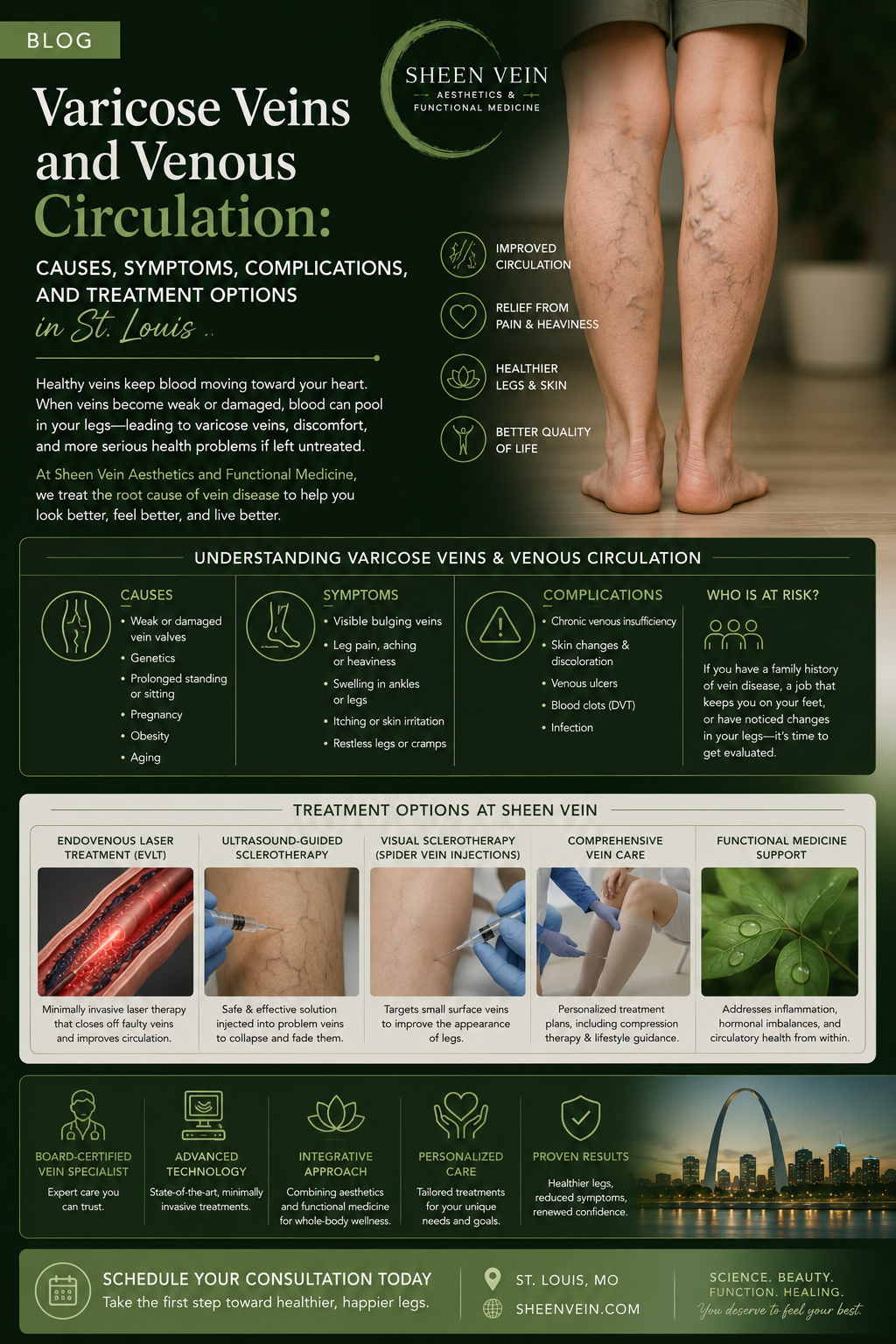
Varicose Veins and Venous Circulation: Why They Develop and How We Can Help
Varicose veins are often dismissed as a cosmetic concern. Patients may notice bulging blue or purple veins on their legs and assume they are simply an unavoidable result of aging, pregnancy, genetics, or spending too much time standing.
However, varicose veins may represent more than a change in appearance. In many patients, they are a visible sign that blood is not circulating efficiently through the veins of the legs.
When the valves inside the veins become weak or damaged, blood can flow backward and pool in the lower extremities. This condition is called venous reflux. Over time, the increased pressure can enlarge superficial veins, producing the twisted, rope-like vessels we recognize as varicose veins. Weak or damaged one-way vein valves are a major reason blood backs up and causes veins to swell.
Varicose veins may be accompanied by aching, heaviness, swelling, fatigue, itching, nighttime cramping, restless legs, skin discoloration, inflammation, or wounds near the ankle. These symptoms can interfere with exercise, work, sleep, and everyday activities.
At Sheen Vein Aesthetics and Functional Medicine, we do not simply look at the veins visible on the surface. We use a comprehensive approach to determine whether underlying chronic venous insufficiency is contributing to the problem. When appropriate, we offer minimally invasive treatments such as endovenous laser therapy, ultrasound-guided foam sclerotherapy, Varithena, and visual sclerotherapy.
Our goal is not only to improve how the legs look. It is to improve abnormal venous circulation, relieve symptoms, protect the skin, and reduce the risk of progression.
How Normal Venous Circulation Works
The circulatory system contains both arteries and veins.
Arteries carry oxygen-rich blood away from the heart and deliver it to the tissues. Veins return blood from the body back toward the heart.
Returning blood from the legs is challenging because the blood must travel upward against gravity.
The body accomplishes this through several important mechanisms:
- One-way valves inside the veins
- Contraction of the calf muscles
- Normal breathing-related pressure changes
- Healthy vein walls
- Regular movement
The one-way valves inside healthy leg veins open to allow blood to move upward. They then close to prevent blood from falling back toward the feet.
The calf muscles also play an essential role. Each time you walk, the muscles squeeze the veins and push blood upward. This is often called the calf muscle pump.
For this reason, the calf muscles are sometimes described as a “second heart” for the lower extremities.
What Happens When Vein Valves Stop Working?
When vein valves weaken or fail, they do not close completely.
Blood begins moving backward through the vein instead of continuing efficiently toward the heart. This backward flow is called venous reflux.
As blood accumulates, pressure rises within the veins.
The increased pressure may cause superficial veins to:
- Stretch
- Widen
- Twist
- Become visible beneath the skin
- Bulge above the skin
This process produces varicose veins.
However, the visible vein is not always the original source of the problem. A bulging vein on the calf may be receiving abnormal pressure from a larger refluxing vein higher in the leg.
That is why simply treating what can be seen without evaluating the underlying circulation may produce incomplete or temporary results.
What Is Chronic Venous Insufficiency?
Chronic venous insufficiency, often abbreviated CVI, occurs when the veins cannot efficiently return blood from the legs to the heart.
Venous reflux is one of the most common causes.
As pressure builds within the venous system, fluid and inflammatory substances can leak into the surrounding tissues.
Over time, chronic venous insufficiency may cause:
- Varicose veins
- Leg swelling
- Aching
- Heaviness
- Fatigue
- Itching
- Nighttime cramping
- Restless legs
- Skin discoloration
- Hardening of the skin
- Venous stasis ulcers
Varicose veins and chronic venous insufficiency exist along a spectrum. Some patients have visible veins with few symptoms, while others develop significant discomfort and progressive skin damage.
Why Do Varicose Veins Usually Develop in the Legs?
Gravity creates constant downward pressure within the veins of the lower body.
The veins in the legs must work much harder than veins located closer to the heart. This makes valve dysfunction especially noticeable in the lower extremities.
The longer a person stands or sits without moving, the more blood may collect in the legs.
Walking helps activate the calf muscle pump. Remaining stationary for long periods removes much of this natural assistance.
This is why symptoms often worsen:
- Later in the day
- After prolonged standing
- After prolonged sitting
- During warm weather
- After long car or airplane trips
Many patients report that their legs feel relatively normal in the morning but become swollen, heavy, tired, or painful by evening.
What Causes Varicose Veins?
Varicose veins usually develop because of a combination of genetics, anatomy, hormonal influences, lifestyle factors, and aging.
Common risk factors include:
Family History
Genetics is one of the strongest risk factors.
If one or both parents have varicose veins or chronic venous insufficiency, their children may have a greater likelihood of developing similar problems.
Inherited differences may affect the strength of the vein walls or the function of the valves.
Aging
As we age, vein walls and valves may lose strength and elasticity.
This makes backward blood flow and vein enlargement more likely.
Varicose veins are not an inevitable part of aging, but their frequency increases over time.
Pregnancy
Pregnancy increases blood volume and pressure within the veins of the pelvis and legs.
Hormonal changes may also relax vein walls, while the enlarging uterus can place additional pressure on pelvic veins.
Some pregnancy-related veins improve after delivery, but others persist or worsen with future pregnancies.
Prolonged Standing
Teachers, nurses, physicians, hairstylists, factory employees, restaurant workers, retail employees, and others who stand for long periods may experience increased venous pressure.
Standing does not necessarily cause varicose veins by itself, but it may worsen symptoms in someone who is already genetically susceptible.
Prolonged Sitting
Long periods of sitting reduce calf muscle activity.
This can contribute to blood pooling, particularly when a person has underlying venous reflux.
Excess Body Weight
Additional body weight can increase pressure within the veins and make symptoms more noticeable.
Obesity may also reduce mobility and make compression garments more difficult to use.
Previous Blood Clots
A deep vein thrombosis can damage venous valves and create long-term circulation problems.
This condition is sometimes called post-thrombotic syndrome.
Hormonal Influences
Pregnancy, hormonal medications, and hormonal changes may influence vein-wall elasticity and the risk of developing varicose veins in susceptible patients.
Are Varicose Veins Only Cosmetic?
No.
Some patients have varicose veins that primarily concern them because of appearance. Others experience significant medical symptoms.
Varicose veins may cause:
- Aching
- Throbbing
- Burning
- Heaviness
- Leg fatigue
- Swelling
- Itching
- Tenderness
- Nighttime cramping
- Restless legs
- Discomfort after standing
- Pain during exercise
Varicose veins can occasionally lead to complications such as inflammation, bleeding, skin changes, and venous ulcers.
The severity of symptoms does not always match the size of the visible veins. A patient with modest-looking veins may have significant reflux, while another person with prominent veins may report relatively little discomfort.
The only reliable way to understand the circulation is through proper evaluation.
Symptoms That May Indicate Venous Reflux
Patients often recognize varicose veins but overlook other symptoms of vein disease.
Possible signs include:
- Legs that feel heavy or tired
- Aching after standing
- Swelling near the ankles
- Socks leaving deep marks
- Nighttime leg cramps
- Restless legs
- Burning or itching
- Tender veins
- Symptoms that worsen by evening
- Improvement with leg elevation
- Brown discoloration near the ankles
- Thick, tight, or hardened skin
- Slow-healing wounds
These symptoms should not automatically be blamed on aging, arthritis, weight, or inactivity.
A vein evaluation may reveal a treatable circulatory problem.
The Connection Between Varicose Veins and Leg Swelling
When venous pressure rises, fluid may escape from small blood vessels into the surrounding tissue.
Initially, swelling may occur only around the ankles late in the day.
As venous disease progresses, swelling may:
- Develop earlier
- Extend farther up the leg
- Become more persistent
- Cause tightness or discomfort
- Contribute to skin inflammation
Not every swollen leg is caused by vein disease. Heart disease, kidney disease, liver disease, medications, lymphedema, infection, and blood clots may also cause swelling.
This is why a medical evaluation is important, especially when swelling is new, severe, painful, or affects only one leg.
Skin Changes From Poor Venous Circulation
Long-standing venous hypertension can gradually damage the skin and tissue around the lower leg.
Brown Discoloration
Red blood cells may leak into the surrounding tissue. Iron-containing pigment is then deposited within the skin, producing a rusty or brown color.
This discoloration often begins near the inner ankle.
Venous Eczema
Chronic swelling and inflammation may cause:
- Itching
- Dryness
- Redness
- Scaling
- Irritation
Scratching the skin can further increase the risk of breakdown or infection.
Lipodermatosclerosis
Chronic inflammation may cause the skin and underlying fat to become firm, thickened, tight, and painful.
The lower leg may gradually develop an “inverted champagne bottle” appearance.
Atrophie Blanche
Small white scar-like areas may develop in skin damaged by severe chronic venous disease.
These areas can be particularly vulnerable to ulceration.
Venous Stasis Ulcers
A venous stasis ulcer is an open wound caused by prolonged venous hypertension and tissue damage.
These ulcers commonly develop near the inside of the ankle.
They may be:
- Shallow
- Irregularly shaped
- Painful
- Draining
- Surrounded by brown or inflamed skin
- Slow to heal
- Recurrent
Dressings and wound care are important, but an ulcer may continue to recur if the underlying abnormal venous circulation is not treated.
This is why comprehensive vein treatment can be an important part of long-term wound management.
Superficial Phlebitis
A varicose vein may occasionally become inflamed or develop a superficial clot.
This can produce:
- Redness
- Warmth
- Tenderness
- A hard cord-like vein
- Local swelling
Superficial phlebitis is different from deep vein thrombosis, but it still deserves medical evaluation because clot location and extent matter.
Sudden swelling, deep calf pain, chest pain, or shortness of breath requires urgent medical attention.
How We Diagnose Varicose Veins
Evaluation begins with a medical history and physical examination.
We ask about:
- Aching
- Heaviness
- Swelling
- Cramping
- Restless legs
- Skin changes
- Previous blood clots
- Pregnancy history
- Family history
- Past vein treatments
- Medication use
The most important diagnostic test is usually a venous duplex ultrasound.
What Is a Venous Duplex Ultrasound?
A venous duplex ultrasound is a non-invasive test that uses sound waves to evaluate the veins.
It allows us to examine:
- Direction of blood flow
- Valve function
- Venous reflux
- Deep veins
- Superficial veins
- Previous blood clots
- Vein anatomy
- Potential treatment targets
The ultrasound is essential because visible veins do not tell the entire story.
A treatment plan should be based on the patient’s anatomy and circulation rather than appearance alone.
Conservative Treatment Options
Some patients can manage mild symptoms with conservative measures.
These may include:
Walking
Walking activates the calf muscle pump and helps move blood upward.
Even brief movement breaks can be beneficial for patients who sit or stand for prolonged periods.
Leg Elevation
Elevating the legs above heart level can temporarily reduce venous pressure and swelling.
Compression Stockings
Compression stockings apply graduated pressure to the legs.
They may help reduce:
- Swelling
- Aching
- Heaviness
- Venous pressure
Compression can improve symptoms, but it does not permanently repair damaged valves.
Weight Management
When appropriate, weight reduction may decrease pressure on the venous system and improve mobility.
Avoiding Prolonged Immobility
Patients should try to change positions regularly, walk periodically, and perform calf raises during long periods of sitting or standing.
Conservative care can be helpful, but patients with significant reflux may continue to experience symptoms until the underlying abnormal veins are treated.
Modern Treatment Options at Sheen Vein Aesthetics and Functional Medicine
Vein treatment has changed significantly.
Traditional surgical vein stripping was once commonly used, but many patients can now be treated with minimally invasive office-based procedures.
Depending on your ultrasound findings and anatomy, we may recommend one or more of the following treatments.
Endovenous Laser Therapy
Endovenous Laser Therapy, often abbreviated EVLT, is used to close a refluxing superficial vein.
During treatment, a small laser fiber is placed inside the abnormal vein under ultrasound guidance.
Laser energy heats and seals the vein from within.
Once the diseased vein closes, blood naturally reroutes through healthier veins.
EVLT may help improve:
- Leg heaviness
- Aching
- Swelling
- Fatigue
- Venous pressure
- Skin-related complications
Most patients walk immediately after the procedure and return to many routine activities quickly.
Ultrasound-Guided Foam Sclerotherapy
Some abnormal veins are too twisted, small, or anatomically unsuitable for laser treatment.
Ultrasound-guided foam sclerotherapy allows medication to be delivered directly into these veins while the physician watches its movement with ultrasound.
The medication irritates the inner lining of the abnormal vein, causing it to close gradually.
Sclerotherapy is a recognized treatment in which a solution or foam is injected to close varicose veins.
This approach may be used for:
- Tributary varicose veins
- Residual veins after EVLT
- Recurrent varicose veins
- Veins that cannot be treated with a catheter
- Complex networks of abnormal veins
Varithena
Varithena is a prescription microfoam used to treat certain incompetent veins and visible varicosities.
The foam fills and closes the targeted vein without requiring surgical removal.
The treatment may be helpful for veins that are tortuous or difficult to treat with thermal ablation.
The decision to use Varithena depends on the patient’s anatomy, symptoms, ultrasound findings, and medical history.
Visual Sclerotherapy
After the larger sources of reflux have been addressed, smaller visible veins may remain.
Visual sclerotherapy involves injecting these veins with a medication that causes them to close and gradually fade.
It may be used to treat:
- Small varicose veins
- Reticular veins
- Spider veins
When both medical symptoms and cosmetic concerns are present, treatment should usually begin with the underlying circulatory problem rather than focusing only on the smallest visible veins.
Why Treatment Often Requires More Than One Step
Venous disease often involves multiple levels of the circulation.
A patient may have:
- Reflux in a large superficial vein
- Bulging tributary veins
- Reticular veins
- Spider veins
Closing the main refluxing vein may reduce pressure, but visible tributaries may still require additional treatment.
A staged treatment plan may include:
- Treating the primary source of reflux.
- Treating remaining varicose tributaries.
- Addressing residual reticular or spider veins.
- Monitoring the circulation over time.
This approach treats the circulation in a logical order rather than chasing individual surface veins.
What Happens to Blood After a Vein Is Closed?
Patients sometimes worry that closing a vein will reduce circulation.
The opposite is usually true.
A refluxing vein is already functioning abnormally. Instead of moving blood efficiently toward the heart, it allows blood to fall backward and pool.
When that vein is closed, blood reroutes through healthier veins with properly functioning valves.
The body contains an extensive network of veins, so closing a diseased superficial vein generally improves the efficiency of venous return.
Can Varicose Veins Return?
Treatment can successfully close diseased veins, but it cannot eliminate a person’s genetic tendency to develop vein disease.
Over time, other veins may weaken or become refluxing.
Factors that influence recurrence include:
- Genetics
- Pregnancy
- Aging
- Weight
- Hormonal changes
- Previous blood clots
- Disease severity
Periodic follow-up allows new problems to be identified and treated before they become more advanced.
Frequently Asked Questions
Are varicose veins dangerous?
Many varicose veins do not cause serious complications. However, some lead to pain, swelling, inflammation, bleeding, skin damage, or venous ulcers. A vein evaluation can determine whether the visible veins are associated with significant reflux.
Can exercise eliminate varicose veins?
Exercise improves calf-muscle function and may reduce symptoms, but it cannot repair valves that are already damaged. Walking remains helpful for overall circulation and treatment recovery.
Do compression stockings cure varicose veins?
Compression can reduce symptoms and swelling, but it does not permanently close a refluxing vein or restore a damaged valve.
Is vein treatment painful?
Most modern treatments are performed with local anesthesia and involve limited discomfort. Patients may experience pressure, brief stinging, soreness, or bruising depending on the procedure.
Will insurance cover vein treatment?
Coverage depends on the insurance plan, symptoms, ultrasound findings, vein size, and documentation of medical necessity. Cosmetic treatment of spider veins is generally not covered.
How quickly can I return to normal activity?
Recovery depends on the procedure, but most patients are encouraged to walk immediately and can return to many ordinary activities quickly. Temporary restrictions may apply to heavy lifting, intense exercise, hot tubs, or prolonged travel.
Can men develop varicose veins?
Yes. Varicose veins affect both men and women. Men may delay treatment because their veins are covered by hair or because they assume the problem is cosmetic.
Should I wait until the veins become severe?
Not necessarily. Earlier evaluation may help identify reflux before significant swelling, skin damage, or ulceration develops.
Why Choose Sheen Vein Aesthetics and Functional Medicine for Varicose Veins in St. Louis?
At Sheen Vein Aesthetics and Functional Medicine, we understand that varicose veins are not simply marks on the surface of the skin.
They may be signs of an underlying circulatory condition that affects comfort, mobility, sleep, skin health, and quality of life.
Our physician-led vein care includes:
- Comprehensive medical evaluation
- Venous duplex ultrasound
- Personalized treatment planning
- Endovenous laser therapy
- Ultrasound-guided foam sclerotherapy
- Varithena
- Visual sclerotherapy
- Follow-up monitoring
- Treatment of both medical and aesthetic vein concerns
Rather than applying the same treatment to every patient, we use ultrasound findings to identify the source of venous reflux and develop an individualized plan.
Our goal is to treat the underlying circulation first, relieve symptoms, protect the skin, and then address remaining visible veins when appropriate.
Patients frequently come to us after years of assuming their aching, swelling, cramps, or restless legs were simply part of getting older. In many cases, these symptoms may be associated with treatable vein disease.
Schedule a Varicose Vein Evaluation in St. Louis
If your legs feel heavy, swollen, painful, restless, or tired—or if you have bulging veins, skin discoloration, or a wound that will not heal—do not assume nothing can be done.
A venous duplex ultrasound can help determine whether abnormal blood flow is contributing to your symptoms.
At Sheen Vein Aesthetics and Functional Medicine, we provide advanced, minimally invasive treatment options designed to improve venous circulation while helping patients return to their normal activities with minimal interruption.
Contact our St. Louis-area vein clinic to schedule your evaluation and learn how personalized vein treatment may help your legs feel and look healthier.